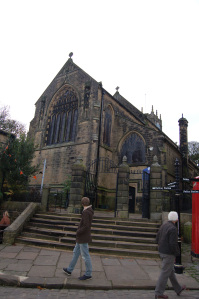
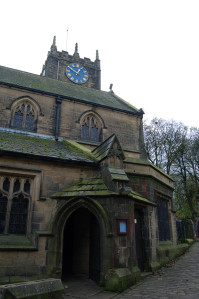
Welcome back to Haworth, the village of the Brontes, where you find us just about to enter the church, in whose parsonage the family of writers lived. As we walked the gently sloping roadway to the church and parsonage we passed another interesting, eccentric shop. Haworth seemed to attract such places. The church itself was a tall, bulky building and very imposing – not an attractive building at all. But visitors are attracted to it for its Bronte links.
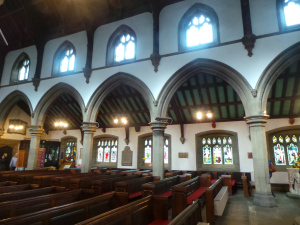
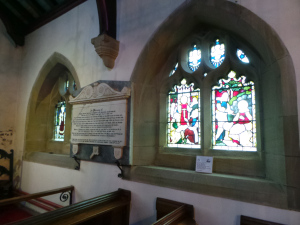
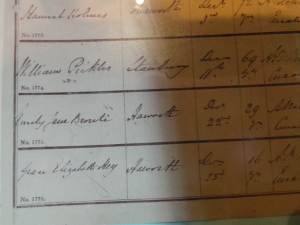
Throughout the church interior we discovered links with the Brontes, which was not always easy in the gloomy interior. Light is always strange inside churches and you feel uncomfortable using a flash. Check out these plaques, old photos and documents.
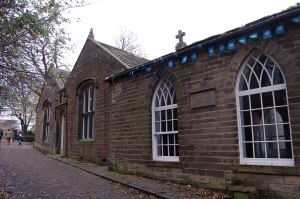
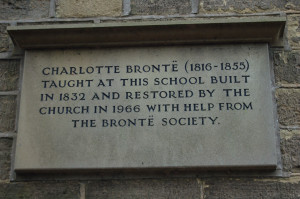
Almost opposite the church was the school in which Charlotte Bronte taught. It was a very short journey to work!
Today is ‘Anti Biotics Awareness Day’ in the UK (I think this extends to the whole week in north America). Last night I attended a fascinating series of talks about work being done in the Norwich Research Park (this includes the University of East Anglia, John Innes Centre, Institute of Food Research and Norfolk and Norwich Hospital) to search for ways to expand the options for combatting infectious diseases.
The Problem
‘Antibiotics are used to treat bacterial infections in humans. Even though these antibiotics are very powerful, some pathogenic bacteria have evolved resistance to all antibiotics currently available. There is an urgent need to find new ways to combat these drug resistant bacteria.’
Solutions?
Most of the antibiotics we currently use are made by a group of benign soil bacteria called actinomycetes. Scientists are now searching environments not previously investigated to find new actinomycetes which might produce new antibiotics; for example deep oceans, desert, rainforests and insects. They are also manipulating actinomycetes bacteria to produce new antibiotics.
This is the first strand of work I heard about last night. It also featured a fascinating look at leaf cutter ants. You’ve probably seen these minute creatures on nature documentaries. They cut pieces of leaf from nearby plants and take these back to their nest. But they don’t eat the leaves, well not directly anyway. Instead they feed them to a fungus which produces the food they use. A sort of ‘agriculture’ that has been going on for 50 million years! It’s this fungus that scientists are studying, and specifically the antibiotics it produces, to see if they could be useful against human diseases.
The second strand of work concerns improving the diagnosis and use of antibiotics. Up to now we’ve been rather profligate with our use of antibiotics, including in animal husbandry (where they encourage weight gain) and agriculture.
This widespread use of antibiotics has led to the crisis we now face- many bacteria developing resistance to ‘broad spectrum’ (a cocktail) of antibiotics and a lack of will to develop new antibiotics as the investment and risk are judged to be too high in relation to the potential returns by pharmaceutical companies. The technology available for analysing bacterial infections is advancing – the speed is increasing and the costs reducing- so that it is increasingly likely that a more precise diagnosis of infections can be made and a more targeted approach to using antibiotics can follow. This will both increase the effectiveness of their use and reduce the side effects- of killing off a lot of other (beneficial) bacteria and inducing the development of resistant pathogens.
Finally, I heard about work being done to harness the inherent bacteriological power of the human body.
Not only are humans walking factories of millions of bacteria, but it turns out that different parts of the body carry different bacteriological ‘eco systems’ of their own. The work to date has revealed the benefit of human breast milk in child development (as well as containing nutrients it transfers a range of bacteria from the mother which help to develop the child’s own bacterial systems). This has included giving ‘pro biotic’ supplements to babies born prematurely to help them make up the deficit they have on full term babies and so helping to reduce infections and premature mortality.
Work is also being done on the human gut and experiments with some very sick patients have shown how powerful an infusion of new bacteria can be in combatting diseases; this infusion takes the form of a ‘faecal transplant’- literally transfusing a healthy person’s gut bacteria to a sick person via their faeces (of course converted into a suitable form!).
On this special day, it’s encouraging to see the work in hand by a wide range of brilliant people (who happen to be on my doorstep) to try to extend our ability to fight infectious diseases. Part of the answer lies in discovering and teasing out new anti biotics from a wider range of soils and other sites, but it seems that better targetting of antibiotics and harnessing the body’s own ‘bacteria factory’ have an important part to play.
To finish, here’s a little quiz about leaf cutter ants…
I’ve recently read the book ‘Noah’s Children’ by Sara Stein. You’ll possibly know from my previous posts about children’s play that I’m interested in how we can improve the opportunities for a more ‘natural’ outdoor play experience in our increasingly urbanised, consumerised and technology- dominated world.
I found Stein’s book a stimulating read, which examines a variety of reasons why children in general these days have less opportunity to engage with the natural world in ways that nurture a responsible and intimate relationship with it (as well as raising wider child development issues), so I thought over the next few weeks I’d feature a few extracts. In the first, Stein sets out the basis of the book:
‘Land is nourished or not by humans; humans are nourished or not by land. Place and occupant only seem seprable because we have created such a distance between liveliness and livelihood. In creating that distance, we have unwittingly detached the nature of childhood from the sense it ought to make. Childish curiosity is to make connections, to realize the larger picture, to become able in the physical environment our lives depend on. We’ve removed the red from the fruit, the fruit from the tree, the tree from the wood, the wood from all the things a child might make of it, and so left fragments much harder to connect than laces on a shoe.’
I’d love to hear your thoughts on this and the wider issues raised…
We spent a midweek break in Yorkshire this autumn, combining a return visit to the RHS Garden Harlow Carr, with a return to Saltaire and a first visit to the village of the Brontes, Haworth. A busy few days full of interest, enjoyment and variety.
First I shall share with you our visit to Haworth a village up on the moors of Yorkshire. The village and the moors are closely linked to the well-known and much loved family of writers, the Brontes. We found the village after miles of travelling high in the moorland on roads with regular steep climbs and descents. The road began to drop steeply as we approached the village and signposts indicated a car park on the edge of the village. We parked up in a car park hidden in woodland and from there a footpath took us into the very heart of the village.
The 40,000 words of Thomas More’s ‘Utopia’ painted onto the sides of a redundant Electricity building in Norwich by Rory McBeth and students of Norwich School of Art and Design (2006).
A Learning Through Landscapes film in which Sir David Attenborough explains how schools in England are facing tough decisions to accommodate a sharp rise in pupils. He strongly believes that making the choice to sacrifice their outdoor spaces will not only have a catastrophic effect on children’s connection with nature but also their learning, behaviour, health and well-being too.
Our 2014 September visit to Portugal featured some interesting new places, including three wonderful gardens. The first I’m featuring was a visit to the home of wealthy ex pat Brits when it was established over a century ago. Monserrate sits in the mountains north-west of Lisbon in the regal suburb of Sintra.
The website which covers many of the Sintra garden gems describes Monserrate gardens and its palace as:
‘..one of the most beautiful architectural and landscape Romantic creations in Portugal… unique representatives of 19th century eclecticism.The Palace combines gothic and Indian influences as well as Moorish suggestions together with exotic and plant motifs which are harmoniously extended to the exterior. The gardens have received species from all corners of the world, which were planted according to their geographical origin. The front lawn of the Palace provides a well-deserved rest, while discovering one of the richest Portuguese botanical gardens.’
It was built in 1858 for Sir Francis Cook, an English baronet who had amassed a fortune as a trader and textile baron and was created Visconde de Monserrate by King Luis. Cook turned to an English architect, James Knowles jr. for the house design. He took inspiration from the many countries Cook had dealings with and also the flamboyantly oriental Royal Pavilion in Brighton, England, built for the Prince Regent, later Goeorge IV over 50 years earlier. I loved the round tower and proportions of the palac, the use of reflected light under the wide eaves with subtle creamy and terracotta hues to create a lovely warm glow. The rich decoration is a generally successful blending of eastern, moorish and gothic revival styles. Here are some pics of the house….
This slideshow requires JavaScript.
Cook hired William Nevil as Botanical expert and landscaper. The project was completed within 5 years and was Cook’s summer residence. The entire estate was put up for sale in the 1920s by Cook’s great-grandson, and after many years of neglect was purchased by the state in 1949. Since then it has been open to the public as a national monument.
The English influence emanates throughout the gardens which have a romantic feel, especially as you wind your way along rough paths through shaded glades with waterfalls, pockets of sunlight and mock ruins, and eventually up to the rather more manicured lawn (the first laid in Portugal) that stretches away from the house down to the grounds. These also include specialist and exotic gardens with non-native plants from Cook’s personal collection. Here are some pics of the gardens and grounds…
This slideshow requires JavaScript.
The Monserrate Palace is the smallest of Sintra’s three palaces but it is by far the most decorative – and beautiful- and certainly captivated me, as did the winding and varied gardens – especially the Mexican Garden, some pics of which follow…
This slideshow requires JavaScript.
It has taken 20 years to restore the gardens and the result was recognised in 2013 when they were voted the winner of the European Garden Awards in the category for “Historical parks”. In 1995 the park was recognised by the UNESCO as a World Heritage Site as a part of several palaces and parks in Sintra. The citation for its latest award says:
‘Light and shadow, exotic and rare plants, winding paths and breath-taking views, but even new garden sections, such as the rose garden that was opened in the year 2011 by the Prince of Wales, make a visit to Monserrate, in spite of the many other wonderful parks in Portugal, a unique, fascinating and therefore “prize worthy” event.’









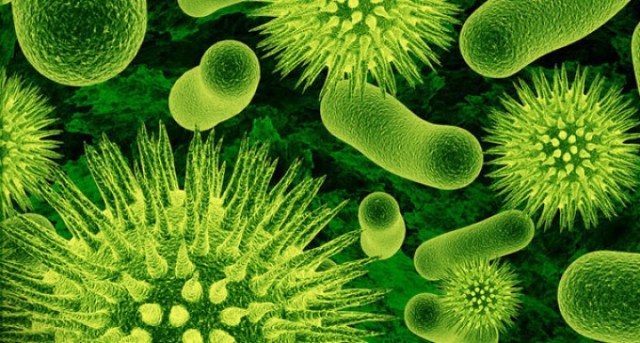 Today is ‘Anti Biotics Awareness Day’ in the UK (I think this extends to the whole week in north America). Last night I attended a fascinating series of talks about work being done in the

 I’ve recently read the book ‘Noah’s Children’ by Sara Stein. You’ll possibly know from my previous posts about children’s play that I’m interested in how we can improve the opportunities for a more ‘natural’ outdoor play experience in our increasingly urbanised, consumerised and technology- dominated world.


 Our 2014 September visit to Portugal featured some interesting new places, including three wonderful gardens. The first I’m featuring was a visit to the home of wealthy ex pat Brits when it was established over a century ago. Monserrate sits in the mountains north-west of Lisbon in the regal suburb of Sintra.
 Old School Gardener






 Old School Garden