
‘The worst ENEMYES to gardens are Moles, Catts, Earewiggs, Snailes and Mice, and they must be carefully destroyed, or all your labor all the year long is lost.’
Archive for July, 2014

 A new report by researchers at the University of Minnesota’s Institute on the Environment, published in Science, shows that an extra 3 billion people in the world need not lead to higher levels of hunger if existing cropland is used more efficiently, additionally reducing agriculture’s environmental impact. The report focused on 17 crops that account for 86% of the world’s crop calories as well as the majority of irrigation and fertilizer use. The hope is that the report can help guide and prioritise donors’ and policy makers’ activities for the greatest benefit.
The report identifies three areas of priority that, with the suggested actions, hold the most potential for meeting global food needs and reducing agriculture’s environmental footprint, a key pillar of sustainable intensification. Geographically the majority of these opportunities occur in China, India, U.S., Brazil, Indonesia, Pakistan and Europe. To summarise we need:
1. To produce more food…
View original post 539 more words
As today looks like it’s going to be the hottest of the UK year to date (exceeding 30 degrees celsius in some areas), this brilliant project of a ‘self watering system’ by a chap called Guillermo for his polytunnel deserves an airing- it may inspire you to do something similar in your garden?
Old School Gardener
via Vertical Gardens
By Stephanie Brittain, Agriculture for Impact
“Poverty eradication is the greatest global challenge facing the world today and an indispensable requirement for sustainable development. We are therefore committed to freeing humanity from poverty and hunger as a matter of urgency”.
This introductory quote from the draft Sustainable Development Goals (SDG’s) highlights that tackling poverty and hunger are still key targets for the SDG’s, the evolution of the Millennium Development Goals (MDG’s). Aims to ‘End Extreme Poverty including Hunger’ and ‘Improve Agriculture Systems and Raise Rural Prosperity’ show that poverty and hunger are intrinsically linked. Indeed, most of the world’s poorest and hungriest are the smallholder farmers that ironically produce 80% of the world’s food. It’s important that the SDG’s meet the needs of these farmers if they are to meet their targets.
So what are the SDG’s going to offer the world that the MDG’s didn’t? Well this time we…
View original post 689 more words

When Geoff and Anne Shaw bought Follers Manor in 2006 it was a mess. The house was virtually uninhabitable and the grounds an eyesore: a jumble of tussock, weeds and builders’ rubble with a large, long-abandoned tennis court as a central feature. 
Today with the house and gardens rejuvenated it is easier to understand why they bought Follers. Invisible from the road, the house sits high above the Cuckmere valley just outside Alfriston in East Sussex.

Below it to the east lies the small village of Litlington with far views of the South Downs National Park beyond. After renovating the house, Geoff and Anne realised that they would need help with the derelict garden and turned to designer, Ian Kitson for inspiration. His brief was simple: a garden that was colourful; that would encourage wildlife and trickiest, a garden that would vie confidently against such an impressive backdrop.

I first…
View original post 909 more words

St Anne’s Park lies close to the lovely coastline on Dublin’s northside, its 300 acres owned by the Guinness brewing family until purchased by Dublin City Council in 1939. The parkland is full of mature trees and children populate it, playing happily in the woodland or riding their tricycles.

But situated deep in the park is one of Europe’s finest rose gardens – 25,000 plants grouped into hybrid tea, floribunda, climber, shrub and so on.
There is a special section with the newest unnamed varieties of roses, to be judged by an international panel of judges for the prestigious International Rose Trials held this week, followed by the Dublin Rose Festival this weekend with rose growers, nurseries, the Federation of Beekeepers, Dublin Community Growers and many other attractions such as Art studios and workshops.

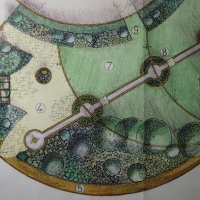
The focal point of course will be the roses, laid out in large concentric circles, with…
View original post 138 more words

Hi my name’s Sonny and I am a Heritage Gardening Trainee at Gressenhall Farm and Workhouse. I’ve been here since February 20th 2014 so nearly five months which have gone ever so quickly. I spend two days a week at Gressenhall Farm and Workhouse helping the volunteer gardeners keep the gardens as well looked after as we can. We have made great progress in maintaining the gardens in the short time I’ve been here.
I spend another day on placement being Peckover gardens in Wisbech where I’ve learned a lot about plants and all manner of horticulture. I have just finished my placement at Peckover and am now going to Holkham Hall to work in the walled gardens there, and hopefully the woodland if I’m lucky, so I can use my chainsaw certificate that I gained through my traineeship here at Gressenhall Farm and Workhouse.
So far I…
View original post 98 more words

I have long been a fan of – and cheerleader for – the forest school movement. That is why I am happy to give my support to Love Trees Love Wood – a new crowdfunding initiative that aims to spread its reach and impact. And I am inviting you to do the same.

View original post 405 more words
I know you like seeing great ideas for recycling pallets into useful (and beautiful), garden and outdoor objects. So, here are a few more- hope you like them!

Beautiful terrace planters

Garden shed cum woodstore

Fence from pallets

Bench

More benches

Another fence cum planter

A colourful gate

A bee hive

A plant stand- reminiscent of my own ‘plant theatre’ made recently…

…and finally- an Igloo!!
Old School Gardener
Most examples from the wonderful site 1001 pallets




 Old School Garden