Archive for 2013


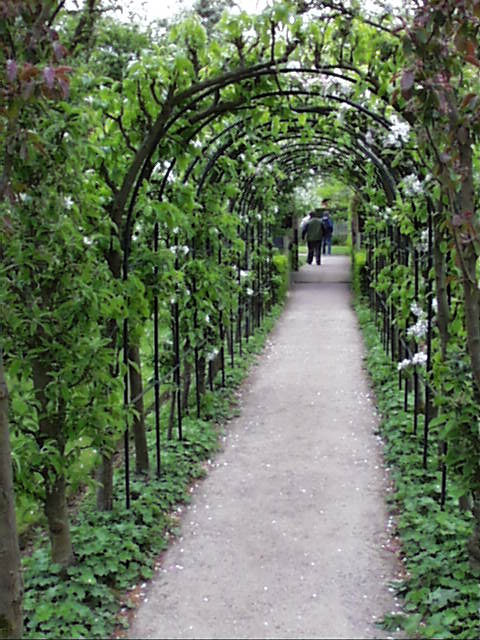
PicPost: Hanging baskets are so boring...

Rob Viens's avatarThe Beagle Project

First off, thanks to Tamara and all the readers of My Botanical Garden who have been visiting and posting comments. It has been a pleasure being able to cross pollinating between blogs and to hear from some new readers! Today – the last installment in the three-part series on the vegetation of Tierra del Fuego.

Darwin’s diary remains quiet today, but in the January/February section of this Zoological Notebook he has quite a bit to say about the dominant vegetation of the other major ecosystem of southwestern Tierra del Fuego – the Magellanic moorlands (I love that name – I think it is my new favorite place).

Again, let me turn the floor over to Darwin to set the stage:

“In every part of the country which I have seen, the land is covered by a thick bed of peat.— It is universal in the mountains, above the limits [of]…

View original post 1,062 more words

Pena PalaceThe Pena National Palace (Palácio Nacional da Pena) is a Romanticist palace in Sintra, Portugal. The palace stands on the top of a hill above the town of Sintra, and on a clear day it can be easily seen from Lisbon. It is a national monument and constitutes one of the major expressions of 19th century Romanticism in the world. The palace is a UNESCO World Heritage Site and one of the ‘Seven Wonders of Portugal’.

Pena Palace Park is a vast forested area completely surrounding the Pena Palace, spreading for over 200 hectares of uneven terrain. The park was created at the same time as the palace by King Ferdinand II, who was assisted in the task by the Baron von Eschwege and the Baron von Kessler. The exotic taste of the Romanticism was applied to the park as it was to the palace. The king ordered trees from diverse, distant lands to be planted there. Those included North American Sequoia, Lawson’s cypress, Magnolia, and Western Red Cedar, Chinese Ginkgo, Japanese Cryptomeria  and a wide variety of ferns and tree ferns from Australia and New Zealand, concentrated in the Queen’s Fern Garden (Feteira da Rainha). The park has a labyrinthine system of paths and narrow roads, connecting the palace to the many points of interest throughout the park, as well as to its two gated exits.

Source: Wikipedia

cyclamenCyclamen is a genus of plants containing around 20 species, part of the Primrose family.

They originate from areas surrounding the mediterranean, have tuberous roots and aren’t an obvious relation of the primrose. Growing in Beech woodland, scrub and rocky areas, and even alpine meadows, they’ll flower in snow meltwater. Although there are relatively few species in the genus there is at least one that will be in flower at all times of the year. In the UK, there are some species which can withstand frost, others which are more tender and some which are not at all frost hardy. Some cultivars of C. persicum are indoor or florists’ plants, flower in the winter or spring and come in a wide range of colours.

The medieval gardens of Constantinople featured Cyclamen as they looked so different from wild flowers in the surrounding fields.

The name Cyclamen is Latin in origin (cyclamīnos) which in turn comes from the Ancient Greek (kyklos) meaning “circle” . This seems to refer either to the round tubers that sit just below ground level or to the way, after flowering, the slender flower-stalk twists into a spiral curl, and, bending over, ripens the seed vessel on the surface of the ground.

Rather like truffles, these tubers are said to be a favourite of pigs. Hence, in many languages the different species have common names reflecting this – Sowbread in English, Pain de pourceau in French, Pan porcino in Italian and Varkensbrood in Dutch.

Cyclamen cilicicum leaves

Cyclamen cilicicum leaves

Some of the species names are:

C. cilicicum = cicilian

C. coum = of cous or cos, an island off Turkey

C. europaeum = European

C. hederifolium = Ivy – leaved

C. ibericum = of Iberia

C. latifiolium = broad-leaved

C. neapolitanum = of Naples

C. persicum = of Persia

C. repandum = scalloped- refering to the leaf margins

C. hederifolium, which is hardy in the UK, retains it’s attractive marbled leaves for at least nine months of the year, and has a graceful display of pale – to deep-pink, delicate blooms on slender stalks through autumn. This is one of the most popular woodland shade plants and is swift to colonise areas beneath trees. The Royal Horticultural Society has given it the Award of Garden Merit (AGM).
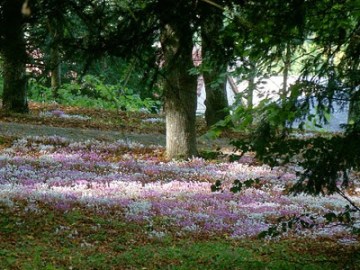
Cyclamen in a woodland setting

Cyclamen in a woodland setting

Further information:

Growing Cyclamen from seed

The Cyclamen Society

Wikipedia

Cyclamen hederifolium

Cyclamen coum

‘Pretty in Pink’ – article by Sarah Raven

Medicinal uses of Cyclamen

Old School Gardener

If you’ve enjoyed reading this post and others on this blog, why not comment and also join some other people and sign up for automatic updates via email (see side bar, above right ) or through an RSS feed (see top of page)?

PicPost: Great Garden @ Barnsdale

Barnsdale Gardens in Rutland, England were made famous by Geoff Hamilton through the BBC television series Gardeners’ World which he presented from 1979 until his death in 1996. With 38 gardens in it’s eight acre site, the gardens have been described as a ‘theme park for gardeners’. Not only do they provide a host of ideas for smaller scale gardens, but they are a delight to experience.

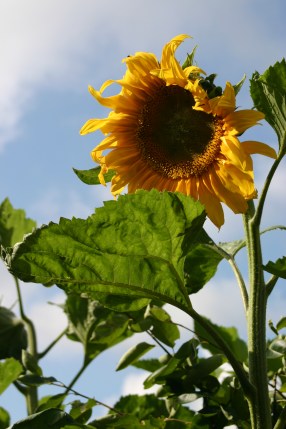
Sunflowers were planted by a local playgroup at the May opening of the garden - with the wet summer they grew to over 2.5 metres tall!

Sunflowers were planted by a local playgroup at the May opening of the garden – with the wet summer they grew to over 2.5 metres tall!

A renovated garden is moving towards maturity in what were once exercise yards for tramps and unmarried mothers at Gressenhall Farm and Workhouse Museum, Norfolk.

The garden occupies what were once two exercise/work yards for inmates of the Victorian Workhouse. The footings of what was once the dividing wall between these two yards can still be seen, emerging as the lawn above is worn away.  In Victorian times these yards joined two blocks of accommodation:

  • for so-called  ‘casuals’ or tramps who used to travel between workhouses earning ‘a night’s board for 2 days hard labour’ – possibly crushing stones for use in road building
  • for unmarried mothers nursing their babies – they wore distinctive uniforms to mark them out from the other workhouse inmates.
The refurbished 'Education Garden'

The refurbished ‘Education Garden’

These buildings today provide the Museum’s Learning Centre and space for occasional groups and events. Until last year the garden area between the two buildings was kept maintained as grass and a range of mixed borders which is an important picnic/ rest spot as well as being used by school and pre school groups for art and learning activities. In 2012 funding from the Friends of the Museum as well as the Museum itself and donations from a range of local businesses were secured to refurbish and redesign it. A number of design issues were tackled, including:

  • Providing further paved terrace space with new picnic tables and some renovated paving
  • Introducing a number of planting containers to add interest to the paved terraces
  • Realigning paths to follow ‘desire lines’ and make access easier
  • Deepening borders to provide more visual interest and unified planting
  • Creating a new ‘curiosity corner’ to provide a space designed for under 5’s which contains a range of features to encourage children to explore.
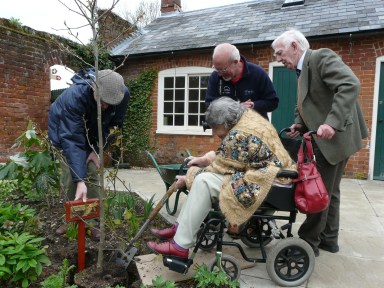
Mary and Derek Manning plant a tree to mark the opening of the garden

Mary and Derek Manning plant a tree to mark the opening of the garden

The newly renovated garden was formally opened on 6th May 2012, and two of the original gardening volunteers, Mary and Derek Manning, planted a ‘Paper Handkerchief Tree‘ to mark the occasion. Local children also played their part and cut ribbons to open ‘Curiosity Corner’.

One of the new residents of the Garden!

One of the new residents of the Garden!

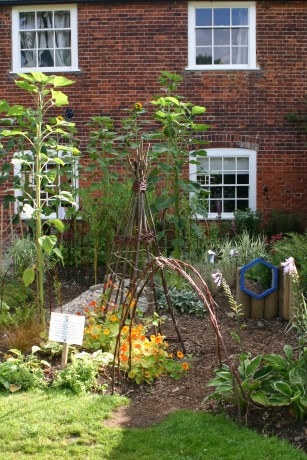
The Curiosity Corner proved to be very popular in its first season last year and included some giant sunflowers planted by a local play group as well as a turf seat; a willow tunnel and arches; hazel wigwam; mirror; ‘fossil slab’; various ‘animals’  hidden away in the planting and a range of different path surfaces and planting. There is also a half barrel filled with stones,water and pond plants, so that youngsters can ‘get up close’ to this watery habitat.

 'Curiosity Corner'

‘Curiosity Corner’

The coming year will see the garden mature further and hopefully there will be sunny days so that visitors can really enjoy this lovely picnic area at its best.

New planters with sweet peas on conical obelisks

New planters with sweet peas on conical obelisks

Quizzicals:

Two more cryptic clues to the names of plants, fruit or veg…

  • The scourge of female chickens
  • Cheap goods in a pile of dung

Old School Gardener

If you’ve enjoyed reading this post and others on this blog, why not comment and also join some other people and sign up for automatic updates via email (see side bar, above right ) or through an RSS feed (see top of page)?

Rob Viens's avatarThe Beagle Project

Darwin did not have much to write about on the 10th, merely stating:

“Removed to a bay North of Orange Bay.” (Feb 10)

So I’ll use the opportunity to continue the story of the southern forests. Today – the story of a little yellow golf-ball shaped fungus that Darwin found growing on the trees. As it bears his name, it only seems fair that he should have the first chance to describe it:

“In the Beech forests, the trees are much diseased: on the rough excrescences vast numbers of yellow balls grow.— These are of the colour of yolk of an egg.— & vary in size from a bullet to a small apple.— in shape globular, but a little produced towards the footstalk or point of attachment. They grow both on the branches & stems in groups…

Sketch of Darwin’s fungus from Voyage of the Beagle:

Cyttaria darwinii

The…

View original post 706 more words

PicPost: Great Garden @ Cambridge Botanic Garden

‘Since its opening in 1846, Cambridge University Botanic Garden has been an inspiration for gardeners, an exciting introduction to the natural world for families and a refreshing oasis for all our visitors. This heritage-listed Garden has been designed for both year-round interest and seasonal inspiration so, whenever you visit, you will find plants to intrigue and enchant.’

Finding Nature

Nature Connectedness Research Blog by Prof. Miles Richardson

Norfolk Green Care Network

Connecting People with Nature

Discover WordPress

A daily selection of the best content published on WordPress, collected for you by humans who love to read.

Susan Rushton

Celebrating gardens, photography and a creative life

Unlocking Landscapes

Writing, photography and more by Daniel Greenwood

Alphabet Ravine

Lydia Rae Bush Poetry

TIME GENTS

Australian Pub Project, Established 2013

Vanha Talo Suomi

The Journey from Finnish Rintamamiestalo to Arboretum & Gardens

Marigolds and Gin

Because even in chaos, there’s always gin and a good story …

Bits & Tidbits

RANDOM BITS & MORE TIDBITS

Rambling in the Garden

.....and nurturing my soul

The Interpretation Game

Cultural Heritage and the Digital Economy

pbmGarden

Sense of place, purpose, rejuvenation and joy

SISSINGHURST GARDEN

Notes from the Gardeners...

Deep Green Permaculture

Connecting People to Nature, Empowering People to Live Sustainably

BloominBootiful

A girl and her garden :)