
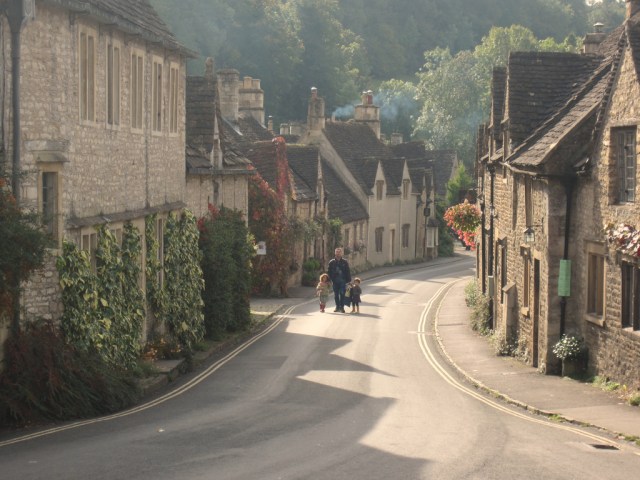
Castle Combe – one of the prettiest villages?
I spent a few days in the south and south-west of England last week. The weather was very sunny and dry – which from my many previous visits to Devon is very unusual (bordering on the unheard of). My wife and I initially stayed near Winchester and then went via Salisbury to Tavistock in Devon. We visited some wonderful places, including two gothic cathedrals (see my PicPost of the roof of Winchester Cathedral) as well as a super garden at Mottisfont Abbey (more pictures and words on this later in the week).
It was on our way to Salisbury that we came across a road sign to Sherfield English. This name conjured up images of a delightful, romantic ‘chocolate box’ English village, complete with thatched cottages, olde worlde pub (complete with Morris dancers), hand- painted village sign, cricket pitch on the village green, village school and a couple of local shops all jostling to be the lead players in a fairytale scene.
As we approached the village, the first signs were not discouraging – a garden nursery and old time garage on the outskirts. But these soon gave way to handfuls of bland bungalows and other modern-looking houses with no apparent ‘plan’ – either God or man made. To be fair I’m not sure we actually found the true centre (if there is one), but in any event my expectations were rudely shattered by an incoherent sprawl that definitely did NOT live up to its name! (apologies residents of Sherfield English, I’m sure it’s a wonderful place).

The hand painted village sign- a must have for choc box aspirants…
This got me thinking about village names and the sorts of expectations they give us. My theory (in the course of development into an ‘Iron Law’) is that the most interesting names (or rather those that promise to deliver your romantic english village expectations) have at least four syllables and ideally spread over two words (I’ve yet to find one with three or more). We passed some other lovely examples en route to the west country:
Kingsbury Episcopi (5 syllables – there must be some religious heritage here)
Eyewell Wales (OK, only 3 syllables but such an unusual construction- I wonder what the views must be like with such a name)
Compton Pauncefoot (4 syllables – sounds rather like a home for ageing cats)
In all these cases the main village centres (if there are any) were off the main road, so we couldn’t be sure of their pedigree, but on the strength of our earlier experience my betting is that they’ll be a disappointment. On the other hand, am I seeking after something that never really existed or has long gone? A romantic myth rather than reality, a sort of Holy Grail of rural prettiness and sense of ‘community’?

Another view of the english village…
Midsommer Murders (a modern-day TV crime series set in the sleepy, imaginary, forever – sunny group of ‘Midsommer’ villages) has for one thing given a rather different (if equally unconvincing) view of this ‘rural idyll’- one where the murder- rate must be something like Chicago – on a good day…
And I guess that post – war changes in travel to work – the birth of the ‘commuter village’ or so-called ‘bed and breakfast’ communities – have probably also done for what was left of the ideal ‘village’ and ‘village life’. To coin a phrase, do most of these modern-day villages enjoy ‘a repose bordering on stagnation’?
In my search for answers (or rather to find at least one example of a ‘pretty village’), whilst in West Devon we set out in search of the beautiful – sounding Tamerton Foliot on the outskirts of Plymouth (that fact alone should have given me pause for thought). This sun -filled day out saw us driving over Dartmoor (glorious, if in some places the narrow, steep, twisting, pot – holed roads requiring serious concentration) and into Plymouth to enjoy an Ivor Dewdney pasty looking out on Plymouth Sound and the Hoe (very busy with families, out enjoying the sunshine and skating, playing football, trying out new bikes, promenading etc.). Our way home was to be via the ‘back roads’ to Buckland Monachorum (another lovely name whilst I think about it) for afternoon tea at Buckland House (once home to Sir Francis Drake of Armada fame).
Could we find it?
The short answer is no. What we did find was the sprawling suburbs of post – war municipal housing, out of town shopping centres, run down community centres that make up large swathes of the northern edge of Plymouth. These couldn’t have been further from the image of the romantic english village. We eventually found our tea – stop via another route, having abandoned all hope of finding said village. Quizzing locals (in Tavistock that is) about the place did not inspire confidence. It seems it was once a pleasant enough place but it too has succumbed to the encroachments of modern life (though Wikipedia does have some rather nice photos of a fine granite country church).
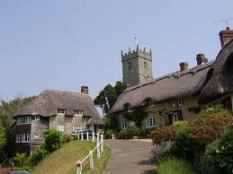
Godshill, Isle Of Wight – one of the few remaning ‘chocolate box’ villages preserved in aspic…
So, my conclusion is that whilst there are undoubted examples of the ‘chocolate box’ village (at least to look at) it is rather less likely that they will be the close-knit, thriving communities they once were – I invite readers to contradict this rather sweeping conclusion! It’s also got me thinking that there is some sort of inverse law that says the most charming places will not possess the most charming names. Maybe we need some sort of ‘transfer window’ a la Premier League whereby the best names (i.e the two-word, four syllable plus ones) can be traded over to the places that most deserve them, at least in terms of the expectations they set up.
Would Kingsbury Episcopi for example, be out of reach, in the multi-millions (so maybe you could have a season-long loan)?!
Old School Gardener
If you’ve enjoyed reading this post and others on this blog, why not comment and join others by signing up for automatic updates via email (see side bar, above right ) or through an RSS feed (see top of page)?





 Old School Garden