Archive for 2013


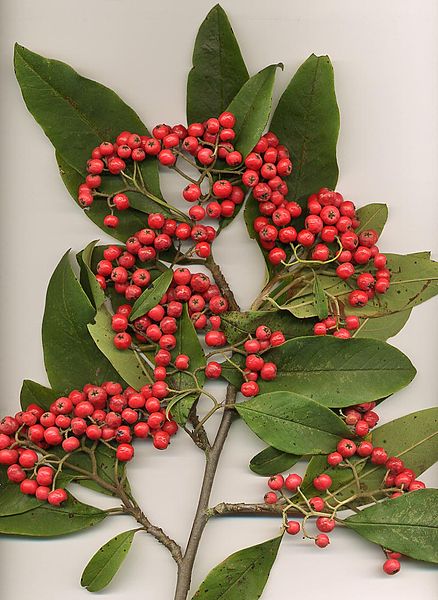
Cotoneaster frigidus leaves and fruit

Cotoneaster frigidus – leaves and fruit

Cotoneaster  is a genus of flowering plants in the rose family, native to temperate Asia, Europe and north Africa. It has  a strong concentration of different species in the mountains of southwestern China and the Himalayas. They are related to Hawthorns, Firethorns, Photinias and Rowans. Depending on the definition used, there are between 70 and 300 different species.

The majority of Cotoneaster species are shrubs from 0.5–5 metres tall, varying from ground-hugging prostrate plants to erect shrubs. A few, notably C. frigidus, are small trees up to 15 metres tall and 75 centimetres trunk diameter. The prostrate species are mostly alpine plants growing at high altitude (e.g. C. integrifolius, which grows at 3,000–4,000 metres in the Himalayas), while the larger species occur in scrub and woodland gaps at lower altitudes. Cotoneasters are very popular garden shrubs, grown for their attractive habit and decorative fruit. Many are cultivars, some of  hybrid origin; of these, some are of known parentage.

Cotoneaster franchetii

Cotoneaster franchetii

Cotoneaster horizontalis

Cotoneaster horizontalis

The name Cotoneaster derives from the old Latin cotoneus meaning Quince and aster probably a corruption of ad instar meaning ‘a likeness’ – so ‘Quince like’.

Other species names are:

C. adpressa = close, pressed-down growth or fruits closely pressed against the branch

C. applanata = the branches lie flat or in a plane

C. bullata = wrinkled, referring to the leaves

C. buxifolia = box (buxus) -leaved

C. congesta = crowded, the plant’s habit

C. divaricata =spread-out, forking , referring to the branches

C. franchettii = after Franchet, a French botanist

C.  frigida = cold,frosty, probably referring to its native habitat

C. harroviana = after G. Harrow, a nurseryman once of Coombe Wood Nursery

C. henryana = after Dr. Augustine Henry, a 19th century Chinese customs official and ‘plant hunter’

C. horiziontalis = horizontal, its growth habit

C. humifusa = spread on the ground

C. lacteus =  milky, probably referring to the milky white flowers (the ‘Late Cotoneaster’)

C. lucida = shining, referring to the leaves

C. microphylla = small – leaved

C. multiflora = many flowered

C. pannosa = woolly, the foliage

C. rotundifoilia = round leaved

C. salicifolia = willow (salix) leaved

C. simonsii = after Simons, (The ‘Himalayan Cotoneaster’ or ‘Simon’s Cotoneaster’)

Cotoneaster adpressus
Cotoneaster adpressus

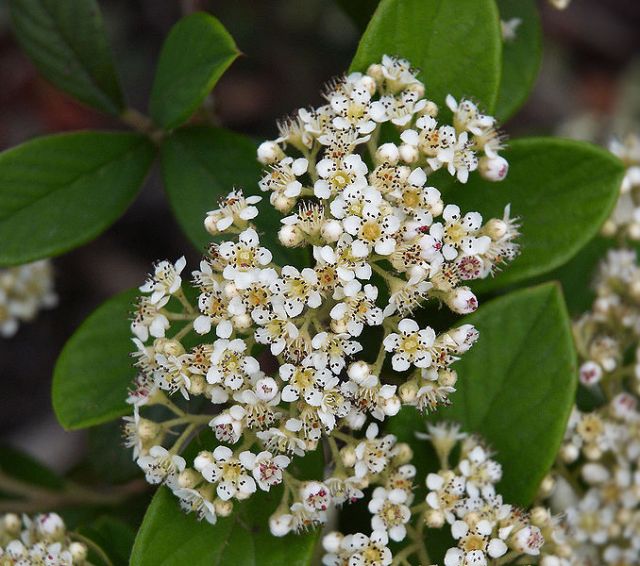
Cotoneaster lacteus - flowers

Cotoneaster lacteus – flowers

Cotoneaster simonsii

Cotoneaster simonsii

Sources and further information:

Wikipedia

Encyclopedia Britannica

Growing Cotoneasters

Cotoneaster horizontalis

Cotoneaster lacteus

Cotoneaster simonsii

Quizzicals: answers to the two in Plantax 7…

  • Bird swearing – Crocus
  • Vasectomy for Dad – Parsnip

..and 2 more cryptic clues to the names of plants, fruit or veg…

  • Irish singer is growing worse
  • Tease Mr Disney

(thanks to Les Palmer, answers in the next Plantax!)

Old School Gardener

If you’ve enjoyed reading this post and others on this blog, why not comment and join others by signing up for automatic updates via email (see side bar, above right ) or through an RSS feed (see top of page)?

PicPost: Spring not sprung

Nature lies dormant ahead of first day of spring

UK Spring Weather : Icicles on the side of a road in South Derbyshire

‘Conservationists report lack of budding plants, animals returning to hibernation and migrating birds held back by wintry weather

One hundred years ago, on the official first day of spring, the Anglo-Welsh war poet and naturalist Edward Thomas set off from Clapham Common in London to cycle and walk to the Quantock Hills in Somerset. The record of his journey, called In Pursuit of Spring, became a nature-writing classic, telling of exuberant chiffchaffs and house martins, daffodils and cowslips in full flower and “honeysuckle in such profusion as I had never before seen”.

Had Thomas taken the same route today, he might not have seen very much wildlife – and could well have frozen. Mist and fog, rain, a bitter north wind, and temperatures just above freezing are forecast for , the first “official” day of spring…’

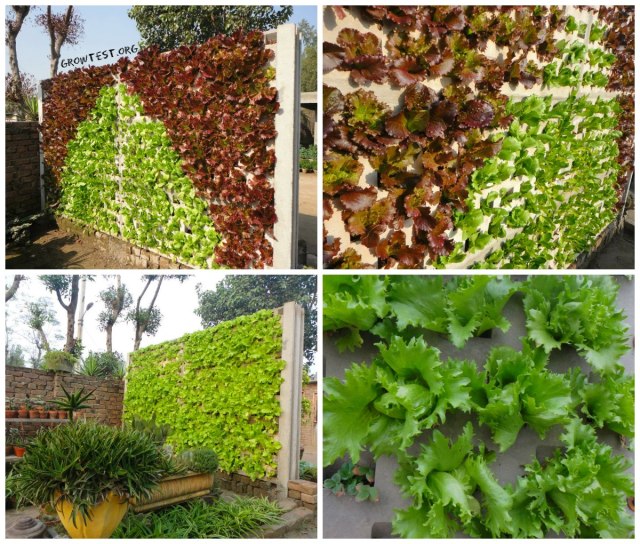
PicPost: Lettuce Play

Tony's avatarnaturestimeline

Looking back at January 2013, were my local climatic conditions much different to that of 2012?

Firstly, in the United Kingdom, 2012 began as “the year of the drought” * with recorded precipitation totalling 32.8mm in my neck of the woods. By comparison, January this time around looked like this.

In total, we received 61.6mm, which is still below the revised 1981 to 2010 mean by approximately 25% or so. What about the Air Temperatures?

January 2012 was mild in comparison with some 11 double-digit Fahrenheit Maximums being achieved back then and unsurprisingly a mean of 0.8cabove the long-term average, mentioned previously. This time around, January2013 saw the following daily Air temperature trend.

Due to almost two-thirds of January 2013 being in the cold to very cold category, it is unsurprising that the mean return of 4.0c was below the long-term average by 0.6c. As a result…

View original post 400 more words

shinealightproject's avatarShine A Light

Norfolk Museums and Archaeological services recently received funding from the Esmee Fairbairn foundation, one of the UK’s largest independent grant-making foundations, to revamp our superstore. The superstore is a highly secure building where larger items in the Norfolk Museum’s reserve collections are held; think Asda but full of museum collections. The aim of the project is to reorganise the space and create access to the stored collection which will benefit both members of the public and museum staff.

We are currently working with a number of curators across the county to compile a list of objects that are our ‘stars of the stores’. Once the project is complete they will have pride of place in the museum store. These objects have been selected for a number of reasons including their popular appeal, historical significance and for the interesting stories they tell. As a sneaky preview we hope to include local…

View original post 172 more words

PicPost: Happy as Larry

Four Seasons in One Day – survey on climate change and the garden

The Royal Horticultural Society needs your help! They’ve partnered with the University of Reading, asking Britain’s gardeners to share your view on climate change and whether it will influence your choices and plans in the garden. Please complete the survey: http://blogs.reading.ac.uk/crg/climate-change-and-gardening

My next article on climate change and the garden will look at how we can be prepared for the unpredictable weather patterns that come with climate change – due out Monday 25th March.

PicPost: Sweet Tee Pea

Finding Nature

Nature Connectedness Research Blog by Prof. Miles Richardson

Norfolk Green Care Network

Connecting People with Nature

Discover WordPress

A daily selection of the best content published on WordPress, collected for you by humans who love to read.

Susan Rushton

Celebrating gardens, photography and a creative life

Unlocking Landscapes

Writing, photography and more by Daniel Greenwood

Alphabet Ravine

Lydia Rae Bush Poetry

TIME GENTS

Australian Pub Project, Established 2013

Vanha Talo Suomi

The Journey from Finnish Rintamamiestalo to Arboretum & Gardens

Marigolds and Gin

Because even in chaos, there’s always gin and a good story …

Bits & Tidbits

RANDOM BITS & MORE TIDBITS

Rambling in the Garden

.....and nurturing my soul

The Interpretation Game

Cultural Heritage and the Digital Economy

pbmGarden

Sense of place, purpose, rejuvenation and joy

SISSINGHURST GARDEN

Notes from the Gardeners...

Deep Green Permaculture

Connecting People to Nature, Empowering People to Live Sustainably

BloominBootiful

A girl and her garden :)