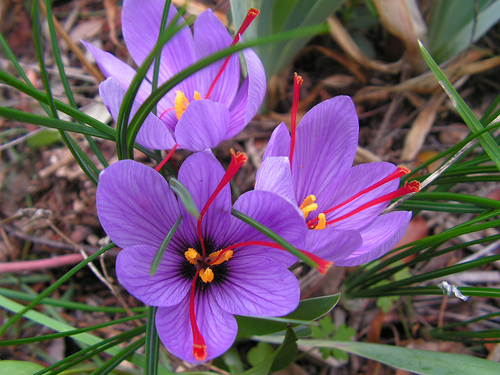
The Saffron Crocus (Crocus sativus)
You will recall that our day out had begun promisingly at Anglesey Abbey in Cambridgeshire. After lunch we drove off (car roof remaining closed in view of the low cloud and short journey) to the town of Saffron Walden in north Essex. More specifically it is the chief town of the District of Uttlesford– I always think this sounds like somewhere you might find in ‘The Shire’ of Hobbit fame!
We’d been here a long time ago and then only driving through so didn’t really have a chance to explore it thoroughly. Here’s a link to Wikipedia’s entry on the town if you’re interested in its history. In brief it’s of ancient standing, there having been a settlement here long before the Roman occupation of Britain 2 thousand years ago. Of particular interest is the derivation of the town’s name. In the medieval period the primary trade in Saffron Walden was in wool, but in the 16th and 17th centuries the Saffron Crocus (Crocus sativa) was grown in the area. Each saffron crocus grows to 20–30 cm and bears up to four flowers, each with three vivid crimson stigma. Together with the styles, or stalks that connect the stigmas to their host plant, the dried stigmas were used originally in medicines, as a condiment, a perfume, an aphrodisiac, and as an expensive yellow dye. This industry gave its name to the town and what used to be Chipping Walden became Saffron Walden. The town itself retains many old buildings, interesting spaces and features, as you’ll see in the gallery at the end of this article.
We began our visit in a fascinating garden – Bridge End Garden. This is actually a series of seven interlinked gardens laid out by the Gibson family (eminent bankers and brewers) in the nineteenth century. They are Grade II* listed (so protected), close to the town centre and church and are open to the public each day free of charge. Careful restoration has replicated gardening techniques and designs typical of the Victorian era and has brought the garden back to its full splendour.
Though there are signs around stating that it is ‘not a playground’ and ‘ball games are not allowed’, I can see it can be difficult to prevent its use for play by the town’s children, some of which might get a bit over exuberant at times…. While we were there I was delighted to see a group of teenage boys playing ‘It’ around the different spaces and the hedge maze was also an obvious draw for local kids. These features in an original 17th or 18th century setting must surely have been used in a similar, playful way – if not by children then by adults! The Dutch Garden with its complex parterre of box bushes also looks so like a ‘mini maze’ (in fact hedge mazes developed out of the complex parterres in France, Holland and elsewhere across Europe), so it wasn’t suprising to see another sign, perhaps rather desperately, announcing that it isn’t a maze!
The gardens are maintained by a team of paid staff (of the Town Council, which also maintains a number of other public gardens) and volunteers, and are in a very good condition. A long winding path flanked by well – kept mixed borders leads you past the formal Rose Garden with views to the parish church beyond (apparently the tallest church in Essex) to the walled garden with its fence and wall – trained fruit trees and two glasshouses with miniature orchard and citrus fruit trees, respectively, in pots that look as though they are brought outside in warmer weather.
All around are little curiosities to intrigue – statues of mock-snarling (or is it smiling) beasts, other classical statuary, some fine, mature trees such as a Cedar of Lebanon, a small summer house with a display of some curiosities from the garden (such as old gardener’s notes) and another gazebo called ‘Poets’ Corner’. The ‘Wilderness’, as it’s name suggests, was an area of more naturalistic planting (now with a developing Yew tunnel) and from the viewing platform at one end you can get a wonderful view of the Dutch Garden, with its swirling pattern of box hedging laid out to a design by Gertrude Jekyll, who visited the garden in the early 20th century.

Bridge End Garden layout

The winding path with mixed planting

spring colour

looking back towards the church

The rose garden and church beyond

Rose Garden

Compost bins in the walled garden

Varieities of Rhubarb in the walld agrden

Rhubarb coming through

Centre fountain in the Walled Garden

The Orchard House

Conference Pear about to blossom in the Orchard House

Cherry blossom in the Orchard House

The Citrus House

Lemon tree

Espalier- trained fruit

Walled Garden

Ferns about to unfurl

Summer House and Cedar

Snarling or smiling?

Definitely smiling…

Inside the hedge maze

Dead end …

Sheltered dead end….

Made it to the centre and viewing tower- local kids enjoying the view..

Monolith and balls in the maze centre

Summer House

Gibson coat of Arms

Decoration inside the summer house

Cherubs? on a pot

Yew tunnel- through shot

New Yew tunnel in ‘The Wilderness’

To the side of the Dutch Garden

A cry of desperation…

Dutch Garden

Dutch Garden- swirling parterres

Dutch Garden close up

Dutch garden
Having seen a hedge maze, we went in search of one that is much older – and made of turf. At one edge of the town’s Common sits this wonderful example of a classical labyrinth (see my post on mazes and labyrinths for more information), of uncertain age, but several centuries at least as it was recut in the 17th century. This splendid feature is certainly a challenge to concentration and determination, being 1 kilometer long if you walk the full length of the winding brick path between the shallow turf mounding! Labyrinths are ancient features, adopted by Christianity as a way of encouraging meditation along the symbolic ‘journey of life’.
From here we passed by some of the medieval charm of central Saffron Walden, with their ‘pargetted’ walls (a technique that creates geometric patterns and pictures on the external render) and Market Square, and found a nice little Tea shop for our afternoon break. Unfortunately the west country ‘Saffron Cake’ appears not to be a local delicacy here, despite the town’s association with the spice! Instead portions of Strawberry Cheesecake and Millionaire’s Shortbread had to suffice! We finished our visit by looking round an old – estabslished Antique shop and the parish church of St. Mary- a superb example of a grand parish church built on wool – wealth (and latterly saffron – wealth). It has glorious glass, high painted wooden roof and stonework. Just as we were leaving this delightful town, the rain began to fall – great timing!

A bit of ‘land art’- we thought it was a pigeon nestling inside!

Saffron Walden’s Turf Maze…

The Maze or should it be labyrinth?

Detail of the brick – marked path

Looping pattern of the maze as it returns on itself..

Snakey eh?

Brightly painted, pargetted cottage in the town centre

Town Hall in the Market Square

The rather grand library building

Library- metal entrance decoration detail

Tea, strawberry cheesecake and millionaire’s shortbread…

Pargetting

Road looking down to the Market Square

Pargetting and metal windows simialr to the originals on the Old School!

The Antique shop and other old buildings

Flamboyant pargetting!

Wonderful pargetting!

Superb pargetting!

The antique shop- around for over 100 years…

Teracotta pots for sale- 50p each (didn’t buy any)

Inside Reed’s the Antique shop

A little history of the Reed’s building…

Downstairs in the vaulted cellar of Reed’s

The parish room, opposite the Church

St. Mary’s Church

Painted wooden church roof

Rood screen and chancel beyond

Lillies and carnations

Chancel

Organ pipes

Tapestry and side windows

Wonderful, tall stonework to the Nave and Aisles

Seeking veg doantions for the local Night Shelter…

Very old wooden mullions with modern glazing

A not so private garden near an old cottage- the Pump house

Lovely shaped brick door surround
Further information:
Plantax 5: Crocus- spicy herald of Spring
Saffron Walden Town Council website
Bridge End Garden- Uttlesford District Council website
Visit Saffron Walden website
Old School Gardener
If you’ve enjoyed reading this post and others on this blog, why not comment and join others by signing up for automatic updates via email (see side bar, above right ) or through an RSS feed (see top of page)?




 Old School Garden