Archive for 2013


Hosta shoots

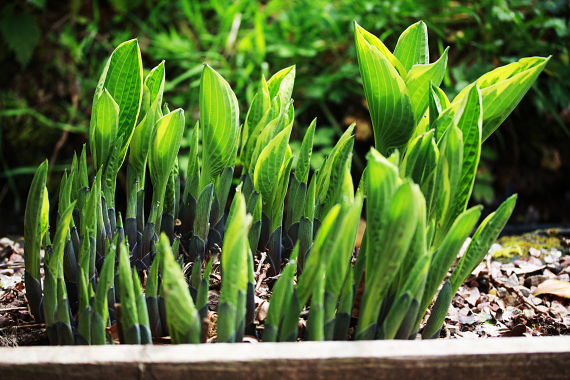
Hosta shoots -courtesy Marcus Bawdon http://www.countrywoodsmoke.com

‘Everyone has Hostas’… OK so you may think them unfashionable, but I love them… the whole growth process –  new shoots spearing up above the soil surface (right now in Old School Garden), the unfurling leaves, the full blousy foliage and the delicate flowers of pinks, lavenders and whites.

Otherwise known as the ‘Plantain lily’, Hostas come originally from eastern Russia, China, Japan and Korea. They are very hardy. Most of the 40 – 70 or so species (there is disagreement over the exact number) and over 7000 cultivars are grown for their foliage, though for many the flowers are also noteable. True perennials, their foliage dies back and they descend underground over winter, to send up new growth spears in spring and achieve their full glory in summer with some varieties flowering into early autumn. Some species also give a second, albeit brief, display in autumn.


The leaves vary between round, ovate, lance or heart – shaped and are between 12cm and 50cm in length. They come in all shades of green, some solid in colour others with margins or centres variegated in shades from white to golden yellow. Flowers range from bell to trumpet shaped, and are held in one-sided racemes or ‘scapes’.


Hostas will grow in full sun to full shade – they flower better if in the sun and the yellow-leaved varieties also do better in full sun. Overall, however, they tend to do best in dappled shade and where they are away from the hot noon-day sun (the blue – green leaved varieties have more intense colouring in the shade). They need moisture at their roots and this is even more the case in full sun – so they need watering in dry spells and generally do best in moist ground which is rich in organic matter and neutral to slightly alkaline . Foliage will start to wilt if they are too dry. They can be easily propagated by division at almost any time of year – a sharp spade or knife thrust down to split the roots is all that’s required.

Slug and snail damage

Slug and snail damage

Pest problems focus on slugs and snails which can nibble the emerging shoots – such damage can scar the leaves for the rest of the season, so preventative and quick action to remove slugs and nails is crucial, especially in early spring. Sometimes, especially in water – logged ground, the plants can be susceptible to ‘crown rot’ and if this is the case they should be moved to a more suitable site. Hostas have low levels of allergens. Some Hostas are edible, their young shoots being forced and harvested in the far east, eaten sauted or rolled in proscuitto!


Hostas look good in groups around ponds and damp areas, and are particularly useful in areas of medium to light shade.   Their foliage makes for a bold texture so they are good as focal points, contrasting well with grassy – like leaves and stems. They are also good in containers where the leaves and flowers can be seen close up. I grow most of mine this way, in black planters in our Courtyard Garden – the black provides wonderful contrast to the rich greens and yellows of the foliage. But it’s important to keep them well watered once growth starts. Other ideas for using Hostas include:

  • ‘Plant different varieties in large masses or drifts for reliable color and texture in the garden.

  • Brighten shady garden areas with gold or variegated hostas.

  • Use hostas to bridge gaps in seasonal perennial bloom.

  • Variegated hostas with white or cream margins paired with other white flowering plants glow in “moonlight gardens” when homeowners arrive in the evening from work.

  • Hosta leaves emerge just as spring bulb foliage starts to fade, hiding it from view.

  • A single hosta in a container is dramatic and sculptural. Hostas look great in containers paired with other foliage plants or annuals. Remember to provide adequate water.

  • Plant fragrant hostas close to paths and walkways for best appreciation.

  • Use small hostas for edging along walkways and flower borders.

  • Hosta leaves and flowers are attractive in floral arrangements.’

Source: University of Minnesota Extension

Images from:  Newtonairds Lodge Hostas and Garden (the national collection), Wikipedia and other sites as shown on picture titles.

Further information:

RHS- Growing Hostas

British Hosta and Hemerocallis Society

Slug resistant Hostas

How to lift and divide Hostas (video)

Hosta varieties and where to buy etc.

The National Hosta collection

Winsford Walled Garden, Devon- success with Hostas

Hosta shoots wrapped in prosciutto

Hostas and their flowers


Old School Gardener

If you’ve enjoyed reading this post and others on this blog, why not comment and join others by signing up for automatic updates via email (see side bar, above right ) or through an RSS feed (see top of page)?

HowardJones's avatarOuse Washes: The Heart of the Fens

Heritage Lottery Fund[This is a guest blog post by Pete Johnstone]

It is always pleasing but rare these days to see new funding opportunities to support environmental and community improvements come into being. Many grants schemes have either disappeared, have been cut back, or if they do survive are often heavily oversubscribed by potential applicants. Or perhaps worse still the grant funds that do exist don’t actually fit what you want to raise money for in the first place.

Well, all is not lost, crowd funding is the new kid on the block and a phenomena that deserves further investigation. Crowd funding is essentially online fundraising, with its roots in the United States, it has over the past few years typically supported a whole range of start-up businesses and one of projects such as in film, music and art.

Crowd funding is now big business, with crowd funding platforms having raised $2.7…

View original post 437 more words

PicPost: Lunch!

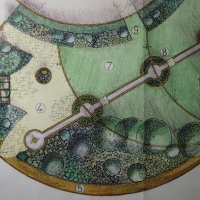
The ‘Education Garden’ at Gressenhall Farm and Workhouse Museum, Norfolk, was in need of a ‘refresh’. As part of my one year Heritage Garden Traineeship I came up with a new design, having consulted staff and volunteers. The agreed design was carried out in 2012 by me and other volunteers at the Museum. It features some minor adjustments to the former planting areas, terraces and grass and also includes an area designed for pre – school children, known as ‘Curiosity Corner’.

‘Curiosity Corner’ is deliberately child – sized, with a winding bark and pebble path and deep borders that sometimes rise above and fall below the path. There are living structures – a willow tunnel and two entrance arches. A ‘pebble mountain’ and a series of wooden features are complemented by a low level mirror, as well as a number of metal and wooden birds, insects, butterfly and a cat, windmills and other ‘oddities’ such as a ‘fossil slab’ set in grass and a wall mask of a ‘small friendly giant’- the idea is to provide unusual things for the the children to spot and stimulate their imaginations.

The planting is varied and includes species with interesting leaves (e.g. Stachys byzantina or ‘Lambs Ears’, ferns and grasses) and last year children planted Sunflowers which grew to an enormous height! There is also a turf seat and a half barrel water feature (complete with metal frog). The garden has now seen a full season of ‘wear and tear’ and has stood up reasonably well – it seems to have been a popular addition to the Museum. However, some adjustments are needed to prevent children accessing the inner path from the terrace, strengthening the enclosed feel of the space and replacing the turf seat which has not really withstood the wear – it has turned into a mound for running up and down rather than sitting on! These changes will be carried out soon.

Old School Gardener

If you’ve enjoyed reading this post and others on this blog, why not comment and join others by signing up for automatic updates via email (see side bar, above right ) or through an RSS feed (see top of page)?

Tim Gill's avatarRethinking Childhood

Rope bridge in play area“How can we make our playground safe?” It seems a simple enough question. Yet the answer is anything but (and even the question is not as simple as it looks). In fact, managing risk in a playground is much more complex than in a factory or a workplace. The reason for this is down to a fundamental difference in the nature of the task. One way to grasp this difference is to think about a wobbly bridge.

View original post 508 more words

PicPost: It'll end in tiers

This is the third in a series of ‘snippets’ on different garden styles. Today, formal gardens.

A successful formal garden is balanced, the design based on symmetry in its layout and a clearly recognisable ground plan or other pattern. Other features include:

  • Vistas – long channels in which the view is drawn towards a distant point or view

  • Statuary – often used as focal points within formal garden spaces or at the end of vistas

  • Topiary – ‘living statuary’ – small-leaved evergreen plants (Box and Yew, typically) are used to create all year round structure and focal points in the borders or spaces as well as hedges to create edges/ boundaries, parterres and knot gardens

  • Ornament – structures or materials are used which embellish otherwise plain surfaces or features

  • Natural stone – limestone, sandstone, granite, marble are all used to create a rich hard landscape which harmonises with the planting

  • Dramatic planting – specimen tress and shrubs are used as focal points and large expanses of single or limited numbers of species are used in mass effects

Let me know what you think makes a Formal style garden, and if you have some pictures I’d love to see them!

Other posts in the series:

Mediterranean Gardens

Cottage gardens

Old School Gardener

If you’ve enjoyed reading this post and others on this blog, why not comment and join others by signing up for automatic updates via email (see side bar, above right ) or through an RSS feed (see top of page)?

Finding Nature

Nature Connectedness Research Blog by Prof. Miles Richardson

Norfolk Green Care Network

Connecting People with Nature

Discover WordPress

A daily selection of the best content published on WordPress, collected for you by humans who love to read.

Susan Rushton

Celebrating gardens, photography and a creative life

Unlocking Landscapes

Writing, photography and more by Daniel Greenwood

Alphabet Ravine

Lydia Rae Bush Poetry

TIME GENTS

Australian Pub Project, Established 2013

Vanha Talo Suomi

The Journey from Finnish Rintamamiestalo to Arboretum & Gardens

Marigolds and Gin

Because even in chaos, there’s always gin and a good story …

Bits & Tidbits

RANDOM BITS & MORE TIDBITS

Rambling in the Garden

.....and nurturing my soul

The Interpretation Game

Cultural Heritage and the Digital Economy

pbmGarden

Sense of place, purpose, rejuvenation and joy

SISSINGHURST GARDEN

Notes from the Gardeners...

Deep Green Permaculture

Connecting People to Nature, Empowering People to Live Sustainably

BloominBootiful

A girl and her garden :)