

Archive for 2013


Decorated Compost Bin Competition
Winners Announced!!
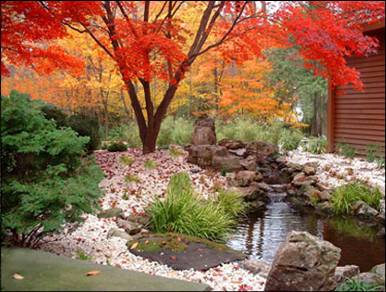
Maples (Acers) provide glorious autumn colour in this Japanese style garden
Today’s ‘snippet’ on different garden styles focuses on a very distinctive form, ‘Japanese Gardens’.
Japanese gardens have a balance which is achieved through the careful placing of objects and plants of various sizes, forms and textures. These are placed asymmetrically around the garden and are often used in contrast – rough and smooth, vertical and horizontal, hard and soft. These gardens often create miniature idealized landscapes, frequently in a highly abstract and stylised way. Pruning and garden layout are usually considered to be more important than the plants themselves which are used sparingly and with restricted use of both different species and colours.
Historically, there are four distinctive types of Japanese garden:
-
Rock Gardens (karesansui) or Zen Gardens, which are meditation gardens where white sand replaces water
-
Simple, rustic gardens (roji) with tea houses where the Japanese Tea ceremony is conducted
-
Promenade or Stroll Gardens (kaiyū-shiki-teien), where the visitor follows a path around the garden to see carefully composed landscapes
-
Courtyard Gardens (tsubo-niwa)
 Saihouji kokedera- the moss garden begun in the 14th century
  Heian jingu shinen – stepping – stones in the garden of the first Kyoto Imperial Palace- these stones were originally part of a 16th century bridge over the Kamo river which was destroyed by an earthquake
  A modern japanese garden from 1934 (designed by Mirei Shigemor), built in the grounds of a 3rd century Zen temple in Kyoto
Saihouji kokedera- the moss garden begun in the 14th century
Heian jingu shinen – stepping – stones in the garden of the first Kyoto Imperial Palace- these stones were originally part of a 16th century bridge over the Kamo river which was destroyed by an earthquake
A modern japanese garden from 1934 (designed by Mirei Shigemor), built in the grounds of a 3rd century Zen temple in Kyoto
Other key features of Japanese Gardens include:
-
Typical Japanese plants – e.g. Azalea, Camellia, Bamboo, Cherry (blossom), Chrysanthemum, Fatsia japonica, Irises, Japanese Quince and Plum, Maples, Lotus, Peony, Wisteria and moss, used as ground/stone cover
-
Water features and pools
-
Symbolic ornaments
-
Gravel and rocks
-
Bamboo fencing
-
Stepping stones
 Adachi Museum of Art garden
  A modern Moss garden in Kyoto
  Use of gravel and rocks along with bamboo screens
  Water landscape with typical japanese planting
Adachi Museum of Art garden
A modern Moss garden in Kyoto
Use of gravel and rocks along with bamboo screens
Water landscape with typical japanese planting
Bonsai- literally meaning ‘plantings in tray’ – is a Japanese art form using miniature trees grown in containers. The purposes of bonsai are primarily contemplation (for the viewer) and the pleasant exercise of effort and ingenuity (for the grower). Bonsai is not intended for food production, medicine, or for creating domestic or park-size gardens or landscapes, though some people display their bonsai specimens in garden settings, as this video shows.
Let me know what you think makes a Japanese style garden, and if you have some pictures I’d love to see them!
Further information:
Pictures of popular Japanese plants
Other posts in the series:
Old School Gardener
If you’ve enjoyed reading this post and others on this blog, why not comment and join others by signing up for automatic updates via email (see side bar, above right ) or through an RSS feed (see top of page)?
‘The SkyWire will reopen on Saturday 18 May! From this date you’ll be able to take an adrenaline-fuelled headfirst ride in the new ‘superman’ harness. It’s still the longest zip wire in England at 660m and now it’s definitely the fastest. We’ve clocked our test pilots going at 60mph!’
Source: The Eden Project

- by Ann-Marie Peckham
If the title made you think that today’s blog was going to be about the ghost story published by Henry James in 1898 I’m sorry to disappoint you. It’s actually about the wooden Archimedes screw found in our superstore (while not as scary as James’ story, this IS just as interesting…I promise!)

The screw takes its name from Archimedes (c.287-212 BC), a scientist and engineer from Syracuse, Sicily, which at this time was part of Magna Graecia (Greater Greece). Archimedean screws were originally used to move water from a lower level to a higher level. This was done by basically what is a giant corkscrew entwined around a central cylindrical shaft which was inside a hollow pipe. Once the end of the screw was placed in the ground or water a turning handle was used to push the screw down and scoop up the contents which would…
View original post 240 more words
Why Places Matter – new booklet for local councils and communities

Produced by Living Streets with the People and Places Coalition, of which The Glass-House is a member, the booklet is being sent to all councils in England and offers a practical manifesto for councillors and communities on how they can transform the places where they live.
The booklet also includes signposting to useful information and tools that can help communities and local councils work together effectively to shape their neighbourhoods.
The Glass House– Useful resources for open space projects


‘Keeping the play at ‘hand’ level for sight-impaired children at the New York Association of the Blind, c. 1917. From the Museum of the City of New York; unknown photographer.’
From: Playscapes
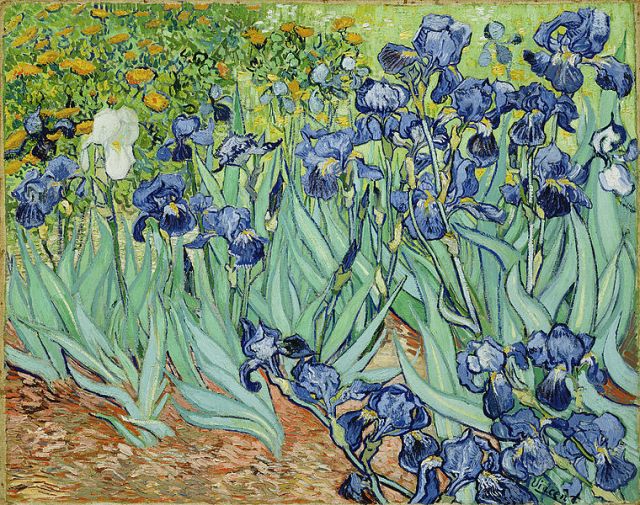
Irises by Van Gogh
I’ve thought for some time that I must grow more Irises in my garden, but somehow the massive choice and being not quite sure about how to grow them successfully tends to make me wary.
I have grown some bearded irises in pots (and they’ve done quite well, despite a bout of Iris Rust last summer), and also some bulbous varieties in the border – they always please, as much for their strappy green foliage as for their flowers. I must be a bit more adventurous and devote a largish area to a bold display of one or two varieties – when I can afford it!
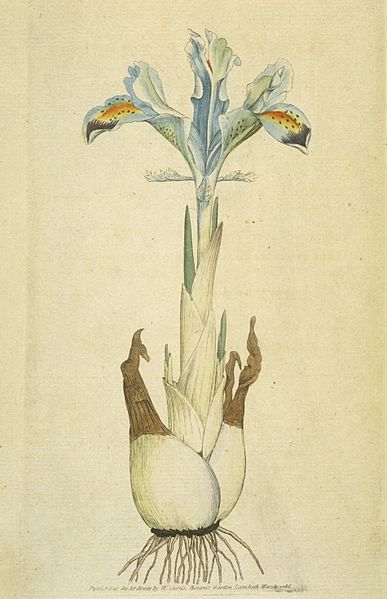
Iris persica – a bulbous Iris as drawn by Sowerby in 1792
Irises – otherwise known as Flags, Sword Lilies or Fleur de Lis – is a genus of some 300 species from very varied habitats from around the northern hemisphere. They vary between those that are bulbs, those with rhizomatous (expanding, tuberous) roots, and some that are fleshy – rooted. They can be evergreen or deciduous and have very varied growth requirements. Irises are classified by the Royal Horticultural Society into these sub sections or ‘subgenera’:
- Bearded species and cultivars– various sizes from miniature dwarf to tall. These are the most widely grown group of Irises, are rhizomatous and prefer well drained soil.
- Aril irises are a group of bearded irises that become dormant in the summer after flowering and need to be kept dry whilst in this state.
- Beardless irises generally have more flowers per stem, than bearded types. They are also rhizomatous and prefer well drained conditions, apart from the Laevigate group which needs damp soil.
- Crested irises are rhizomatous, spread freely, and prefer moist soil.
- Bulbous irises are beardless and summer dormant. They prefer well-drained soil.
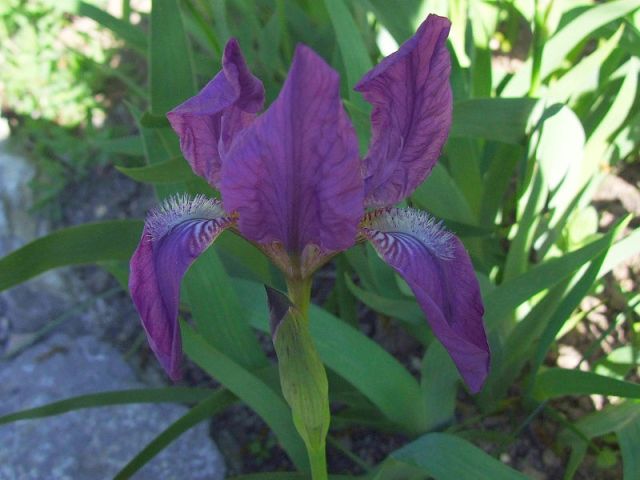
Iris aphylla -with prominent ‘beard’
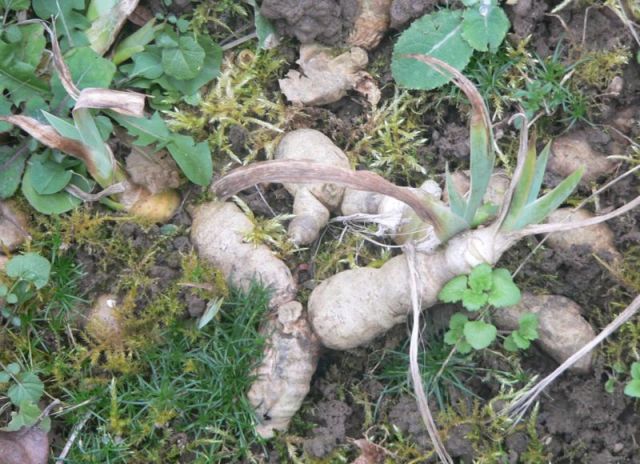
Iris orientalis showing rhizome roots
The Iris has connections with ancient Greece, where Iris was the messenger of the Gods, communicating between heaven and earth through a rainbow (so a reference to the wide range of Iris colours available). Irises have been valued plants for a long time and the flowers have had a long association with heraldry and royalty.
The iris flower has three outer and three inner tepals (a uniform type of petal on the outer part of the flower). The outer three bend back and may also hang down, so are referred to as ‘falls’ – they are usually the most colourful part of the flower and are especially large and colourful in the bearded irises, which have white or coloured hairs, like a beard, in the centre of each fall. Crested irises have a ridge (or crest) on each fall.
The three inner tepals are called ‘standards’, as they generally stand upright in the middle of the flower (like a flag), but may also lie horizontally as in I. tectorum; droop as in I. bucharicha; or be much reduced as in I. danfordiae.
Three modified styles called stigma flaps reach out over the falls from the middle of the flower and can be an important feature. The iris flower is of interest as an example of the relation between flowering plants and pollinating insects, the shape of the flower and the position of the pollen-receiving and stigmatic surfaces on the outer petals forming a convenient landing-stage for flying insects. All parts of the Iris plant are poisonous and contact with the sap may cause skin irritation. However, Irises are low in allergens.

Iris orientalis

Iris ‘Samurai Warrior’- the closest breeders have come to a red Iris
Irises are extensively grown as ornamental plants in home and botanical gardens. They grow in any good free garden soil, the smaller and more delicate species needing only the aid of turf ingredients, either peat or loam, to keep it light and open in texture. The earliest to bloom are species like I. junonia and I.reichenbachii, which flower as early as February and March (Northern Hemisphere). These are followed by the dwarf forms of I. pumila which blossom in Spring, and these are followed in early Summer by most of the tall bearded varieties, such as the German Iris and its variety florentina, Sweet Iris, Hungarian Iris, Lemon-yellow Iris and their natural and horticultural hybrids such as those described under names like I. neglecta or I. squalens.
 Iris reticulata
  Iris graminea
  Iris croatica ‘Botaniki’
The Iris is hardy, reliable, and easy to grow. Irises also attract butterflies and make lovely cut flowers. The Old Farmers’ Almanac suggests the following tips for growing Irises:
- ‘Irises need at least half a day of sun and well-drained soil. Without enough sun, they won’t bloom.
- They prefer fertile, neutral to slightly acidic soil. If your soil is very acidic, sweeten it with a bit of lime, and forbear summer watering, which can lead to rot.
- Bearded irises must not be shaded by other plants; many do best in a special bed on their own.
- Soil drainage is very important. Loosen the soil with a tiller or garden fork to a depth of 12 to 15 inches, then mix in a 2 to 4-inch layer of compost.
- Plant iris in mid to late summer.
- Bearded irises have rhizomes (fleshy roots) that should be partially exposed, or thinly covered with soil in hot climates.
- Plant rhizomes singly or in groups of three with the fans outermost, 1 to 2 feet apart, depending on the size.
- Dig a shallow hole 10 inches in diameter and 4 inches deep. Make a ridge of soil down the middle and place the rhizome on the ridge, spreading roots down both sides. Fill the hole with soil and firm it gently.
- Water thoroughly.
- When planting, top-dress with a low-nitrogen fertilizer, and again in early spring.’
As I conclude this article, I’m already thinking of an open, sunny spot where a bold display of summer flowering bearded Irises (one of the brown ones like ‘Kent Pride’) would look great in Old School Garden. Perhaps mixed in with some purple Heuchera to mask their rhizomes and some later seasonal interest ….watch this space.
 Iris wattii
  Iris ensata cv ‘Kumoinogan’
  Iris reichenbachii
  Iris pseudacorus
  Iris regis-uzziae

Bearded Iris drawn by Sue Walker White
Further information:
National collection of water irises event
Iris weekend 6-7 July, Rosemoor, Devon
Places to see Bearded Irises in May- June:
Marks Hall Garden & Arboretum, Essex
Old School Gardener
If you’ve enjoyed reading this post and others on this blog, why not comment and also join some other people and sign up for automatic updates via email (see side bar, above right ) or through an RSS feed (see top of page)?






 Old School Garden