

The moon, clouds and wind were on stage last night here in Ohio. The moon and clouds danced to the howling song of the wind. They gracefully interacted in ways that only two lovers could. The intimacy, passion and chemistry enveloped all who saw and implanted wild and adventurous dreams which were to be realized, though not remembered, later that night in the deepest of sleep.
Archive for 2013





This morning I’ve found these fantastic floral patterns on windows of my car.And I was astonished again by the simple fact, that actually the geometry of the water molecule determines the beauty of the crystals to be formed. Very the same as in the live world of nature-the geometry of molecules as the constituents determines the final beauty we admire. Obeying physical laws of our universe the beauty of flowers, be in frost or those in the garden is determined in advance and inevitable .Means all this beauty is hidden in math, physic, chemistry……..
 Gardens of Court and Country: English design 1640–1730
Dr David Jacques, Garden Historian
6.30 pm, Wednesday 30 January, The Gallery, 70 Cowcross Street
Most traditional histories of the English garden treat formal gardens as a single and unvaried period, filling the gap between the Elizabethan and the landscape garden, but David Jacques’s forthcoming book demonstrates that, by contrast, each generation made huge changes in the design of its gardens. The emergence of the landscape garden is shown in proper context, and connections are made to politics, religion, men’s fashion, gastronomy, the development of carriages, the symbolism of parks, foreign influence, and many other aspects of seventeenth and early eighteenth century life.
Led by the Land
Kim Wilkie, Landscape Architect
11th Annual GHS Lecture at the RHS
6.30 pm, Wednesday 20 February, Royal Horticultural Halls & Conference Centre
Kim Wilkie will explore the future of landscape architecture as set out in his new book, Led by the Land, covering projects such as Transylvania, Longwood Gardens and Boughton Park to illustrate his ideas. He will show how the ancient tradition of sculpting the land can inspire new forms and meanings, merging innovative landscapes with revered historic ones. Mavis Batey has said in interview: “All over the world people want to know how he does it”. This will be your chance to learn.
‘Harmony Compleat’ —
Music in the Garden from Renaissance Italy to Georgian England
Judy Tarling, Specialist in Historical Performance (music and gardens)
6.30 pm Wednesday 27 February, The Gallery, 70 Cowcross Street
Judy Tarling will talk about how music was performed and experienced in gardens from renaissance Italy to Georgian England, illustrated with musical example and images. She will investigate who played which instruments, where, the nature of the audience if there was one, and the repertoire. Judy will show how music, from the sound of water and bird-song to fully staged dramatic performances, was an essential part of the historical garden from the 16th to 18th centuries.
A little bit of Surrey in the sun?
A hundred years of the national botanic gardens of Burma
Dr David Marsh, Garden History Researcher/Lecturer
6.30 pm, Wednesday 6 March, The Gallery, 70 Cowcross Street
Maymyo was a poor relation in the family of Kew-inspired tropical botanic gardens. Established late in colonial rule by ‘amateurs’, it quickly suffered from staff turnover and uncertainty as to its role. After the war and independence it fell further into decline but has recently been ‘privatized’ by the government. Uncovering its story has been difficult but offers a different perspective on the history and political role of botanic gardens and their possible future in the developing world.
Passion, Plants and Patronage:
Three Hundred Years of the Bute Family Landscapes
Robert Peel, Vice Chair of GHS, Kristina Taylor, Vice Chair of GHSS
6.30 pm, Wednesday 20 March, The Gallery, 70 Cowcross Street
Several generations of the Bute family have been intimately involved in the development and maintenance of landscapes in Scotland, England and Wales. This talk will link the personalities and landscapes, with particular reference to the two most prominent family members in the field of parks and gardens, the 3rd Earl in C18 and the 3rd Marquess in C19, and discuss the happy condition of these landscapes today.
Contact:
The Garden History Society
Email: events@gardenhistorysociety.org
Office (information and press enquiries): 020 7608 2409
Website: http://www.gardenhistorysociety.org
Website for press information: www.gardenhistorysociety.org/press
Venues and Times 2013:
11TH Annual GHS Lecture at the RHS
Lecture by Kim Wilkie (20 Feb)
Royal Horticultural Society Halls and Conference Centre.
Greycoat Street, London SW1P 2QD (Victoria, St James’s and Pimlico Stations).
Doors open at 5.45 pm, lecture starts at 6.30 pm.
Lectures by Dr David Jacques (30 Jan), Judy Tarling (27 Feb),
Dr David Marsh (6 Mar), Robert Peel (20 Mar) at
The Gallery, 70 Cowcross St, London EC1M 6EJ (Farringdon Station).
Doors open at 6.00 pm, lectures start at 6.30 pm
Tickets
RHS: £15.00 in advance for members of the GHS and RHS, £18.00 for all tickets purchased at the door.
The Gallery, Cowcross Street: £8.00 in advance for members of the GHS, £10 for all tickets purchased at the door (one glass of wine included).
SEASON TICKET FOR ALL LECTURES: £43.00 members, £54.00 non-members.
A booking form can be downloaded from http://www.gardenhistorysociety.org/events
|
The events at The Gallery are supported by Alan Baxter & Associates
The event at The Royal Horticultural Hall and Conference Centre is supported by
The Royal Horticultural Society
The Garden History Society
70 Cowcross Street, London EC1M 6EJ
020 7608 2409
events@gardenhistorysociety.org
http://www.gardenhistorysociety.org
Old School Gardener
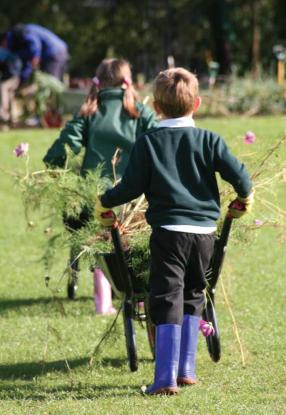 Across the developed world there is concern about a growing ‘disconnect’ between children and the natural world around them – increased time spent indoors, less time out playing – the scenario is well reported. School gardening projects are an important way to reconnect children with nature.
School gardening, like ‘growing your own’ seems to be on the increase in the UK as we look for ways of bridging the ‘ecological disconnect’, saving money, reducing ‘food miles’, improving food quality and strengthening local economies. There’s powerful evidence that school gardening is one, convenient and effective way of ‘learning outside the classroom’. A way of helping to engage children with the natural world and to deal effectively with some other important issues at the same time by:
- raising academic achievement
- promoting healthy eating
- instilling a sense of responsibility for the world around us
- encouraging social and community development and a ‘sense of place’
- providing a place for unstructured, imaginative play
In Norfolk, England, the voluntary group of Mastergardeners is playing its part in supporting around 20 schools and many others are waiting to connect with a suitably trained volunteer in their area to develop new school gardening initiatives.
I’ve been helping a primary school to develop its school garden, which now has several raised planting beds (one for each class) and a recently completed wildlife pond with dipping platform and boggy planting areas. I tried to engage the children in growing food with a short session about the food they like to eat and where it comes from, why growing our own is important and the different types of fruit and veg we could grow. We ended up with each child making their own paper pot and sowing a broad bean seed – these were later transferred by the children to the school garden and formed a wonderful source of ‘free sweets’ during the summer!

Making paper pots – an easy way to get children involved in ‘growing their own’
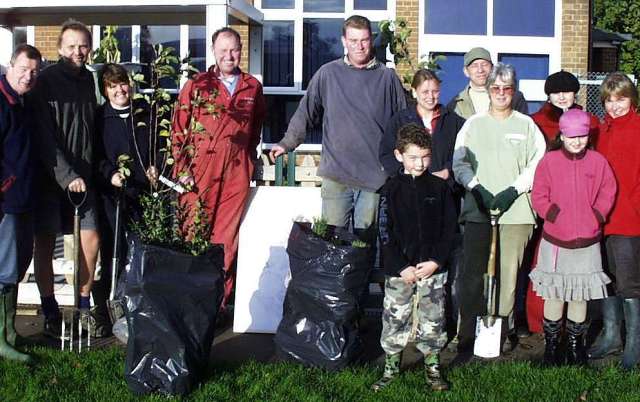
The whole community– governors, staff, parents, children, local businesses together with ‘shopping voucher’ and grant schemes have played their part in creating this valuable resource. The new gardening year is about to kick off with a ‘Garden Gang’ (parents, children, staff and friends of the school) session on Saturday to get the beds ready, complete the greenhouse (made out of canes and plastic bottles) and plant some new apple trees.
Other Mastergardeners are playing their parts around the County. This includes several new and more established gardens at secondary and primary schools and a novel ‘inter – generational’ project in Norwich, where some spare ground behind a library has been turned into a food growing plot by children from a local school, library staff and older people from a sheltered housing scheme overlooking the site.
One secondary school gardening coordinator recently wanted to introduce children to the ideas of ‘veg families‘ and crop rotation. She printed out 56 small veg pictures and separate names – the first task was for the students to ID the veg. Then they looked at veg families (with the students placing the different vegetables into different groups ) – then they used their computers to create their own set of ‘Veg family prints’. Finally, they looked at crop rotation and by the end of the session they had come up with a basic 4 bed rotation over 4 years, along with a write-up explaining about why we rotate crops yearly.
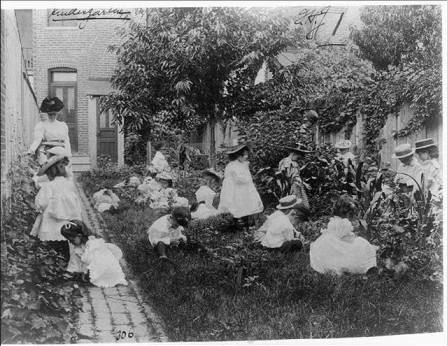
School gardening a century ago- birth of the ‘kindergarten’
School gardening has been around a long time – originally developing as part of the formal school curriculum at a time when many more households grew their own food. There were war – time efforts to boost food production at schools and the ‘Kindergarten’ movement saw playing and being creative in an outdoor setting as the heart of nursery education.

School gardening in war time- US style
Recently in the UK the Food Growing in Schools Taskforce, led by Garden Organic was established as a response to increasing concerns about the health and well-being of children and young people, and a confidence that food growing in schools is a successful way of dealing with these concerns, delivering many benefits. The Taskforce is made up of people representing a diverse set of interests, but all with a strong belief that food growing in schools is an important activity. You can read their findings here.
Getting the whole community involved in the school garden
Over the coming weeks I plan to post a series of articles about how to go about setting up and developing a school garden, so if you have any experiences or ideas to share I’d love to hear from you!
Old School Gardener
If you’ve enjoyed reading this post and others on this blog, why not comment and also join some other people and sign up for automatic updates via email (see side bar, above right ) or through an RSS feed (see top of page)?

It was a glorious morning to get back to the garden..
The snow has gone (for now), it was sunny, there was a sense of expectation in the air and gardening juices were rising…so the real ‘Green Deal’ has begun- a new gardening year!

A blue tit on one of our bird feeders- we seem to have a good number of these
At last it’s been possible to get out in the garden! So what happened?
I submitted my bird watch figures to the RSPB : four Great Tits, four Blue Tits;three Blackbirds; three Seagulls; two Wood Pigeon; 2 Collared Doves; 2 House Sparrows; 2 Carrion Crows; 1 Robin; 1 Chaffinch; 1 Wren… ‘and a cock pheasant in the pear tree…’)
I’ve also sown some seeds ( a tray each of Leeks, Cosmos and Iceland Poppies in my propagators). Nice to get my hands into that peat free compost again…

The border of suckering Lilac before clearing
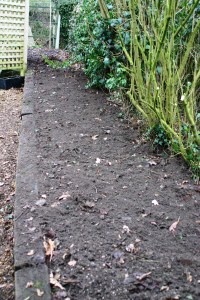
The border after clearing – ready for some annuals- Marigolds?
I did a bit of tidying in the greenhouse, but more importantly cleared a border of some suckering Lilac. This is in a raised bed on the edge of my kitchen garden and though I did think about some sort of barrier fabric to try to keep the lilac back, in the end I don’t think that would be very effective. So, Im thinking it might be best to make this area an annual bed (maybe filled with Marigolds) both to look good and to help attract beneficial insects into my food growing area. This will also be less awkward when I need to cut back the Lilac again in a couple of years.
Finally, before the wind and rain arrived,I dug up a row of Nerine bowdenii bulbs (the ‘Cornish Lily’ or ‘Guernsey Lily’- pink flowers in the autumn). Boy did they need splitting after being in the ground for a good number years- and now I have plenty of new bulbs to plant!
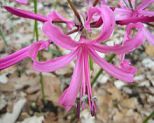
Nerine bowdenii flower
All very satisfying after about three weeks inside! Looks like it’ll be wet today, so I may have to content myself with preparing some new blog posts and thinking about where to put those Nerines…any ideas?
Old School Gardener

The Master’s Garden as it looked in the 1970’s- evidence of food growing when ‘Beech House’ old people’s home occupied the buildings.
In the second of a series about the gardens at Gressenhall Farm and Workhouse Museum, Norfolk, I explain how the former Workhouse Master’s garden has been turned into a wildlife oasis.
During the 19th and early 20th centuries the Master of the workhouse looked down on the walled garden from his family accommodation. There is no evidence of what it looked like or what was grown here then, but during more modern times, when the Workhouse became an Old People’s home, it seems that the area was used to grow food (see photograph).
Today the area is used mainly as a wildlife garden and was the subject of a major overhaul a couple of years ago with financial support from the Big Lottery and Friends of the Museum (totalling £13,000) as well as donations from local nurseries and others. Originally created in the mid 1980’s the Wildlife Garden has been the subject of several awards, but as time passed, with fewer volunteers able to maintain it, the garden was less attractive and the thugs of the plant world rather took over. The pond liner was punctured and the plastic safety cover and overgrown water plants were throttling what life did exist!

The Wildlife Garden before it’s recent makeover
All in all the garden was looking very sad!
After a review it was decided to improve access to the garden by:
- widening one entrance and adding another and a new path
- renovating and re-laying the existing circular path with new infill material between the slabs
- relocating and enlarging the pond to make it a central feature of the garden
- strengthening the different types of habitat for wildlife
- providing some seating and a wheelchair bay
- improving interpretation for visitors so that they can appreciate what is in the garden and why.
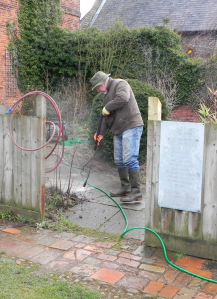
Cleaning the slabs that were later re-used
There is now a central pond (with shelved edges, a pebble beach and shallow water to act as portals for insects), and surrounding bog areas. Other habitats are ranged on each side – a hot and dry gravel garden on the south facing side, a darker and damper shade garden towards the north-facing side. There are some other wildlife friendly features here such as bug hotels and bat and bird boxes which were originally installed in the 1980’s. There is a new attractive interpretation board encouraging visitors to look out for different types of wildlife, including the resident Newts (named either Nigel or Nigella- no one has got close enough to tell their gender!). I find it amazing how quickly amphibians, insects etc. have been attracted to the pond and surrounding areas, so that today a wide range of wildlife can be seen (if you’re patient and quiet).
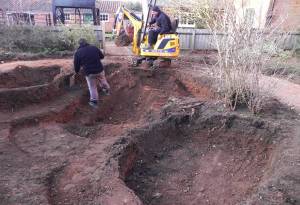
Excavating the new pond

The new garden under construction
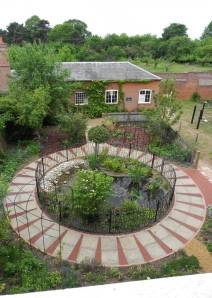
The new Wildlife Garden
I designed and managed the project and with other volunteers put in the new plants and did some of the other renovation work. The main contractor for the new pond, borders and paths was Ian Chatten Ltd. and Kontorted Iron created the wonderful ‘organic’ fence around the pond, together with metal pergolas and an arbour– all in black wrought iron to link with other items in the Museum including the nearby old cattle- weighing machine, originally from Fakenham Market. The Gardening Team’s tool store and sheds are also ranged along one side. The arbour has taken advantage of an old ‘Rambling Rector’ rose growing in the corner of the garden – this has been pruned and tied around the frame of the arbour and provides both a wonderful sight and a romantic spot from where to view the garden in summer.
There’s also a ‘Really Useful Patch’ of flowers, herbs and shrubs. Until very recently households had to be self-sufficient in flavourings, medicines, insecticides, cleaning products and so on. The plants in this garden were all used in the past by the housewife to keep her family healthy. The only other criterion for this area was that it was to cost nothing so all the plants have been grown from cuttings or division, or have been donated or ‘recycled’.
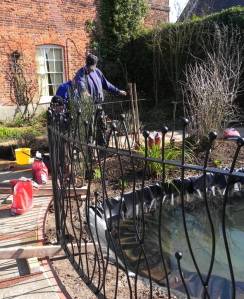
Installing the new wrought iron fence

The new Wildlife Garden from the new entrance
The coming season promises to see the planting and features mature further and hopefully the ‘critters’ will enjoy it too!
Quizzicals (courtesy of Les Palmer):
two more cryptic clues to the names of plants, fruit or veg…
- The noise of a bird imitating a cat
- How Australians describe English rock
Old School Gardener (with thanks to Christine Walters for some of the photographs)
If you’ve enjoyed reading this post and others on this blog, why not comment and also join some other people and sign up for automatic updates via email (see side bar, above right ) or through an RSS feed (see top of page)?

The Mistle Thrush- photo RSPB
The Mistle Thrush is in decline, warns a major bird charity today.
The RSPB Big Garden Bird Watch survey reveals that they are being seen in less than half the number of British gardens than 10 years ago, resulting in the species being given an ‘amber’ warning of it disappearing. Other birds have seen their numbers decline since 1979, when the survey began, but the numbers of Blue, Great and Coal tits, in contrast, have been on the increase.
The Mistle Thrush is the largest bird in the Thrush family and its name means literally ‘Mistletoe eating Thrush’. It can be seen romping across the garden or standing defiantly on the lawn, but is more likely to be heard perched high up in a tree singing its melodious song. Because it sings so loudly on exposed perches in bad weather it’s sometimes nicknamed the ‘Stormcock’.
Living in parks, woodland and gardens they build their cup-shaped nest in trees early in the year. Of some benefit for the gardener because they like to eat worms, snails, insects, and slugs, in winter they turn to fruit such as berries from trees- mistletoe, holly, yew, rowan and hawthorn. They can be quite combative too, defending ‘their tree’ against other thrushes! They will occasionally visit gardens for food particularly if they are provided with their favourites on a regular basis – meal worms and suet seed mixes are a good bet.
The RSPB Big Garden Watch takes place this weekend and everyone can take part by recording the numbers of different birds they see in their garden. A handy recording sheet can be downloaded from the website here.

The RSPB Big Garden Watch survey sheet
There are also a number of events taking place around the country; e.g. A ‘Wild Weekend’ event at The Forum in Norwich will show how to garden for wildlife and there’ll be lots of family activities on offer. Norfolk Mastergardeners will also be on hand with wildlife gardening and grow your own food tips and advice. For tips on making your garden butterfly friendly click here.
Old School Gardener
If you’ve enjoyed reading this post and others on this blog, why not comment and also join some other people and sign up for automatic updates via email (see side bar, above right ) or through an RSS feed (see top of page)?

The Maze at Longleat House, England
I must admit I’m a bit of a fan of labyrinths and mazes.
As a play landscape designer I’ve tried to find ways of incorporating them in my designs as they are especially attractive to children. Usually they are one of the first design ideas to be dropped, generally on grounds of maintenance requirements. I’ve tried to suggest simple materials like grasses to mark out a pattern, rather like the one in the Cambridge Botanic Garden, but again they do take some looking after. The best I’ve managed is a wooden stepping stone and daffodil spiral. One day I’ll find a client with the imagination and deep(ish) pockets to give a bigger one a real go.
Labyrinths and mazes – what’s the difference between them?
Well, the answer is ‘it rather depends…’. There is one school of thought that sees labyrinths as different to mazes and another that sees labyrinths as one type of maze. Labyrinths have just one route– so there’s no danger of getting lost – whereas mazes are rather more cunning in that they have dead ends, twists and turns which are set out to puzzle and confuse. Sir Walter Scott’s ‘O, what a tangled web we weave, when first we practise to deceive!’ comes to mind.
Labyrinths (remember the single route or ‘unicursal’ one) are found in many cultures, some as old as 3,500 years. They all have an entrance or mouth, one route to follow and a central destination, sometimes marked with some sort of stone/statue/ feature. A further detail is how many concentric circuits or paths they contain and they can vary from the small to the huge – several hundred feet across. They have traditionally been seen as spiritually symbolic, meditative paths as well as just entertaining and can be found in many religious buildings such as Chartres and Ely cathedrals.

The Labyrinth pattern in Chartres Cathedral
Humankind has been fascinated by patterns in the land for millennia and some of the earliest were forms of spiral (some multiple spirals). These later developed into the sorts of maze-like patterns we’re more familiar with, including the Cretan maze (or labyrinth as its usually called!). Of course the famous one was that in classical mythology where Theseus found his way to the centre and killed the Minotaur to ensure he freed his fellow Athenians. He used a length of thread to trace his way in and so find his way out. Which rather suggests that this ‘labyrinth‘ was in fact a more complicated maze as it would have been easy to retrace his steps in a one-route labyrinth! This all goes to support the case that the words labyrinth and maze are interchangeable, and certainly common usage suggests this- e.g the turf ‘mazes’ in some English gardens are in fact labyrinths (i.e. one routers).
A-maz-ing Gardens
Mazes as multi – choice routes really developed in gardens out of the parterre and knot gardens which used lines of plants (usually Box) to create patterns within which other plants, gravel, grass or sometimes coloured powders created a contrast in colour and level. You can wander around these hedges in some gardens and it isn’t difficult to imagine how (either deliberately or perhaps through lack of maintenance!) these hedges grew taller. This both made it difficult to grow anything successfully within them and also added a touch of mystery to the experience of walking round the garden. A book by Daniel Loris – ‘Le Thresor des Parterres de l’univers‘ – written in 1629, seems to capture the developing fashion for such mazes (though most of it is concerned with the traditional parterre).

Hampton Court Maze, England
Britain’s oldest surviving hedge maze is at Hampton Court – created by George London and Henry Wise in 1690 and also thought to be the oldest hedge maze in the world in continuous use. Originally planted with Hornbeam and having two trees at the centre the hedging is now Yew, the hedging used in many traditional hedge mazes.

Labyrinth of Horta, Barcelona
The Labyrinth Park of Horta in Barcelona, Spain, was created around 1794 as part of a neoclassical ‘makeover’ of the garden by its Marquis owner. In recent years the garden and maze have been restored and I have had the good fortune to almost stumble across it.

A simple bulb labyrinth at Cornell University, USA
Today there are many different types of maze to be found in gardens, parks and estates around the world, some using hedges or walls (for your truly ‘puzzling maze’), others using turf, other grasses, low-growing plants or materials to mark out the (usually labyrinthine) route. In Britain temporary ‘Maize mazes’ created in agricultural fields have become a popular summer visitor attraction.
There is something magical about these labyrinth and maze ‘puzzles on the land’ and I hope that one day I can create one in a park or garden…maybe you have scope for one in your garden?
Sources and further information:
Quizzicals (thanks to Les Palmer for these):
answers to the last two-
- Has had too much already – Sycamore
- A country full of automobiles – Carnation
and a couple of gardening ditties…
‘Big in Japonica’
‘You picked a fine time to leave me lucerne’
Old School Gardener
If you’ve enjoyed reading this post and others on this blog, why not comment and also join some other people and sign up for automatic updates via email (see side bar, above right ) or through an RSS feed (see top of page)?
 OK, it’s the beginning of a new gardening year and minds turn to tools and equipment to make life easier or more efficient.
I’m currently awaiting a Wolf two-way hoe (a birthday present) to clip into the handle I got for Christmas. I came across this wonderful tool whilst on my Heritage Gardening traineeship last year. Basically, if you don’t know, it’s twice as efficient as the normal dutch hoe, as you till the ground on the pull as well as the push stroke. I can’t wait, but it’ll be a little while yet before the ground is thawed enough for me to get it moving.
What about boots or other footwear in the garden? I find I have about 6 pairs of old shoes and boots, only one of which was purposefully bought for the garden (and not by me). This one- a padded leather boot with steel toe cap – is brilliant. But at different times of the year I find weather and ground conditions make one of my other pairs better.
What about you? Do you care what you wear? Do you hanker after some top of the range foot protection? Or do you, like me, just relegate those ‘not good enough for town’ shoes to the ‘there’s a few more years life in them yet’ rack?
Here are some pics for you to ponder- let me know if you have a favourite or what you actually wear out there!

My own personal favourite- safe with a toe cap,but cushioned ankle support too!


















And when you finally can’t use your boots any more, turn them into a stylish planter!
Further information:
Michelle Obama’s gardening boots
Old School Gardener
 The ‘Queen of Annuals’ is being billed as the ‘cottage garden favourite for 2013′.
It’s botanical name- Lathyrus odoratus- comes from an ancient greek word (Lathyrus) meaning pea or vetchling and odoratus meaning ‘fragrant’. The genus Lathyrus contains about 160 species and of the many cultivars of the Sweet Pea, some 52 varieties have been awarded the RHS Award of Garden Merit. The many varieties of Sweet pea available today come in a wide range of colours, but not yellow!
“The Sweet Pea has a keel that was meant to seek all shores; it has wings that were meant to fly across all continents; it has a standard which is friendly to all nations; and it has a fragrance like the universal gospel, yea, a sweet prophecy of welcome everywhere that has been abundantly fulfilled” – Rev. W. T. Hutchins 1900
Sweet pea cultivation is thought to have begun in the 17th century. The originator of the modern plant naming system, the swedish botanist Linnaeus, carried on using the genus name Lathyrus, which was in common use in the 18th century, but gave the Sweet pea it’s species name odoratus to codify the various names used for it at the time.
 Victorian times saw a craze for the plant and a host of new cultivars were created as a result, many beginning their lives as mutations or ‘sports’ of known varieties. The original dwarf sweet pea was found growing in a row of a popular grandiflora variety in California in the late 19th century. It had similar flowers to its parent but was much shorter and with a spreading habit. Given the name ‘Cupid’, this later became the general name used for dwarf sweet peas. Later crossings of these and other grandifloras produced a wide range of ‘cupids’ and later still these were crossed with the newer ‘Spencer’ sweet peas which resulted in a range of ‘cupids’ with larger flowers.
The large-flowered Spencer sweet pea appears to have arisen in two or three places at around the same time, but perhaps the most famous source was the home of the Spencer family (of Lady Diana fame) in Northamptonshire. The head gardener of Althorp House – Silas Cole – named this ‘Countess Spencer’, though he seems at the time to have claimed it arose from deliberate cross breeding rather than as an accident of nature!
Sweet peas can be grown in different ways, but perhaps the most common technique is the cordon, introduced in 1911 by Tom Jones of Ruabon. This is used to produce flowers of the highest quality and in effect is a form of pruning and training which channels the plant’s energies into a smaller number of larger blooms. This process involves:
- The top of a young seedling being pinched out once it has produced several true leaves, which encourages branching
- One of the resulting side shoots (a strong one emerging near the base of the plant) is retained, and the others removed before they develop
- The remaining stem is allowed to grow and is tied in, but all of its side shoots are removed as they form, as are any tendrils to prevent them fastening onto the flower stems
- The fewer flower stems produce larger blooms and once finished these flowers are removed to encourage new ones to form.
Several plants can be grown in this way along a row to produce a sweet pea screen.
Fresh sweet pea flowers in the house have been shown to improve general wellbeing, boost both male and female libido, and lessen the effects of a hangover! However, the seeds of some species of Lathyrus contain a toxic amino acid which if eaten in large quantities can cause the serious disease Lathyrism.

Sources and further information:
Quizzicals: two more cryptic clues to plants, fruit or veg:
- Has had too much already
- A country full of automobiles




 Old School Garden