Archive for July, 2013


Cath Prisk's avatarLove Outdoor Play

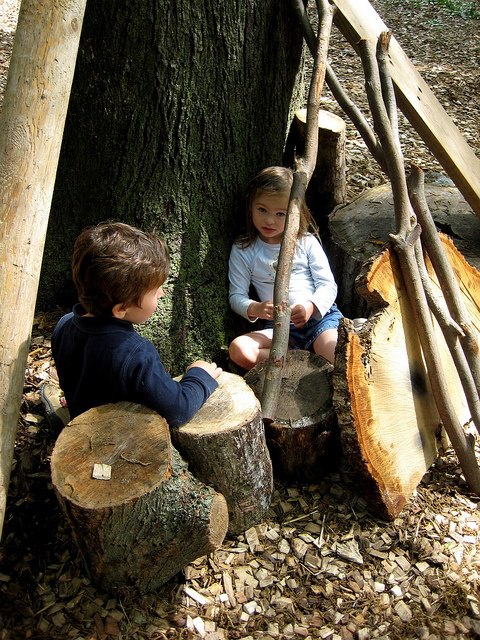
So when you were 10, 12, 15, could you be ‘annoying’? Could you be a ‘nuisance’?

I interviewed my grandmother recently about what she did as a young girl.

She is now nearly 90 and has led, I think it’s fair to say, an almost blameless life. Yet as a young girl her and her group of friends would run up to houses, knock on the doors and run away…

Well if the new Anti-social Behaviour, Crime and Policing Bill 2013-14 gets passed, behaviour that my grandmother got up to could conceivably land her with a criminal record.

I’m no expert on this sort of issue – I’m an ex-teacher, done some community development, and spent the last five years promoting and leading programmes and campaigning to get kids more freedom to play. But my colleagues at the Standing Commitee on Youth Justice are. As are the Association of Chief…

View original post 254 more words

Picpost: Home, sweet home

redcurrantsIt’s the time of year to harvest red currants around here and this week’s question comes from Frew T. Bunn of Oldham:

‘Our red currant bushes always lose their leaf colour in July or August, but the ribs of the leaves always stay green – are they suffering from some sort of disease?’

By the summer months red currant bushes are starting to lose their lustre, but the fact that the leaf ribs of yours remain green suggests a shortage of Magnesium, one of the ‘trace elements’ of importance to plant health. Commercial ‘Epsom Salts’ applied in the spring at around 65 grammes per square metre should improve matters, so try this next year.

My blackcurrants look like they'll give a good crop again this year

My blackcurrants look like they’ll give a good crop again this year

On the subject of currants, my black currants are dripping off the three bushes I have here in Old School Garden, and the family of blackbirds nesting in the courtyard is relieving us of some – literally pecking them through the netting of my too – small fruit cage!

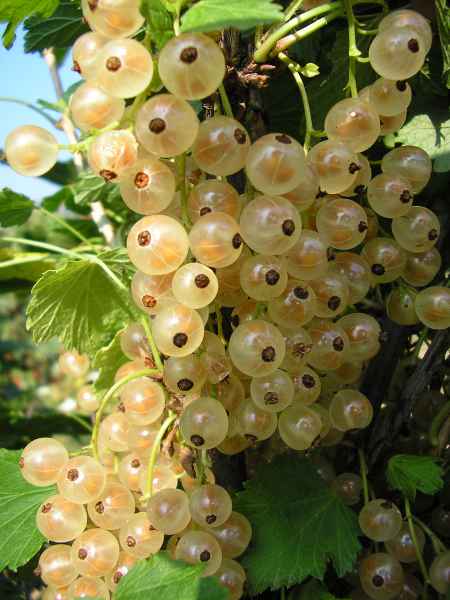
Have you ever thought of growing white currants?

They are apparently not difficult to grow and seem to have returned to favour in recent years. Like red currants (and black currants) they fruit on old wood. ‘White Versailles’ is a popular and reliable early variety, the first white currant to crop. It produces a heavy crop of large, shiny, soft pale yellow/white berries in long heavy trusses during mid-late summer. The fruit is deliciously sweet, not as acidic as red currant, so is great for eating fresh or using for a wide range of culinary purposes. White Versailles has a vigorous, upright bushy growth habit with attractive arching canes and serrated three lobed pale green leaves. It is a very reliable cropper year after year, is self fertile so you only have to grow one bush if you want to – eventual height and spread: 1.5m (5ft).

I’m thinking that I might reorganise my bush fruit cage and substitute one of the three blackcurrant bushes with a white currant, just to get a bit more variety and perhaps less of a storage problem, with the glut of black currants we’ve had in the last couple of years!

'White Versailles' - I thinki I'll try to get hold of one of these to replace one of the blackcurrant bushes

‘White Versailles’

Old School Gardener

If you’ve enjoyed reading this post and others on this blog, why not comment and join others by signing up for automatic updates via email (see side bar, above right ) or through an RSS feed (see top of page)?

PicPost: Mosaic

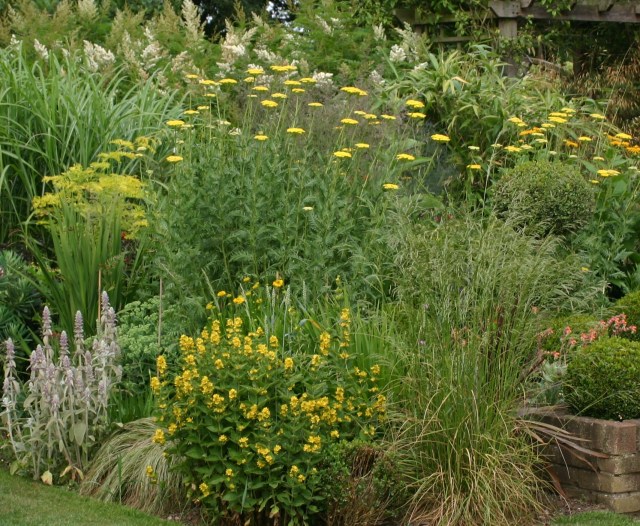
Achilleas coming into flower at the back of one of Old School Garden's borders

Achilleas coming into flower at the back of one of Old School Garden’s borders

The bright golden plates of Achillea are coming into bloom in Old School Garden and they look splendid, too. Achillea millefolium is commonly known as Yarrow – a name often applied to other species in the genus which is made up of about 85 flowering plants.

Achillea is native to Europe and temperate parts of Asia and a few grow in North America. Achillea can be mat-forming or upright perennials, mostly herbaceous, with sometimes aromatic, pinnately divided or simple and toothed leaves and flattened clusters of small, daisy-like flower-heads.  These heads of small flowers sit like mini helicopter pads at  the top of the stem, the flowers being white, yellow, orange, pink or red. The Achillea is a useful source of food for the larvae of some moths.

The genus was named after the Greek mythological hero Achilles. According to the Iliad, Achilles’ soldiers used yarrow to treat their wounds, hence some of its common names such as allheal and bloodwort. I somehow have the idea that the flower plates are also  reminiscent of Achilles’ ‘burnished shield’ (assuming he had one) and it’s this connection that I’m reminded of whenever I see them.

Some of the species names are:

A. alpina = of the alps or alpine

A. argentea = silvery white, referring to the foliage

A. compacta = compact

A. millefolium = thousand – leaved, the Yarrow or Milfoil

A. mongolica = Mongolian

A. montana = of mountains

A. ptarmica = from the greek ptarmos, meaning sneezing – the dried flowers were once used as snuff, otherwise knownas the ‘Sneezewort’

A. rupestris = growing on rocks

A. santolina = resembles the plant Santolina

A. serbica = of Serbia

A. tomentosa = downy foliage

Achilleas are traditional border flowers valued for their feathery foliage and striking flat, circular heads of flowers throughout the main summer season. They team well with other perennial flowers and are a vital ingredient of a traditional herbaceous border. They are also at home in island beds, cottage gardens and other perennial planting schemes.They look good with Leucanthemum and Kniphofia.

Sources and further information:

Wikipedia

How to grow Achillea

Achillea filipendulina

Article by Chris Beardshaw

Quizzicals: answers to the two clues given in Plantax 12…

  • Place in Oxfordshire painted a gaudy colour – ‘Blenheim Orange’
  • Tie up skinny coward – Bindweed

..and 2 more cryptic clues to the names of plants, fruit or veg…

  • Bovine stumble
  • Simpler tombola

Special thanks to Les Palmer, whose new book ‘How to Win your Pub Quiz’ was published recently. A great celebration of the British Pub Quiz!

Old School Gardener

If you’ve enjoyed reading this post and others on this blog, why not comment and join others by signing up for automatic updates via email (see side bar, above right ) or through an RSS feed (see top of page)?

deltagardener's avatarThat Bloomin' Garden

Yesterday I had the privilege of walking through Minter Gardens in Rosedale, BC. What a wonderful garden to visit with 32 acres of garden exquisitely designed. Minter Gardens has been open since 1980 and is obviously the passion of Brian Minter. The colours and design elements are outstanding. It was sad news when we heard recently that this garden would close in October of 2013. The garden is made up of twelve theme gardens with vistas I can only dream about.

minter gardens

The first one we saw was the lake garden with its beautiful waterfall. As we walked through the gardens it was a warm 31C and just seeing the water made it seem cooler outside.

DSC03561

What I loved about this garden is, it was like walking through a  series of garden rooms. You have to love this arbor and how it leads the eye way down to the arbor far…

View original post 461 more words

PicPost: Pallet Artwork

http://www.1001pallets.com/2013/07/pallet-artwork/

Keep the bird bath topped up in hot weather

Keep the bird bath topped up in hot weather

Well, yesterday was St. Swithin’s day and folk lore decrees that the weather on that day sets the pattern for the next 40, so we can ‘look forward’ to days in the mid to upper 20’s Celsius (and warm nights too):

‘St. Swithin’s day if thou dost rain
For forty days it will remain
St. Swithin’s day if thou be fair
For forty days ’twill rain nae mair.’

dost = does
thou = you
nae mair = no more.

And the forecasters seem to be saying this hot weather is likely to continue for the next couple  of weeks at least. So how can we care for the fragile eco systems that are our gardens? It’s all about moisture- using it wisely, keeping it in place in the plants and making sure wildlife has enough to survive. Here are 7 tips that might help:

1. Apply a mulch around plants that are most sensitive to water loss – grass clippings are ideal as they are light reflective (though you might well not have many that are usable in a heat wave- see tip 5 below). Straw is another option.

grass_mulching_tomatoes tiny farm blog

Grass mulching tomatoes from  tiny farm blog

2. Water your garden early morning or late evening (ideally from your own saved rainfall or ‘grey water’ forom the house) – morning is best as the plants need most of their water during the day time when they are growing. Leave a bucket or watering can full of water inside the greenhouse to help keep up humidity and so reduce the rate at which plants lose water through transpiration.

3. Get creative about shading your tenderest plants and crops – use shade netting, cloth, or fleece and maybe even think about using picnic awnings, table parasols and even tent poles with bedsheets!

movable awning

Movable awnings can bea useful shade for tender plants

4. If you need to plant out seedlings try to plant them alongside taller neighbours to help provide some protection, or even better hold off transplanting until the weather is more suitable – you can better care for seedlings in a container if you remember to water and shade them (and pot them into bigger pots if need be).

5. If you haven’t already stopped mowing your lawn then do so and leave at least 5 – 8cms of growth to help conserve moisture.

6. Avoid adding fertiliser to your ground as plants don’t need it in the heat as their growth rate slows.

7. Look after the wildlife – top up ponds, bird baths and drinking bowls for hedgehogs etc. and put out some food for these critters too, as it will be harder for them to find natural food like worms which bury themselves deeper into the ground.

Here’s hoping you and your garden survive the heat – how long before we Brits are hankering after a ‘traditonal’ Summer!

Old School Gardener

Finding Nature

Nature Connectedness Research Blog by Prof. Miles Richardson

Norfolk Green Care Network

Connecting People with Nature

Discover WordPress

A daily selection of the best content published on WordPress, collected for you by humans who love to read.

Susan Rushton

Celebrating gardens, photography and a creative life

Unlocking Landscapes

Writing, photography and more by Daniel Greenwood

Alphabet Ravine

Lydia Rae Bush Poetry

TIME GENTS

Australian Pub Project, Established 2013

Vanha Talo Suomi

The Journey from Finnish Rintamamiestalo to Arboretum & Gardens

Marigolds and Gin

Because even in chaos, there’s always gin and a good story …

Bits & Tidbits

RANDOM BITS & MORE TIDBITS

Rambling in the Garden

.....and nurturing my soul

The Interpretation Game

Cultural Heritage and the Digital Economy

pbmGarden

Sense of place, purpose, rejuvenation and joy

SISSINGHURST GARDEN

Notes from the Gardeners...

Deep Green Permaculture

Connecting People to Nature, Empowering People to Live Sustainably

BloominBootiful

A girl and her garden :)