 As this week is ‘International Compost Awareness Week’ I thought I’d do a little piece about the basics of composting. Hope you enjoy it and look at your own composting efforts!
1. What is compost?
Compost is organic matter that has been decomposed and recycled as a fertiliser and/or soil improver (it’s not the same as the bags of stuff you buy from the garden centre).
2. How does the composting process work?
There are 3 stages to the composting process:
Degradation – microbes feed off the various chemicals in organic waste (mainly carbon and nitrogen) – the abundance of these chemicals mean the microbes multiply rapidly, generating heat and so rasing the temperature of the decomposing material;. a new set of microbes that operate at a higher temperature take over the process.
Conversion – as the temperature in the waste material starts to drop as microbial activity declines, microorganisms that operate at lower temperatures take over and complete the decomposition process.
Maturation – microbial activity decreases and the material cools down, providing the ideal conditions for earthworms, insects and mites to complete the process. chemical reactions make the material more stable and suitable for use with plants in the garden.
Compost can be made in as little as six to eight weeks, or, more usually, it can take a year or more. In general, the more effort you put in, the quicker you will get compost.
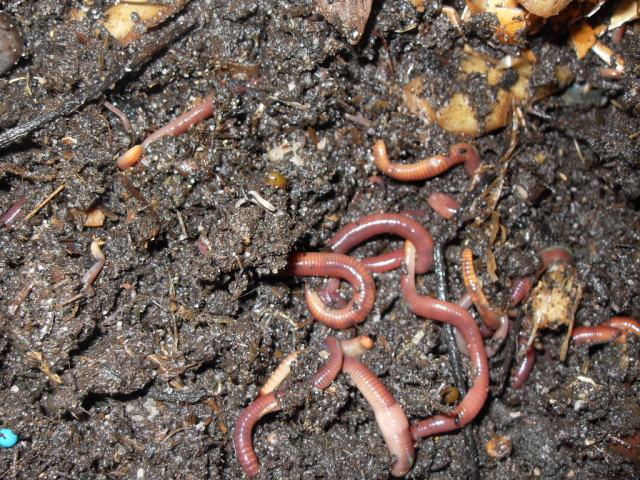
worms at work in compost-making
3. What is needed to make compost?
Composting organisms require four equally important things to work effectively:
- Carbon — for energy; the microbial oxidation of carbon produces the heat, if included at suggested levels
- High carbon materials tend to be brown and dry.
- Nitrogen — to grow and reproduce more organisms to oxidize the carbon.
- High nitrogen materials tend to be green (or colorful, such as fruits and vegetables) and wet.
- Oxygen — for oxidizing the carbon, the aerobic decomposition process.
- Water — in the right amounts to maintain activity without causing anaerobic conditions (this is the other sort of decomposition that is slower and operates in leaf mould).
Certain ratios of these materials will provide beneficial bacteria with the nutrients to work at a rate that will heat up the pile. As a general rule you should have a 50/50 mix of ‘browns’ and ‘greens’.
4. What is compost used for?
Compost can be rich in nutrients and is added to soil, supplying these as well as humus – a fine-textured material that improves soil strucure. It provides a rich growing medium, or a porous, absorbent material that holds moisture and soluble minerals, providing the support and nutrients in which plants can flourish, although it is rarely used alone, being primarily mixed with soil,sand, grit, bark chips and other materials to produce loam, the very best of growing mediums. Compost can be tilled directly into the soil or growing medium to boost the level of organic matter and the overall fertility of the soil. Compost that is ready to be used as an additive is dark brown or even black with an earthy smell.

Soil improving with compost
5. How old is the practice of composting?
Composting as a recognized practice dates to at least the early Roman Empire, since Pliny the Elder (AD 23-79). Traditionally, composting involved piling organic materials until the next planting season, at which time the materials would have decayed enough to be ready for use in the soil. The advantage of this method is that little working time or effort is required from the composter and it fits in naturally with agricultural practices in temperate climates. Disadvantages (from the modern perspective) are that space is used for a whole year, some nutrients might be leached due to exposure to rainfall, and disease-producing organisms and insects may not be adequately controlled.
6. I’ve heard that human urine is beneficial to compost making – is this true?
Human urine can be put onto compost (and it can be added directly to the garden as a fertiliser!). Adding urine to compost usually will increase temperatures (it is an ‘activator’) and therefore increase its ability to destroy pathogens and unwanted seeds. You can also compost:
- Anything that was once living, but some items are best avoided (see next question)
- For best results, use a mixture of types of ingredient. Remember the rough guide is to use equal amounts by volume of ‘greens’ and ‘browns’.
- Some things, like grass mowings and soft young weeds, rot quickly. They work as ‘activators’, getting the composting started, but on their own will decay to a smelly mess.
- Older and tougher plant material is slower to rot but gives body to the finished compost – and usually makes up the bulk of a compost heap. Woody items decay very slowly; they are best chopped or shredded first, where appropriate.

kitchen waste into the compost bin
7. What can’t I compost?
Basically, don’t compost things that will attract vermin, plus one or two other things that contain potentially harmful materials:
-
Meat
-
Fish
-
Cooked food
-
Coal & coke ash
-
Cat litter
-
Dog faeces
-
Disposable nappies

Compost bin – wooden with slatted, removable front for easy access
8. What sorts of composting are there?
There are basically two types of composting – hot and cool. If you generate a lot of waste material and quite often you can actively manage (turn) your compost pile to replenish the oxygen within it and so achieve high temperatures and rapid decomposition – ‘hot’ composting. If you produce less waste , less frequently then you are more likely to have a ‘cool’ composting system that doesn;t require as much turning, generates less heat and will take longer to decompose.
There are different scales of composting from large centralised sites through community schemes where local people collect green waste and compost it centrally to home and school – based composting using a range of different types of bin – old pallets used to construct a slatted wooden box, plastic bins, wormeries and so on. There’s a bin and system to suit most situations, so if you live in a flat and only have a balcony you can even compost on a small scale here.
9. Why should I compost?
As landfill space declines (and the cost of dumping into landfill for hard – pressed councils and taxpayers increases), worldwide interest in recycling by means of composting is growing, since composting is a process for converting decomposable organic materials into useful stable products. Apart from reducing landfill and greenhouse gases, composting provides a wonderful material for improving your garden or other growing areas.

Plastic Dalek compost bin
10. How can I start to compost?
You can make compost simply by adding compostable items to a compost heap when you feel like it. It will all rot eventually but may take a long time, may not produce a very pleasant end product, and could smell.
With a little extra attention – taking the ‘COOL HEAP’ route – you could improve things dramatically.
If you want to produce more compost in a short time, and are able to put more effort into it, follow the ‘HOT HEAP’ route.
So, why not create a compost heap, or if you want a neater solution make or buy a compost bin – there are various models on the market and in England you can get a discounted deal on some plastic bins. Think about the best site for your bin – and Get composting!
Sources and Links:
Wikipedia
Garden Organic
homecompsoting.org.uk
recycle now- composting
Royal Horticulural Sociaety- composting
Reducing wastelines and making earth – article about master composter training in Norfolk
Decorate your compost bin competition and other Compost Awareness Week events
Old School Gardener











 Old School Garden