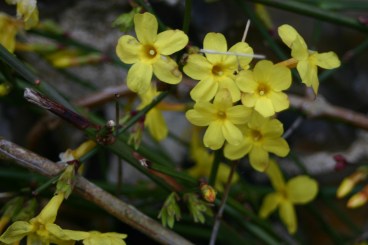
Looking good in Old School Garden at present – Winter Jasmine (Jasminum nudiflorum)
Planning your crops- to rotate or not to rotate…
Well, I guess that I’m sold on the benefits from rotation. Basically, you reduce the chances of persistent pests and diseases building up (which affect a particular plant or group of plants) and you manage the demands placed on the soil from different crops (and in the case of peas and beans actually stand to replenish, or if not that, then at least not deplete the store of Nitrogen).
Fine in theory, but it’s posed a real challenge to me in planning my crops in the kitchen garden. I’ve survived to date (just) with hasty diagrams on odd scraps of paper and scribbled ideas about what to grow where. To be quite honest, I’ve become muddled about what was previously grown in the different beds, what needs to follow what and whether I should manure, fertilise and/or add lime….sound familiar? With just the two of us at home to cater for it’s also been a bit difficult avoiding growing either too much or too little of the right things (generally the former).
Part of the problem is that my Kitchen Garden is divided up into a number of raised beds of different sizes and aspects, so it’s a challenge fitting things into the spaces available. I also feel that it’s important to max the growing potential by putting in follow-on crops once early harvests of things like Broad Beans, onions and early potatoes have been ‘garnered in’.
Then there’s the issue of focusing on what we like to eat (sounds simple, eh?). Over recent years we’ve had mixed results:
- some rather exotic looking French Beans which turned out a pretty yellow on the plant and then went a sort of beige when cooked- not inviting,
- peas -they seem to involve an awful lot of trouble for not much reward
- main crop potatoes– they take up a lot of ground and don’t taste that different from a large bag bought for a fiver…
So we’ve started to focus on the crops we like (with a bit of experimenting), things that can be expensive to buy, freezables for the winter months (Courgettes come to mind) and some particular varieties that ‘float our boat’- Mangetout for instance in preference to those whopper peas that pigeons seem to rather enjoy!
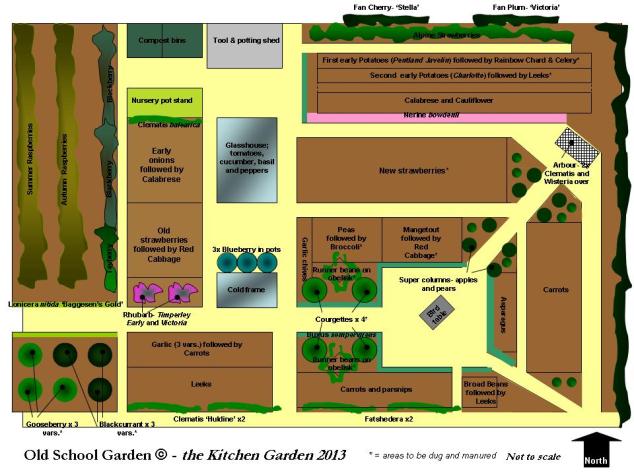
So yesterday (after pruning the apple trees), I spent a couple of hours drawing up a proper diagram of the plot, tried to think through what could go where (once I’ve taken permanent crops like fruit, Rhubarb and Asparagus out of the equation)- and also whether there’s potential for second crops in some areas, too.
I’ve tried to follow the rules on rotation (brassicas following legumes, potatoes following brassicas and onions and roots following potatoes), but I must admit it’s a bit hit and miss, taking all of the other variables into account! What’s your experience and do you have any sure- fire tips to help me?
At last, a cunning plan for food growing in 2013! (I hope)
P.S. A note on manure: if you can get some well rotted animal manure it could be good to either dig it into your beds or just lay some on top for the worms to incorporate into the soil. I’d be careful about putting it down everywhere though, as root crops like carrots and parsnips don’t like freshly manured ground (they tend to fork and not grow well in the heavier conditions that are created). However, ‘hungry’ cops like potatoes, brassicas (cabbages, calabrese, cauliflower, broccoli), courgettes, squashes and legumes (peas, beans) would all benefit from some, as would a greenhouse if you’re planning to grow tomatoes. Ideally it needs to be obtained and placed or dug in in the next few weeks in order for the weather to break it down and help to incorporate it into the soil.
Quizzicals: answers to the last two…
- Private part of a old crooner – Periwinkle
- The organ that enables you to say ‘2 plus 2 = 4’ – Adder’s Tongue
and just for fun two more ‘gardening ditties’:
‘Pepper’s got a brand new bag’
‘Spice Oddity’ (topical huh?- thanks Les)
Old School Gardener




 Old School Garden