Latest Entries »

Aly B's avatarAly Baumgartner

The history of science is full of interesting characters, and Carl Linnaeus certainly fits the bill. Known as the father of modern taxonomy, he was born in Sweden on May 23rd, 1707. He was only the second generation of the name Linnaeus. In fact, when his father enrolled in school he was required to take a family name (instead of using the patronymic name Ingemarsson) and he chose Linnaeus after a giant linden tree that grew on his family homestead. With a name like that, Carl seemed to be destined for biological greatness.

Linnaeus showed an interest in botany from a very young age. His father, an amateur botanist, encouraged his son’s enthusiasm. When he enrolled at the Lund University in 1727, he knew that botany was a very serious subject. He registered under the name ‘Carolus Linnæus’, the latinized form of his name. He later would use this form…

View original post 688 more words

PicPost: Not mushroom

Dragon Trees | Socotra Island | Republic of Yemen

Geranium 'Johnson's Blue'

Geranium ‘Johnson’s Blue’

Geraniums comprise over 400 species of annual, biennial and perennial plants commonly known as ‘Cranesbills’. They originate from around the globe.The perennials are very useful as border plants, with beautiful flowers. They are easy to grow, long lasting and are useful ground cover. Underplanted with spring bulbs, their leaves are good at hiding untidy bulb foliage after flowering. They also give new life to a border otherwise left bare when the spring bulbs are over.

They don’t like waterlogged soil and so in the wild you find them all habitats except boggy ones. They are a diverse group, varying in both hardiness and their growing needs. G. malviflorum is unusual in that it makes top -growth through the winter, flowers in spring and disappears until winter!
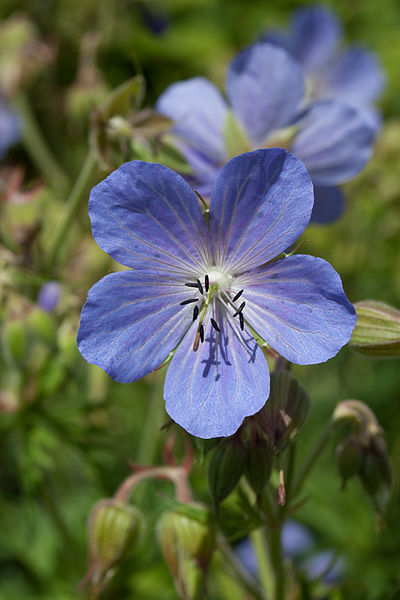
Geranium pratense (Meadow Cranesbill)

Geranium pratense (Meadow Cranesbill)

Geranium platypetalum

Geranium platypetalum

Geranium dissectum

Geranium dissectum

Most Geranium flowers are saucer-shaped, but can be flat or star like. They can come in umbels, panicles or cymes. They range in colour from white to dark plum through an array of pinks, blues and purples. Leaves are grouped around the base and the stem and are often deeply divided and toothed, and some are evergreen.

Many species are floppy or scramble and most need some sort of support to make them look reasonable. They all need shearing over the autumn/winter to encourage new basal growth, and some species, if sheared immediately after flowering will put on a second flush of leaves and flowers. Propagate by taking semi-ripe cuttings in summer, by seed, or by division in autumn or spring.
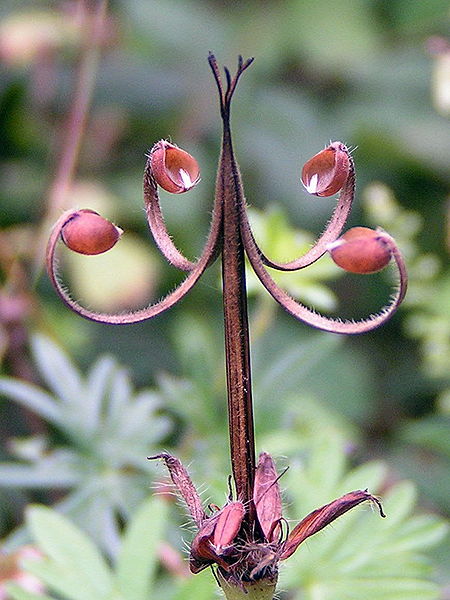
Geranium sanguineum showing 'bill' which aids seed dispersal

Geranium sanguineum showing ‘bill’ which aids seed dispersal

Most are drought tolerant and all are low in allergens. Some, such as G. nodosum and G. procurrens root when their stems touch the soil and G. thunbergii self seeds to a considerable extent, so should be deadheaded before the seeds form, if you want to restrict its spread.

Pelargoniums are often given the common name ‘Geranium’- both genuses are members of the Geraniaceae family. both were originally part of one family as defined by the botanist Linnaeus.

Geranium maculatum

Geranium maculatum

Geranium maderense

Geranium maderense

Further information:

10 AGM Hardy Geraniums for the garden- RHS

‘Geraniums- my hardy heroes’ – article by Bunny Guinness

Geraniums for shady places

National Collection of Geraniums- Cambridge Botanic Garden
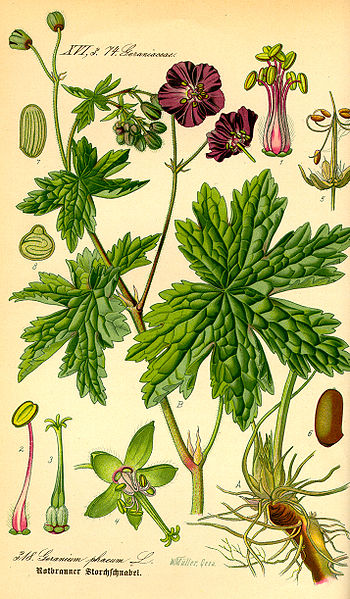
Geranium phaeum - from Thomé Flora von Deutschland, Österreich und der Schweiz 1885

Geranium phaeum – from Thomé ‘Flora von Deutschland, Österreich und der Schweiz’ 1885

Old School Gardener

If you’ve enjoyed reading this post and others on this blog, why not comment and join others by signing up for automatic updates via email (see side bar, above right ) or through an RSS feed (see top of page)?

An Oscar Winner?


‘The pargetting at 25-27 Church Street, Saffron Walden (below and featured in my recent post ‘Milling, Mazes and Millionaire Shortbread’), has just been shortlisted for the prestigious Museum + Heritage awards in the restoration and conservation category, the conservation equivalent of an Oscar according to owner, Douglas Kent.

Church St

The work involved the exterior pargetting, especially of two huge figures which, legend says, were the giants, Gog and Magog. Kent, however, has discovered that they were more likely to be taken from a novel by the 17th century owner and author, William Winstanley. ‘I knew they were in a parlous state but when we looked closely there were doubts they could be saved.’ New techniques and £30,000 have stabilised them – very important as the two figures are perhaps the most memorable feature of the town. Kent, who had no grants towards the work, has decided to paint them in a creamy off-white though they were probably buff coloured originally. He has also decided on three extra ‘Invitation to View’ opening days, Wednesday, June 26 at 2.30 pm; Thursday, August 1 at 11 am and Wednesday, September 4 also at 11 am. The winner of the award will be decided on May 1.’

Source: ‘Invitation to View’ Newsletter, April 2013

shinealightproject's avatarShine A Light

by Dayna Woolbright

Raindrops on roses and whiskers on kittens
Bright copper kettles and warm woollen mittens
Brown paper packages tied up with strings
These are a few of my favourite things…

I do love kittens but one of my favourite things that I have come across since working on the Shine a Light project is a Church Rood screen from St Gregory’s chapel in Norwich. St Gregory’s is located in the centre of Norwich on the historic Pottergate Street.

The Church is now open to the public but during a period of redundancy some of the important historical artefacts have been removed and loaned to the Norfolk Museums and Archaeology service, where they benefit from the care of trained conservators. Other than the screen NMAS also possess a brass lectern in the shape of an eagle, a 14th century door knocker in the form of a lion’s head…

View original post 678 more words

PicPost: Blood bath

PicPost: Stone age mouse

Chas Spain's avatarChas Spain

The Gisborne Garden full of gold and silver glimpses.

Have been out painting the outside of (another) house all weekend – absolutely knackered – so this is in honour of enjoying those arcadian afternoons when you can wander around someone else’s garden.

View original post

PicPost: Plotting

deltagardener's avatarThat Bloomin' Garden

Last week as part of the demonstrations at the Milner garden Party, I happened to visit the Kwantlen Polytechnic University Seed Library. Now I know what you are thinking, seed library, whats that?  Good question! The seed library opened to keep heritage seed varieties alive and to build interest in locally sourced sustainably grown food.

So how does someone use the seed library? There is no charge. The seed library asks that you return to the library with some saved seed from your own garden to make up for what you have taken. They want their seed library to keep on growing and supply gardeners for years to come.

What is a seed library?

I think this such a great idea. Just look at this file bursting with flower seeds. Think about it, when you buy package of something like onions seeds, do you use them all? Often there are almost 800-1000 seeds per package and…

View original post 187 more words

Finding Nature

Nature Connectedness Research Blog by Prof. Miles Richardson

Norfolk Green Care Network

Connecting People with Nature

Discover WordPress

A daily selection of the best content published on WordPress, collected for you by humans who love to read.

Susan Rushton

Celebrating gardens, photography and a creative life

Unlocking Landscapes

Writing, photography and more by Daniel Greenwood

Alphabet Ravine

Lydia Rae Bush Poetry

TIME GENTS

Australian Pub Project, Established 2013

Vanha Talo Suomi

The Journey from Finnish Rintamamiestalo to Arboretum & Gardens

Marigolds and Gin

Because even in chaos, there’s always gin and a good story …

Bits & Tidbits

RANDOM BITS & MORE TIDBITS

Rambling in the Garden

.....and nurturing my soul

The Interpretation Game

Cultural Heritage and the Digital Economy

pbmGarden

Sense of place, purpose, rejuvenation and joy

SISSINGHURST GARDEN

Notes from the Gardeners...

Deep Green Permaculture

Connecting People to Nature, Empowering People to Live Sustainably

BloominBootiful

A girl and her garden :)