
A short, easy to understand video from the UK Meteorological Office
A short, easy to understand video from the UK Meteorological Office
 iLandscape.com

A Roof Garden by Hugo Nicolle Design
A roof garden is any garden on the roof of a building. Roof gardens can be of ornamental value – especially in urban locations where no ground level garden is available. They can also play a part in:
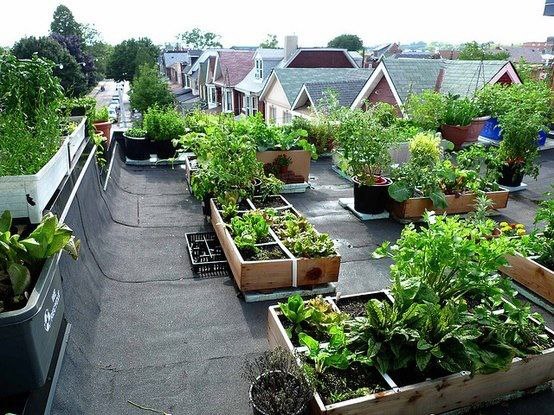
A great place to grow vegetables
Cultivating food on the rooftops of buildings is sometimes referred to as rooftop farming, and is usually done using special systems such as hydroponics, aeroponics/air-dynaponics or in containers. These systems can also help to reduce the stress on the roof that would otherwise have to carry a depth of soil over its whole surface. Sometimes as well as using the space on a roof, additional growing areas are added as ‘air bridges’ between buildings.


primarily the bearing capacity of the roof structure – this can be designed to be minimal, so really creating a ‘green roof’ (bearing about 100-300kgs per square metre) or ‘stepable’ (bearing over 300kgs per square metre)
prevention of roots and water penetrating the roof structure
the inclination of the roof (this should not exceed 30°)
the altitude of any attic, etc.
Roof gardens are likely to feature more and more in major cities – 80% of Singapore residents voted for more roof gardens in the City’s future plans. The containers/planters on a roof garden may be designed for a variety of functions and vary greatly in depth to satisfy aesthetic and recreational purposes. These planters can hold a range of ornamental plants: anything from trees, shrubs, vines, or an assortment of flowers. Where aesthetics and recreation are the priority roof gardens may not provide the environmental and energy benefits of a green roof.

A ‘green roof’ made up of various succulent plants
Once again you need to be aware of how much weight your balcony can take, so seek structural engineer or architect advice if you’re unsure. Balconies can be used for both ornamental or food plants, but it’s worth thinking about your layout before you start. To maximise growing space, suspend window boxes along the balcony edges, place soil-warming terracotta planters in the sunniest patches, and put lean-to shelves against the wall to accommodate extra pots. Here’s a video about setting up a balcony garden using permaculture principles.


For those who live in small apartments with little space, ‘square foot gardening’, or (when even less space is available) vertical gardens or ‘living walls’ can be a solution. These use much less space than traditional gardening – square foot gardening is said to use 20% of the space of conventional rows and ten times more produce can be generated from vertical gardens. These also encourage environmentally responsible practices – eliminating tilling, reducing or eliminating pesticides, and weeding, and encouraging the recycling of wastes through composting. Some of the most familiar vertical gardens are called ‘living walls’ – a concept where low growing and small plants are placed into a matrix which is then fixed to a wall. Such designs can be immense in size, covering the entire sides of buildings. They are also increasingly being used inside building spaces, such as foyers and receptions, to create a contemporary and eco-friendly ambiance. There is a trend towards more living walls in people’s homes. This has led to many companies now providing products which create a vertical garden to liven up the side of a house or patio, and platforms of pots which can be planted with herbs and vegetables on a balcony. Some of my own articles feature the use of old pallets for vertical planters and these too can be considered as ‘living walls’ and are a useful addition to conventional ground level gardens as well as homes which lack much outside space.
There are clear advantages to vertical gardens:
creating growing space where normal ground level space is restricted
offering a green outlook to those who want to avoid views of concrete and bricks
creating spaces which are beneficial to both mental and physical health
making it easy to grow food plants such as herbs and salads


RHS- roof gardens and balconies
6 green roofs you can relate to
Balcony Garden and rooftop garden ideas
Green Roof and Green Wall ona Sydney high rise building – David Eugene
If you’ve enjoyed reading this post and others on this blog, why not comment and join others by signing up for automatic updates via email (see side bar, above right ) or through an RSS feed (see top of page)?

Tombstone at Weybourne, Norfolk via http://www.ournorfolk.org.uk
Source: Dictionary of Phrase and Fable, E. Cobham Brewer, 1894
Source: Wikipedia

from Gardenphotos.com, via Growveg

‘Iron Man’ Gorilla outside the County Council tent- one of many hand painted gorillas that have just been put on display around Norwich in aid of a local children’s charity.


Before this afternoon stint I was able to stroll around, camera in hand, and soak up the atmosphere on this first of the two day show. Over both days the organisers are expecting around 90,000 people to attend, and they are aiming to ‘break even’ financially. It’s interesting that the show has managed to survive the tough financial times as some other county shows have folded completely due to dwindling attendances, not moving with the times or a lack of facilities to cope with poor weather. No signs of that at Easton, where there was a busy, joyful atmosphere, especially as the weather (until the very end of the afternoon) was warm and sunny.
 Definetely a day of hats…
  More hats/helmets…
  Summer hats…
  And more hats…
  Red and black… plus tea and cakes
  and other hats…
As expected the crowds were a curious mix of ‘old and new’, or perhaps more accurately, different social groups – the well dressed ‘County Setters’ in their blazers, shirts and ties, flowery hats and summer dresses (most involved in farming in some way), alongside groups of school children and more casually dressed families, teenagers and older couples. A microcosm of the local community in what remains predominantly a rural, agricultural County. Of course an agricultural show wouldn’t be the same without the ranks of huge and intricate machinery, some old, some brand spanking new as well as age-old crafts like horse shoeing and sheep shearing – including an impressive display by the Gressenhall Fam Manager, Richard Dalton, using a set of 100 hundred year old hand cranked clippers!
 Steam traction engine from yesteryear
  A trio of Fordsons not quite so old
  Morris Minor Van – on podium
  Big boy
  Horse shoeing display
  Dina and Hannah (in the red) attednignt o the Gressenhall sheep before they were shorn…
  Milking practice…
  Richard Dalton sheep shearing
It’s always impressive to see some of the ‘beasts’ entered for the various cattle, horse, pigs and other animal competitions and the efforts put into their grooming and presentation for the judges. On the horticultural front there was an impressive floral display in one marquee, including some delightful orchids, chrysanthemums and looser mixed arrangements of garden plants nicely in flower and leaf. There were also some amazing floristry displays and the usual competitions for different types of home grown fruit and veg- some impressive Gooseberries caught my eye in particular. I managed to come away from the Norwich and Norfolk Horticultrual Society ‘plant tombola’ with a hand full of very nice seed packets, so I now have a supply of purple Pansies, Amaranthus, Morning Glory and Carrots to add to my seed bank!
 Champion bull
  Champion cow
  Pigs being ‘persuaded’ to walk round the ring
  Guinea pigs looking rather ‘sheepish’- part of the Norfolk Industries for Disabled people stand – this social enterprise makes animal bedding.
  Turkeys
  One of the Cromer Crabs gathered from the sea that morning and destined for a restaurant in a couple of days time…
  A beautiful wild flower display
  Orchids
  Exotics – Cannas
  Elephants…
  You can cover almost anything with artificial grass…
  Floral design winner
  Hostas heaven
  Chrysanthemum combos looked super
And the varieties of food on offer reinforced the summery feel too – tumblers full of freshly cut fruit, strawberries and cream and of course ice cream a plenty. And not wasting food was one of the key messages of the Norfolk Waste Reduction Team’s display, which also hosted the Master Composter/Gardener stalls, along with some fascinating crabs illustrating the work of the Fisheries Conservation Agency. This was a great draw for the children who continually asked ‘which one is the most dangerous?’- in truth none of them really, as despite their fierce looking claws, the staff were able to pick them up to show the to the crowds without any apparent fear – or nipping!
 Prize winning Gooseberries
  Prize winning onions
  Strawberries and cream
  Fruit cocktails
My afternoon was spent talking to show goers about growing their own food and composting. I had some very interesting chats including a teacher from a local High School who teaches horticulture there and sounds to have a splendid school garden, several couples about starting or improving their compost, helping children to make paper pots and sow seeds to take home (along with all the other ‘trophies’ they collected from the stalls at the show), and other show goers clearly just enjoying growing their own food and with whom I shared tales of the late spring, compared potato growth rates and discussed rhubarb diseases. The next door County Council tent with which we were associated also put on a splendid carousel of displays and activities (including live music) illustrating the array of ways in which the Council serves Norfolk – in fact it (and we) were so good that the whole stand won the Show’s top prize for ‘trade’ stands, so congratulations all round!


If you’ve enjoyed reading this post and others on this blog, why not comment and join others by signing up for automatic updates via email (see side bar, above right ) or through an RSS feed (see top of page)?

When growing a vegetable garden its important to note how choosing the location of the garden has an effect on plant growth. I planted a raised bed of squash and zucchini plants at our community garden at least a week before my garden at home. Our community garden is in full sunshine and very open meaning its exposed to winds at all times.

But take a look at the plants in the beds today and you will see there is something seriously wrong. We have new soil but so does everyone else who gardens at the front of the garden and their plants are doing well. So the soil is most likely not a factor in why the plants aren’t thriving. I water regularly so that is not an issue. Here is my theory. I think that being at the very back of the community garden, the raised garden beds…
View original post 796 more words
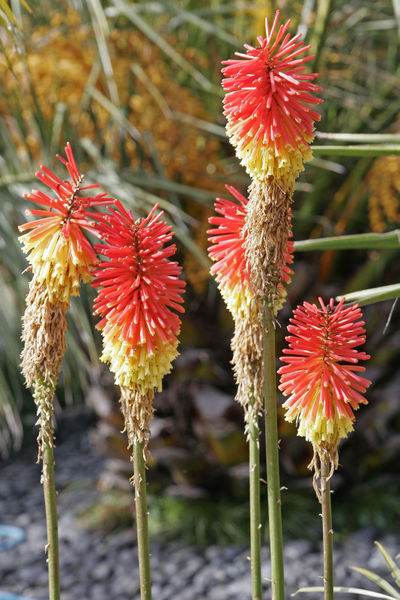 A genus of 70 or so rhizomatous perennials from central and southern Africa, Kniphofia – or ‘red hot pokers’ – can often be found in moist places; alongside river banks, in grasslands or mountainsides. They are also called tritoma, torch lily, knofflers or poker plant. The Kniphofia genus is named after Johann Kniphof, an 18th-century German physician and botanist.
Kniphofia form clumps, with arching, strap-like leaves. They can be evergreen or deciduous, the leaves of the deciduous varieties tending to be narrower and shorter than the evergreens. They thrive in any soil as long as it is moisture retentive, prefer sun but will tolerate light shade and can vary from tender to fully hardy. Many tolerate coastal conditions. Coming from South Africa, they are not completely hardy, particularly in the far north. For safety grow the more hardy evergreen varieties, where you should tie up the leaves over the winter, so protecting each other from frost. They are also susceptible to ‘wet feet’ – this is particularly bad in clay soils when they are also cold.


The flowers are cylindrical or tubular and usually hang down (‘pendent’), though in some varieties are upright. Flowers are borne well above the leaves in dense spike – like racemes. The flowers come in various colours, including green and toffee, but most of the commonly seen types open red and turn to yellow, giving the characteristic, bicoloured flower spikes.
Red Hot Pokers make good cut flowers. The flowers produce copious nectar while blooming and are attractive to bees and butterflies. In the New World they may attract sap-suckers such as hummingbirds and New World orioles. They are low in allergens.
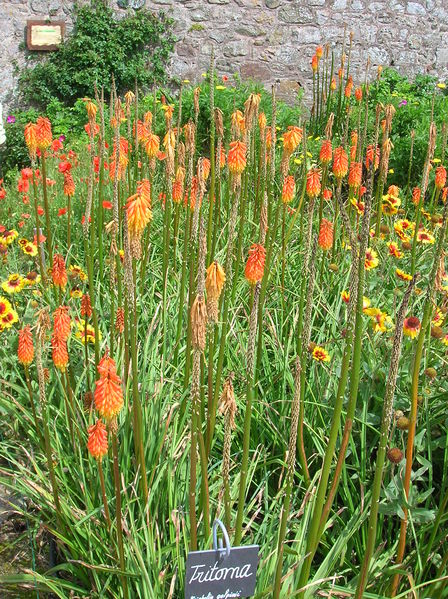
A group of Kniphofia or ‘Tritoma’
Red hot pokers seem to have suffered a bad press over the years, stemming from Victorian times when one influential garden writer (Shirley Hibberd) thought they were vulgar and that their use required “a little extra care to avoid a violation of good taste”.
Cultivars range from 50cm to 2 metres in height, and the taller ones may need staking. Late-summer flowers such as Crocosmias look good with them, as do different sorts of marigolds; e.g. ‘Touch of Red’ and ‘Art Shades’ which are ideal for a showy look. Salvia uliginosa combined with yellow or coral-coloured pokers gives a more subtle effect. They mix well in the border with other tall plants such as Alliums and Echinops. Sometimes a mixture of gaudy colours – Delphiniums, Alliums, Lilies and Knifophia – is quite attractive.
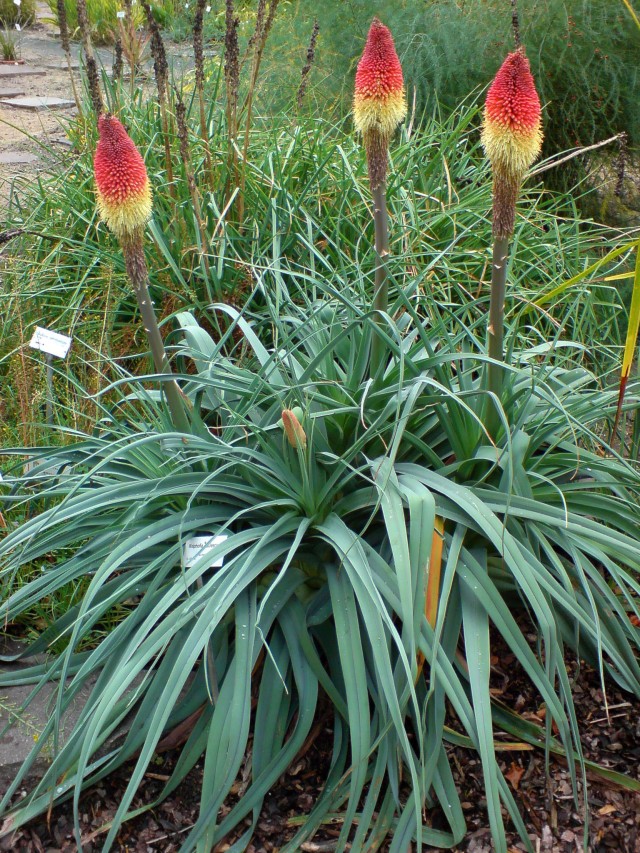
Kniphofia caulescens
You can grow them from seed quite easily using ordinary seed compost – just push the seeds partially into the compost in April, water and they will be transplantable by summertime. Once mature, after a year of growth, the plant is dividable to increase stock. Do this in late September, into pots of 50% compost 50% grit. Dividing is easy enough, they pull apart quite easily and you can simply pot them up. Leave the divided plants in pots in a cool but frost-free greenhouse, and replant in May the next year. When transplanting your Kniphofia, dig a hole that is about 20cm deep by 10cm wide, and half fill with 50% compost, 50% grit mixture and then top up with compost and plant in this. Each spring give them a mulch with good rich compost. You can also give them a liquid feed in June when they start to show signs of flowering. I have some in my long borders at Old School Garden and they are just coming into flower.
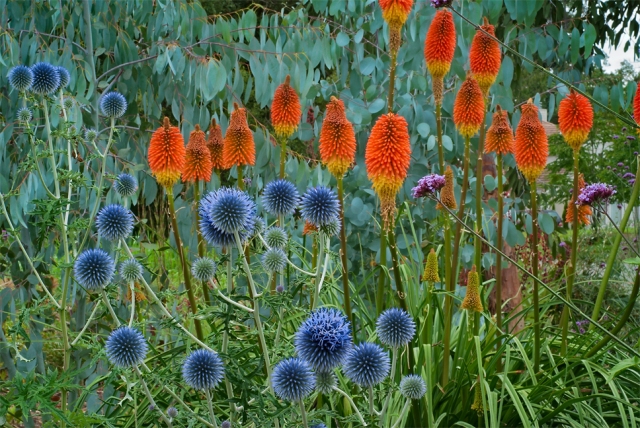
Kniphofia and Echinops. Photo- Jenny Cochran’s garden
Further information:
How to grow Kniphofias- Telegraph article
How to grow Kniphofias-Mirror article
RHS- Kniphofia ‘Bees Sunset’ and other links
If you’ve enjoyed reading this post and others on this blog, why not comment and join others by signing up for automatic updates via email (see side bar, above right ) or through an RSS feed (see top of page)?
Nigel Boldero aka 'Old School Gardener'
 | Nigel Boldero on Fighting to Reduce Climate Cha… |
 | Anonymous on Fighting to Reduce Climate Cha… |
| Anonymous on PicPost: Carrot, my foot! |
| 18 Surprising Hydran… on Plantax 16: Hydrangea the wate… | |
| Nigel Boldero on Poppyland: A Victorian romance… |
| Anonymous on Poppyland: A Victorian romance… |
| Anonymous on Plants to die for… |
 | Isabella Childress on PicPost: Forest, but not as we… |
 | Happiness Factor on Is child-friendly planning a l… |
 | zidane on Top Tip: On a Pedestal- make m… |





Nature Connectedness Research Blog by Prof. Miles Richardson
Connecting People with Nature
A daily selection of the best content published on WordPress, collected for you by humans who love to read.
Celebrating gardens, photography and a creative life
Writing, photography and more by Daniel Greenwood
Lydia Rae Bush Poetry
Australian Pub Project, Established 2013
The Journey from Finnish Rintamamiestalo to Arboretum & Gardens
Because even in chaos, there’s always gin and a good story …
RANDOM BITS & MORE TIDBITS
.....and nurturing my soul
Cultural Heritage and the Digital Economy
Sense of place, purpose, rejuvenation and joy
Notes from the Gardeners...
Connecting People to Nature, Empowering People to Live Sustainably
A girl and her garden :)


 Old School Garden