Latest Entries »

leeky boat

WP_20151112_14_20_33_ProThe ‘dynamic duo’ of Peter and I continued with strimming the avenues and connecting paths in the outer gardens at Blickling this week.

I arrived to find the gardeners and Peter gathered around a large, new trailer which had just been delivered. I later looked this over and had an interesting discussion about its features and how useful an addition it was going to be to the gardeners’ armoury….

Hmm...big, shiny, but how useful?

Hmm…big, shiny….

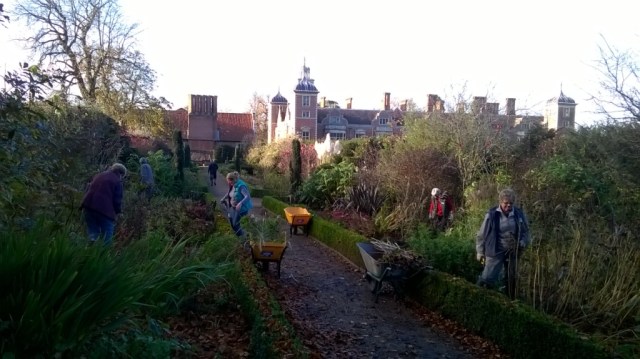
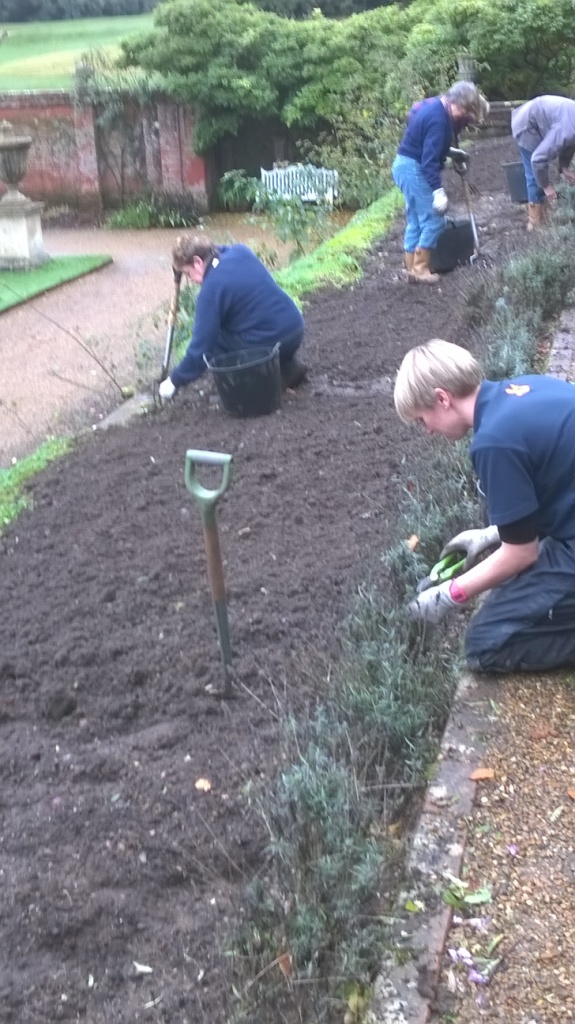
The ladies, meanwhile were finishing off cutting back and clearing the double borders, which only a few weeks ago had been resplendent in their late summer colours.

Cutting back the double borders on a beautiful autumn day

Cutting back the double borders on a beautiful autumn day

Having adjusted the belt on the strimmer I found I was really getting into my stride (or should I say ‘swing’?) with this useful machine- it was rather like old-time scything but without the muscle power needed for that. However, it was sweaty work clearing around trees and the edges of shrubs  where the mowers can’t reach.

After lunch I had an interesting chat with gardener Ed and Peter about the way the avenues of Beech, Oak and other trees have to be regularly cleared of fast-growing understorey trees and shrubs such as holly, yew and rhododendrons. The impact of letting these plants over grow the trees was evident in the bent over trunks of some examples (or ‘on the huh’ as we say in Norfolk!).

The maintenance plan involves every year or so stooling (or coppicing) these vigourous plants and so maintaining  space around the avenue trees. As Ed pointed out, there are some clear examples of where action is going to be required in the near future, so perhaps Peter and I will be moved on to chain saws soon!

Blickling has a new website, why not take a look at the link below?

A virtually deserted garden at a sun-scanned Blickling..

A virtually deserted garden at a sun-scanned Blickling..

Further Information:

Blickling Hall website

Blickling Hall Facebook page

A 360 degree tour of Blickling Hall

Old School Gardener


bird feeder

Old School Garden's Kitchen Garden cropping plan 2016

Old School Garden’s Kitchen Garden cropping plan 2016

It’s getting to that time of year when we ‘kitchen gardeners’ like to think about our plans for next year’s food crops. Here are a few thoughts on how to approach this with an eye on maximising what you get for your efforts and minimising costs and waste….


1. Grow only the crops you’ll eat (but also try out something new?)

2. Think ahead and work out how much time you can spend each week before deciding what to grow.

Maximise space by using vertical growing containers like this simple 'A' Frame made from pallets

Maximise space by using vertical growing containers like this simple ‘A’ Frame made from pallets

3. Draw up a cropping plan of what you will grow during which season and where in the plot, trying to avoid growing the same things in the same place as last year. And try to maximise the use of your plot by early sowings (e.g. Broad Bean, garlic and onion sets in the autumn) and late sowings (e.g. carrots, lettuce and other winter vegetables). Also, think about planting green manures to provide soil cover and which can be dug in as a soil feed before you sow your first crop of vegetables.


4. Choose pest and disease resistant varieties where available (but have an eye on quality too).


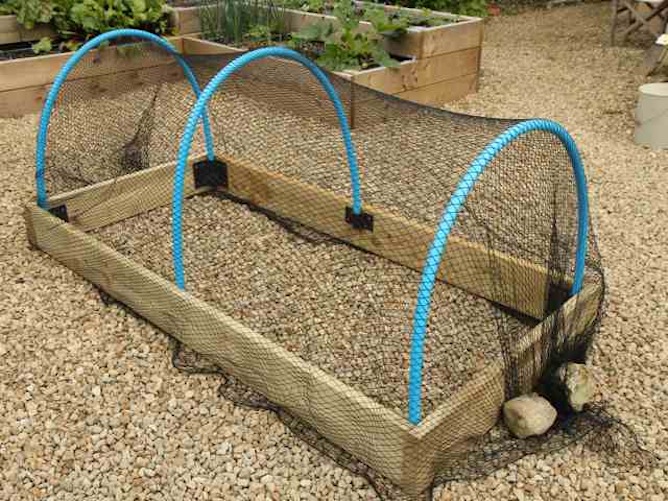
5. Invest in fruit cages and crop covers to protect your produce. Plastic plumbing pipe can provide a relatively cheap frame on which to fix various kinds of protection- including fleece and other material to help warm up your beds as well as keeping pests off.


Plastic pipes can provide a good frame for protection

Plastic pipes can provide a good frame for protection

6. Concentrate on growing fewer crops well.

7. Avoid growing too much of one thing or you’ll have waste to throw away (or perhaps pass on to neighbours). Grow small quantities at different times to avoid a glut (‘succession planting’); think about dividing up your plot into smaller parcels (maybe usuing ‘square foot gardening’) and grow varieties that aren’t ‘F1’ hybrids as their plants tend to produce at the same time.

'Square Foot Gardening' can help to manage the range, timing and amounts of produce

‘Square Foot Gardening’ can help to manage the range, timing and amounts of produce

8. Avoid crops that aren’t worth the effort-  either because they’re difficult to grow, unreliable performers or where the cost and quality of what you can buy in the shops makes it sensible to buy rather than grow your own.

Source: ‘Short Cuts to Great Gardens’- Reader’s Digest 1999

Old School Gardener

lizard


olive potsThe ‘O’ in my A-Z of garden trees is a tree that has grown in popularity in the UK in recent years, though is a little tender. I have an olive tree growing in a pot in the courtyard here at Old School Garden. It’s a couple of years old and though producing fruit, these have not yet developed into anything edible….

Common name: Olive

Native areas:  found in much of  Africa and the Mediterranean basin, the arabian peninsula, southern asia and has been naturalised in many other places.

Olive characteristics from the Kohler Medicinal Pflanzen

Olive characteristics from the Kohler Medicinal Pflanzen

Historical notes: The olive tree as we know it today had its origin approximately 6,000 -7,000 years ago in the region corresponding to ancient Persia and Mesopotamia. It later spread from these countries to nearby territories corresponding to present-day Syria and Israel.

Olive oil has long been considered sacred. The olive branch was often a symbol of abundance, glory and peace. The leafy branches of the olive tree were ritually offered to deities and powerful figures as emblems of benediction and purification, and they were used to crown the victors of friendly games and bloody wars. Today, olive oil is still used in many religious ceremonies.

 Features: Olives grow very slowly, and over many years the trunk can attain a considerable diameter. One was recorded as exceeding 10 m (33 ft) in girth. Olive is an evergreen tree or shrub. It is short and squat, and rarely exceeds 8–15 m (26–49 ft) in height, and are generally confined to much more limited dimensions by frequent pruning. The yellow or light greenish-brown wood is often finely veined with a darker tint; being very hard and close-grained, it is valued by woodworkers. 

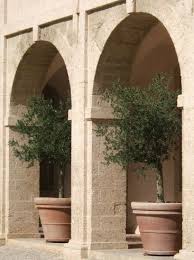
Uses:  As a small tree with a rounded form, the olive can take on an attractively gnarled appearance as it develops and is a good choice for small gardens. It has small, but attractive leathery grey-green leaves and small,  fragrant white flowers. They can be grown as half standards pruned to the classical Tuscan shape, or as full standards as well as more natural forms. They can benefit from a severe biannual prune in April, but as the fruit develops at the tips of the previous year’s growth you’ll sacrifice one year’s crop. These look especially good in teracotta pots and in Mediterranean style gardens.
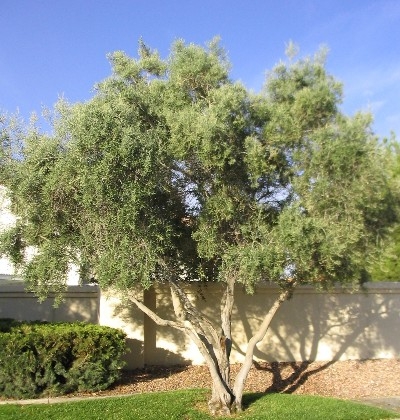
An Olive Tree in a garden setting

An Olive Tree in a garden setting

Growing conditions:  If you have a protected city garden or live in a mild area, olives can be grown outdoors as long as you give them a sunny position and plant them in well-drained soil, for example, against a warm wall would be ideal.  In cold or northern regions winter protection in a conservatory for example, will be required.

Once established they are extremely drought-tolerant, but plants will do better if watered regularly in dry spells during the growing seasons. To encourage strong growth, it’s a good idea to feed each spring with a general fertiliser, such as Vitax Q4. Olives naturally shed their older leaves in spring (April in the UK) as new growth begins.

Olives are not entirely hardy in the UK, and will be damaged by temperatures below -10°C (14°F). So, in colder areas of the country, you can grow olives in large (60cm, 24ins) diameter and depth) containers. Plant in a well-drained mix of compost, such as loam-based John Innes No 3 with 20 percent by volume added horticultural grit. You can place containers outdoors in summer and then move into a cold conservatory, porch or greenhouse over winter.

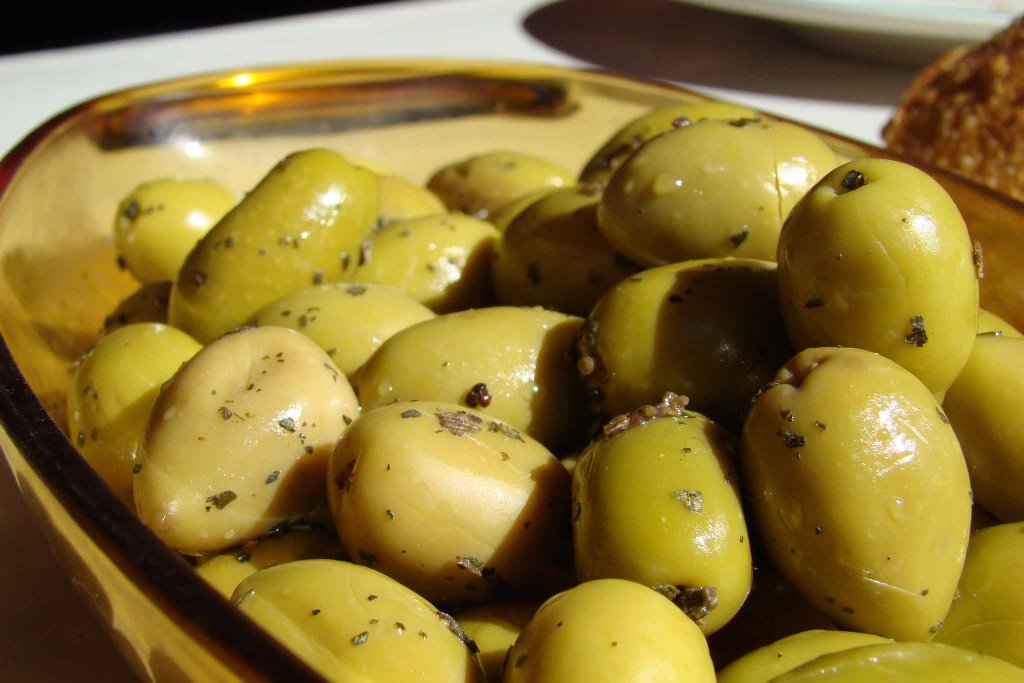
Olives ready to eat- Picture by K'm

Olives ready to eat- Picture by K’m

Although they can cope with dry periods, olives in containers need regular watering and feeding to produce fruit. During the growing season keep the compost moist and feed with a balanced liquid fertiliser such as Phostrogen or seaweed, every month. In winter, you can reduce watering, but don’t let the compost dry out completely.

Olive trees can live for several centuries and can remain productive for as long if they are pruned correctly and regularly. 

The Olive Tree of Jerusalem mural

The Olive Tree of Jerusalem mural

Further information:

Wikipedia

RHS- Olea europaea

Barcham trees directory- Olea europaea

‘The Olive Branches Out’- Daily Telegraph

Old School Gardener

Capture 2Capture 1Source: http://www.pressreader.com/bookmark/b8qNx4jmHxCAhI015mRv-vCye14JtGorv_vxoSDPCUM1/

Caloplac flavorubescens - picture Yoshihiro Ohno

Caloplac flavorubescens – picture Yoshihiro Ohno

Council homes, Stow Road, Ixworth

‘They called them ‘Thingoe’s Follies’ – the eight homes built on Stow Road in Ixworth, Suffolk, which formed the first council housing built (in 1894) in the English countryside. And so they were if the attempt to provide decent homes for some of the poorest in England – the agricultural working class of the day – was folly……’ read more at….

Source: Stow Road, Ixworth: ‘Thingoe’s Follies’

WP_20151105_12_20_46_ProMore strimming this week in my short session at Blickling.

The ladies were whisked away to pull up the Penstemons for over wintering and to make way for next spring’s display of Hyacinths.

WP_20151105_12_29_36_ProFellow volunteer Peter and I were sent to the wider gardens where the grass had been mown a few days before, but where the mower couldn’t go, we were to strim away the long grass around tree trunks and edges etc. There are several avenues of beech and other trees radiating away form the more formal gardens area and we worked our way along and around these.

As I’ve reported before, these strimmers are pretty strong and use a plastic-sheathed metal cord which is quite capable of cutting through pretty thick stems as well as grass. We were mindful of this and were careful not to go too near the trunks of the trees for fear of ‘ring-barking’ them, which causes wounds that are open to disease and rot.

WP_20151105_12_21_22_ProThe Hall has now closed for the winter (apart from special events and group visits) and the gardens are on shorter opening hours. The last colour of flower has now pretty much disappeared and the focus in the gardens is on cutting down, pulling out, dividing and mulching in preparation for winter.

Further Information:

Blickling Hall website

Blickling Hall Facebook page

A 360 degree tour of Blickling Hall

Old School Gardener


Finding Nature

Nature Connectedness Research Blog by Prof. Miles Richardson

Norfolk Green Care Network

Connecting People with Nature

Discover WordPress

A daily selection of the best content published on WordPress, collected for you by humans who love to read.

Susan Rushton

Celebrating gardens, photography and a creative life

Unlocking Landscapes

Writing, photography and more by Daniel Greenwood

Alphabet Ravine

Lydia Rae Bush Poetry

TIME GENTS

Australian Pub Project, Established 2013

Vanha Talo Suomi

The Journey from Finnish Rintamamiestalo to Arboretum & Gardens

Marigolds and Gin

Because even in chaos, there’s always gin and a good story …

Bits & Tidbits

RANDOM BITS & MORE TIDBITS

Rambling in the Garden

.....and nurturing my soul

The Interpretation Game

Cultural Heritage and the Digital Economy

pbmGarden

Sense of place, purpose, rejuvenation and joy

SISSINGHURST GARDEN

Notes from the Gardeners...

Deep Green Permaculture

Connecting People to Nature, Empowering People to Live Sustainably

BloominBootiful

A girl and her garden :)