Latest Entries »

canwefeedtheworld's avatarOne Billion Hungry: Can We Feed the World?

By Alice Marks

Story-2-SDGsSkimming the eye across the colourful chart of the Sustainable Development Goals (SDGs), it is easy to spot a couple which are intrinsically and directly linked to agriculture, but a closer look reveals that they are in fact all linked to agriculture. A healthy global agricultural sector underpins and supports so many aims of the SDGs that its development will be important for their overall success. As sustainable agriculture is essential for sustainable food systems and livelihoods, here is a breakdown of how agriculture, farming and nutrition fit into the first 7 goals

1. No Poverty

Over 70% of the world’s poorest people live in rural areas, and rely heavily on agriculture for their survival and livelihoods. According to the World Bank, evidence shows that GDP growth generated in agriculture has large benefits for the poor, and is at least twice as effective in reducing poverty…

View original post 958 more words

nook

canwefeedtheworld's avatarOne Billion Hungry: Can We Feed the World?

ID-10085673 Image by Ventrilock from freedigitalphotos.net

As 2016 begins many international development issues are threatening to intensify – the crisis in Syria and the thousands of people now refugees, the growing global power of ISIS, and the World Bank’s recently released flagship report, Global Economic Prospects, which predicts a “perfect storm” of financial turmoil coupled with slowing of growth in emerging markets this year. A recent article named the 10 news stories most likely to dominate the news this year as being:

  1. The Syrian refugee crisis
  2. Climate change
  3. Data security
  4. The US presidential election
  5. Regulating drones And self-driving cars
  6. Gun violence
  7. ISIS
  8. Global internet access
  9. Regulating the sharing economy (companies such as Airbnb and Uber)
  10. Online social justice

And while news organisations are looking ahead to the events that will shape the world in 2016, others are focused on how we can prevent and solve some of these global development…

View original post 491 more words

Number six in this series of posts on what makes gardening is all about learning and giving. We can learn about gardening in formal and informal ways and ‘on the plot’, in the classroom and online. For many, if not most gardeners, learning is usually informally, from other gardeners and especially through visiting other gardens. So my chosen object is an annual booklet of the NGS- the National Gardens Scheme (I’ve selected last year’s Norfolk booklet out of local loyalty). 

NGS-2015-bookletAs the organisation’s website explains, the National Gardens Scheme has a rich and interesting history that is closely connected with nursing in the UK. The origins of today’s sister organisations covering England and Wales, and Scotland go back over a hundred years…

In 1859, William Rathbone, a Liverpool merchant, employed a nurse to care for his wife at home. After his wife’s death, Rathbone kept the nurse on to help poor people in the neighbourhood. Later, Rathbone raised funds for the recruitment, training and employment of nurses to go into the deprived areas of the city.

Later in the Nineteenth Century, based on the idea of local nursing set up by Rathbone, `District` nursing spread across the country. With support from Florence Nightingale and Queen Victoria, the movement became a national voluntary organisation setting standards and training nurses.

Then, in 1926, the organisation decided to raise a special fund in memory of their patron, Queen Alexandra, who had recently died. The fund would pay for training and would also support nurses who were retiring.

A council member, Miss Elsie Wagg, came up with the idea of raising money for charity through the nation’s obsession with gardening, by asking people to open their gardens to visitors and charging a modest entry fee that would be donated.

The year after, in 1927, The National Gardens Scheme was founded.  Individuals were asked to open up their gardens for ‘a shilling a head’. In the first year 609 gardens raised over £8,000. A year later, the district nursing organisation became officially named the Queen’s Nursing Institute.

In 1980 the National Gardens Scheme Charitable Trust was established as an independent charity and since 2010, a different annual ‘guest’ charity has been chosen from recommendations from NGS volunteers.

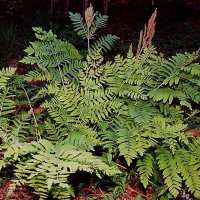
Woodlands,%20ferns,%20North%20EastWe opened Old School Garden up to the public in 2013 for one day (not as part of the NGS, but with proceeds going to three local good causes), so I know how much hard work, excitement and enjoyment comes from doing that (we might have another go one day…). I’m also an enthusiastic visitor to other gardens, as you’ll have seen from many posts on this blog!
And the charitable impact of this sort of scheme can’t be  overstated. Since its foundation, the National Gardens Scheme has donated over £45 million to its beneficiary charities, of which nearly £23 million has been donated within the last ten years (£15.2 million to Macmillan Cancer Support alone since 1985, being that charity’s largest donor).

So, the NGS is both a potent symbol of gardeners’ eagerness to learn – and to give.

 Old School Gardener

outofmyshed's avatarOut of my shed

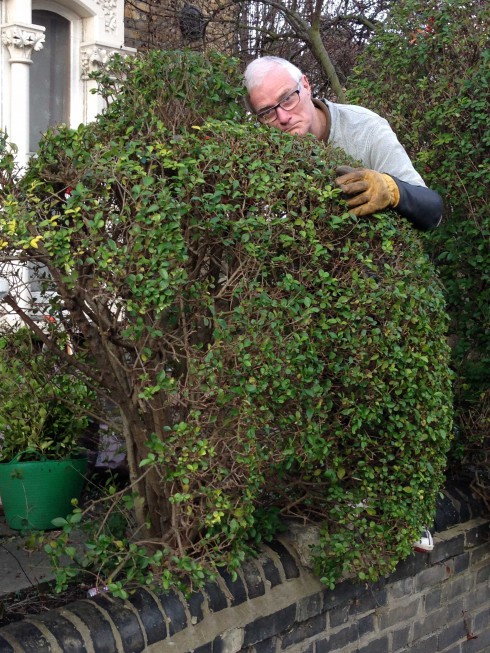
Tim and samll elephantHere’s Tim. Topiary Tim. He’s looking a bit sad. One of our elephants has had to go.

Baby and big elephant2Up until the end of last year, all was looking well in the herd. But then, fairly swiftly, telltale signs of honey fungus were spotted. There was dieback on the trunk and ears of the baby elephant.

At first we were in a state of denial. Maybe somebody had poured some nasty chemicals on the ground or perhaps wandered past with a flame thrower? But who were we kidding. We dug up roots of the wilting/dead trunk and ears, and our worst suspicions were confirmed. White fungus was clearly visible between the bark and wood.

Unfortunately, there is no cure for Honey Fungus. On the RHS website it says, ‘the only effective remedy is to excavate and destroy, by burning or landfill, all of the infected root and stump material. This will destroy the food base…

View original post 276 more words

A Baobab Tree- probably 2000 years old

A Baobab Tree- probably 2000 years old

horticultural_fleeceHorticultural fleece laid over plants can bring earlier crops and other benefits.

Fleece is a finely woven material that protects crops from wind and cold, and raises soil and air temperatures slightly, all helping plants to advance faster than unprotected crops. If it is anchored in the soil properly it also protects against flying pests, such as carrot root fly.

Because fleece allows water and air to penetrate, it reduces watering requirements and increases airflow around the plants. This encourages hardier growth and discourages disease build – up. If used carefully, fleece can last for many seasons.

Being porous, fleece does not warm the soil as well as plastic cloches or black plastic sheeting. It can also lay flat in wet conditions, making germination difficult, and it can easily tear on windy sites.

Fleece comes in all shapes and sizes, like this zip up jacket protector for tender shrubs by Harrod Horticultural

Fleece comes in all shapes and sizes, like this zip up jacket protector for tender shrubs by Harrod Horticultural

Other uses of fleece:

  • to extend the growing season, making maximum use of the garden

to improve the performance of half hardy crops, such as peppers

to produce softer, more palatable growth in vegetables that become tough with winter exposure, such as spinach and chicory.

In recent years another material called ‘Enviromesh’ has come on to the market. This fine-weaved plastic netting is strong and lasts for ages. It is fine enough to keep off small insects such as butterflies, carrot fly, flea beetles and leaf miners, and yet durable enough to keep pigeons off. It is also good frost and wind protection. I use it here in Old School Garden, both early in the season to protect young crops and also later as a useful cover for raspberries and other bush fruit which is otherwise unprotected against birds. The downside is that it is more expensive than fleece, so shop around!

Enviromesh tunnel using pegs to hold it down- picture Enviromesh Ltd.

Enviromesh tunnel using pegs to hold it down- picture Enviromesh Ltd.

Alternatives which can do pretty much the same job are old net curtains (you can get off white ones relatively cheaply from charity shops) or builder’s netting used around scaffolding or to protect against falling debris.

Sources and further information:

Gardeners’ Advice- RHS Wisley Experts, Dorling Kindersley 2004

Alys Fowler- Netting

Old School Gardener

Black Dragon Hibiscus

Black Dragon Hibiscus

Potted_bulbsMore and more garden plants are available from garden centres in flower. If bought in bud, potted bulbs, such as dwarf daffodils, crocuses, hyacinths and tulips, allow you to instantly transform an otherwise dull border into a colourful, early spring centrepiece. This is particularly useful for adding colour to prominent beds near to the house.

Source: ‘Short Cuts to Great Gardens’- Reader’s Digest 1999

Old School Gardener

Finding Nature

Nature Connectedness Research Blog by Prof. Miles Richardson

Norfolk Green Care Network

Connecting People with Nature

Discover WordPress

A daily selection of the best content published on WordPress, collected for you by humans who love to read.

Susan Rushton

Celebrating gardens, photography and a creative life

Unlocking Landscapes

Writing, photography and more by Daniel Greenwood

Alphabet Ravine

Lydia Rae Bush Poetry

TIME GENTS

Australian Pub Project, Established 2013

Vanha Talo Suomi

The Journey from Finnish Rintamamiestalo to Arboretum & Gardens

Marigolds and Gin

Because even in chaos, there’s always gin and a good story …

Bits & Tidbits

RANDOM BITS & MORE TIDBITS

Rambling in the Garden

.....and nurturing my soul

The Interpretation Game

Cultural Heritage and the Digital Economy

pbmGarden

Sense of place, purpose, rejuvenation and joy

SISSINGHURST GARDEN

Notes from the Gardeners...

Deep Green Permaculture

Connecting People to Nature, Empowering People to Live Sustainably

BloominBootiful

A girl and her garden :)