Latest Entries »

A bit of cheating again! My seventh object in this series about the essence of gardening is really at least two objects with a common name- compass or compasses. For me these two objects symbolise the importance of design in gardening- the conscious act of choosing and positioning what plants and other garden elements are used and where.

This can be as simple as thinking about where to place different plants or elements in the garden; by knowing where the prevailing weather patterns are coming from (wind and rain), as well as the direction and strength of light and heat from the sun. For this a magnetic compass is a very useful to back up to observation and wider knowledge.

Picture by Bios-commonswiki

Picture by Bios-commonswiki

And nature has it’s own ‘compasses’, too. The plant  Silphium laciniatum, has a common name of ‘Compass plant’  inspired by the “compass orientation” of its leaves. The large leaves are held vertically with the tips pointing north or south and the upper and lower surfaces of the blades facing east or west. A newly emerging leaf grows in a random direction, but within two or three weeks it twists on its petiole clockwise or counterclockwise into a vertical position. Studies indicate that the sun’s position in the early morning hours influences the twisting orientation. This orientation reduces the amount of solar radiation hitting the leaf surface. Vertical leaves facing east-west have higher water use efficiency than horizontal or north-south-facing blades. Early settlers on the Great Plains of the North America could make their way in the dark by feeling of the leaves.
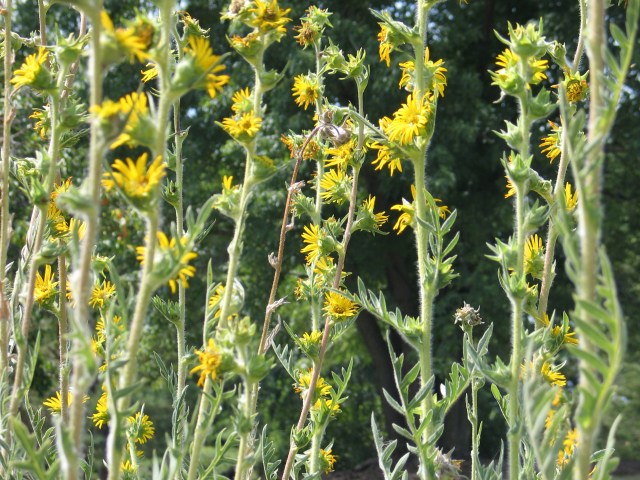
Silphium laciniatum- 'Compass plant'

Silphium laciniatum- ‘Compass plant’

Equally, garden design can involve recording your current plot and devising new elements and patterns for your garden (borders, paths, specimen plants, hard landscaping features). For this, a pair of compasses is a vital tool in plotting key elements in your existing garden (through the technique of triangulation) and also in drawing circles or arcs in a new design (and then setting these out on the ground).

Dividers and compasses are drawing instruments that have been used since antiquity to measure distances, transfer lengths from one drawing to another, and draw circles. The Greek mathematician, Euclid, limited the constructions in his Elements of Geometry to those that could be done with an unmarked straight edge and rudimentary compass. Ancient Roman dividers survive in the collections of the British Museum. Before the 18th century, when one leg was modified to take a pen or pencil point, compasses had two sharp points, like dividers. The user scratched the writing surface in the shape of a circle and then inked the scratches.
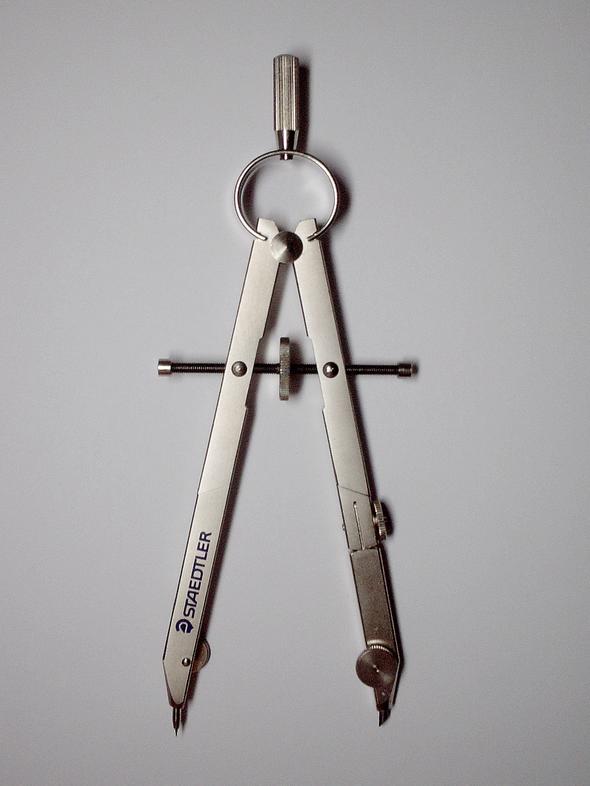
compasses

 Old School Gardener

pond heaven

More trenching this week, but we managed to finish this off...

More trenching this week, but we managed to finish this off…

In my first session of the New Year at Blickling the cold weather had arrived. My colleague Peter and I braved the wet snow to help Mike in the Walled Garden, by finishing off the trenching needed to put in the oak edging for the cross paths in two of the quarters in the new layout.

I was slightly embarrassed to hear that most of the other volunteers had already had a session last week, which I missed (having phoned in to discuss whether to come in with head Gardener, Paul). I thought the weather would put paid to any productive gardening. I was wrong! the team had begun the painstaking work of cleaning off sooty mould from the leaves of the orange and lemon trees in the orangery, so there are some inside jobs for bad weather days!

The ladies continued with this work this week. Peter and I made good progress, and as it was my birthday, I decided to leave after completing the trenching to go home to a nice birthday lunch and peaceful afternoon in front of the woodburner! Incidentally, I held back taking in birthday cakes as I wasn’t sure how many volunteers would be in, so that treat awaits the team next week!

Peter takes a break amidst a gloomy day in the Walled Garden

Peter takes a break amidst a gloomy day in the Walled Garden

Project Manager Mike and gardener Rob continued concreting in the metal uprights which will carry the wires alongside the main paths in the walled garden, where an apple tunnel and other trained fruit bushes will be grown. Though perhaps the Walled Garden doesn’t look much different to how it did on my first day at Blickling (exactly a year ago), on reflection an awful lot of foundation work has been achieved (including drainage and water supply put in, path edging as well as remedial pruning to fan trained fruit), and a good crop of fruit and veg from one side border to boot.

Some of the oak edging in place; hopefully this will all be in by next week

Some of the oak edging in place; hopefully this will all be in by next week

The latest big project is the removal of the rotting wooden and glass roof and walls to the second greenhouse, which will be renovated with anew structure in the next month or two. This, alongside the other Greenhouse, which was renovated last year, will provide a superb pair of facilities for raising and protecting plants, and I get a real sense that this coming year we will start to see the main beds populated and productive.

Mike is giving a talk to the Estate volunteers about the Walled garden Project this week, and I’m looking forward to hearing his review of progress and plans for the coming year.

Further Information:

Blickling Hall website

Blickling Hall Facebook page

A 360 degree tour of Blickling Hall

Old School Gardener


john aspley

Picture by John Aspley

It’s been a while since I put together a selection of outdoor projects using pallets and other recycled materials, so here’s a trawl from the wonderful Facebook site ‘1001 Pallets’.

This slideshow requires JavaScript.

Old School Gardener

Floral Treat

On my Christmas visit to Portugal I was rather taken by the florists’ displays at the Timeout Market in Lisbon and at the Forum in Almada…

Old School Ga

Portland inspiration between the paving Ernst Fuller GardensBefore starting to lay foundations for a paved area, decide on the position of plants around a terrace or patio and in planting pockets within the space and leave the areas free of foundation material and paving (wooden shuttering can be used for larger areas). Once the works are over, replace the topsoil of the planting areas with John Innes number 3 compost (and grit if you’re putting in things like Thymes). This will ensure a weed free growing medium with the right nutrients so plants establish quickly.
Source: ‘Short Cuts to Great Gardens’- Reader’s Digest 1999

Old School Gardener

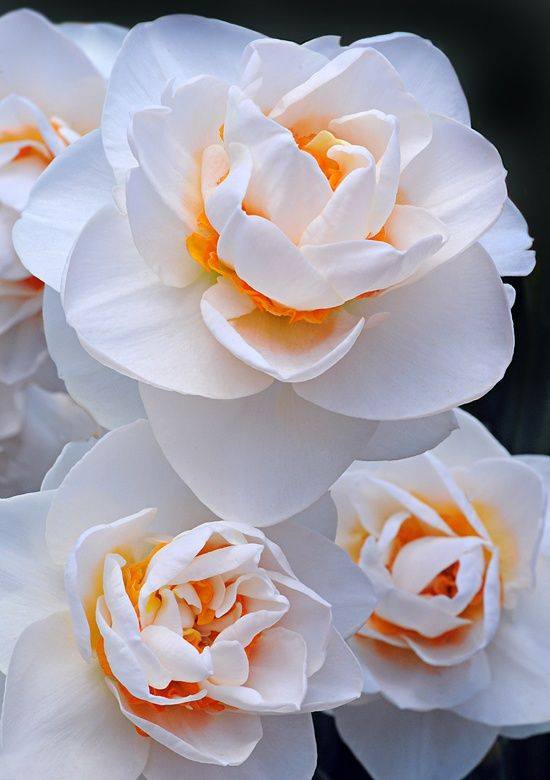
Double Daffodil by Cindy Dyer

Double Daffodil by Cindy Dyer

1280px-Rowan_tree_20081002b by Eeno11This wonderful tree, native to the U.K., is often associated with Scotland. It certainly suits bird life as the profuse red autumn berries provide a lot of autumnal sustenance. As they are not regular in shape,  the parent Rowan can be grown as a multi-stemmed specimen to achieve more uniformity of shape, or alternatively one of it’s clones, such as Sorbus aucuparia ‘Rossica Major’ can be used.

Common name: Rowan , Mountain Ash (due to the fact that it grows well at high altitudes and its leaves are similar to those of the ash, Fraxinus excelsior – however, the two species are not related). It’s latin name is composed of Sorbus for ‘service tree’ and aucuparia, which derives from the words ‘avis’ for “bird” and ‘capere’ for “catching” and describes the use of the fruit of S. aucuparia as bait for fowling. 

Native areas: The Rowan can be found in almost all of Europe and the Caucasus up to Northern Russia and Siberia, but it is not native to Southern Spain, Southern Greece, Sardinia, the Balearic Islands, the Azores, and the Faroe Islands. The species was introduced as an ornamental species in North America.

Historical notes: Fruit of S. aucuparia were used in the past to lure and catch birds. To humans, the fruit are bitter but they can be debittered and made into compote, jelly, jam, a tangy syrup, a tart chutney, or juice, as well as wine and liqueur, or used for tea or to make flour. The robust qualities of S. aucuparia make it a source for fruit in harsh mountain climate and Maria Theresa of the Austrian Habsburg Monarchy recommended the planting of the species in 1779.

The colour red was considered to be the best colour for fighting evil, and so the rowan, with its bright red berries, has long been associated with magic and witches. Its old Celtic name is ‘fid na ndruad’, which means wizards’ tree. In Ireland it was planted near houses to protect them against spirits, and in Wales rowan trees were planted in churchyards. Cutting down a rowan was considered taboo in Scotland. The wood was used for stirring milk to prevent it curdling, and as a pocket charm against rheumatism. It was also used to make divining rods.

The tallest S. aucuparia in the United Kingdom stands in the Chiltern Hills in South East England. This exceptional specimen is 28 m tall and has a trunk diameter of 56 cm.

Features: Sorbus aucuparia occurs as a tree or shrub that grows up to between 5 and 15 m in height. The crown is loose and roundish or irregularly shaped but wide and the plant often grows multiple trunks. The trunk is slender and cylindrical and reaches up to 40 cm in diameter, and the branches stick out and are slanted upwards. The bark of a young S. aucuparia is yellowish grey and gleaming and becomes grey-black with lengthwise cracks in advanced age; it descales in small flakes. Lenticels in the bark are elongated and coloured a bright ochre. The plant does not often grow older than 80 years and is one of the shortest-lived trees in a temperate climate.

6092500778_965c21d14d_bUses:   Rowans are planted in mountain ranges to fortify landslides and avalanche zones. It is also used as an ornamental plant in parks, gardens, or as an avenue tree. It is well suited to wildlife gardens. Cultivars are vegetatively propagated via cuttings, grafting, or shield budding. Ornamental cultivars include:

‘Asplenifolia’, which has divided and sharply serrated leaflets

‘Blackhawk’, with large fruit and dark green foliage

‘Fastigiata’, an upright columnar form

‘Fructu Luteo’, orange yellow fruit

‘Michred’, brilliant red fruit

‘Pendula’, which is a weeping tree

‘Sheerwater Seedling’, upright and slender, has vigorous growth, good-sized leaves and reliable and plentiful berries. It has been used as a street tree and is ideal for sites with little sideways space 

‘Xanthocarpa’ has orange yellow fruit

Growing conditions:  S. aucuparia is an undemanding species and can withstand shade It is frost hardy and can tolerate winter dryness and a brief growing season.  The plant is also resistant to air pollution, wind, and snow pressure. S. aucuparia mostly grows on soil that is moderately dry to moderately damp, acidic, low on nutrients, sandy, and loose. It often grows in stony soil or clay soil, but also sandy soil or wet peat. The plant grows best on fresh, loose, and fertile soil, prefers average humidity, and does not tolerate saline soil or waterlogging. It can be found in light woodland of all kinds and as a pioneer species over fallen dead trees or in clear cuttings, and at the edge of forests or at the sides of roads.

Mature S. aucuparia autumn colour

Mature S. aucuparia autumn colour

Further information:

Wikipedia

RHS- Sorbus aucuparia

Sorbus aucuparia- the Woodland Trust

Growing S. aucuparia ‘Sheerwater Seedling’- Daily Telegraph

Barcham trees directory- Sorbus aucuparia

Old School Gardener

Finding Nature

Nature Connectedness Research Blog by Prof. Miles Richardson

Norfolk Green Care Network

Connecting People with Nature

Discover WordPress

A daily selection of the best content published on WordPress, collected for you by humans who love to read.

Susan Rushton

Celebrating gardens, photography and a creative life

Unlocking Landscapes

Writing, photography and more by Daniel Greenwood

Alphabet Ravine

Lydia Rae Bush Poetry

TIME GENTS

Australian Pub Project, Established 2013

Vanha Talo Suomi

The Journey from Finnish Rintamamiestalo to Arboretum & Gardens

Marigolds and Gin

Because even in chaos, there’s always gin and a good story …

Bits & Tidbits

RANDOM BITS & MORE TIDBITS

Rambling in the Garden

.....and nurturing my soul

The Interpretation Game

Cultural Heritage and the Digital Economy

pbmGarden

Sense of place, purpose, rejuvenation and joy

SISSINGHURST GARDEN

Notes from the Gardeners...

Deep Green Permaculture

Connecting People to Nature, Empowering People to Live Sustainably

BloominBootiful

A girl and her garden :)