Latest Entries »

canwefeedtheworld's avatarOne Billion Hungry: Can We Feed the World?

By Alice Marks

13950908853_b4cba2cd9e_o Using drones for agriculture. Credit: Lima Pix (Flickr)

According to experts at the recent World Economic Forum in Davos, we are sitting on the edge of the Fourth Industrial Revolution. This revolution builds on the third, which was the digital revolution, and is predicted to blur the lines between the physical and digital world through innovations such as artificial intelligence, 3-D printing, nanotechnology, and the use of Big Data, which will integrate digital technologies into daily lives ever more closely. It is predicted to be exponentially fast and far reaching in its scope and impact, transforming entire production, governance and management systems in an unprecedented way. Whether this will mean “promise or peril” for humanity will likely only be clear with the benefit of hindsight, but optimists hope that it offers the opportunities to improve lives and help to eradicate poverty through improved connectivity and…

View original post 593 more words

Levelling up the new cross paths was this week's focus.

Levelling up the new cross paths was this week’s focus.

Having dug out channels for the oak edging to some paths in the Walled Garden in previous weeks, my colleague Peter and I had a day filling in the paths with soil in readiness for these to be put to grass.

It was hard work shifting sticky soil from a huge pile 100 yards away from the paths. These will form access ways across the four major quarters of the garden and will be grassed over- Project Manager Mike is yet to decide whether to turf or seed them.

In contrast to our previous session, today the weather was sunny and ‘crispy cold’ and the exercise (including arm extension from barrowing heavy loads!) was refreshing, if tiring. Two days on and I’m still feeling the effects on my shoulder muscles.  The first line of metal posts has been installed along one side of a quarter and with a nice dark mulch underneath starts to really define the shape of the garden.

Metal posts installed and mulched underneath in readiness for fruit planting

Metal posts installed and mulched underneath in readiness for fruit planting

It was also encouraging to see the progress on restoring the building in the corner of the walled garden which is to become a new ‘Gardeners’ Bothy, plus office and shop. This is expected to be finished by March, when a new crop of volunteers begins work; the recent ‘Volunteer Recruitment Day’, seems to have been a great success.

The roof well underway on the new 'bothy'- pic Blickling Estate

The roof well underway on the new ‘bothy’- pic Blickling Estate

Further Information:

Blickling Hall website

Blickling Hall Facebook page

A 360 degree tour of Blickling Hall

Old School Gardener


Tulip 'Harborlight'

Tulip ‘Harborlight’

This object is all about constructing a garden or shaping the ground. I thought a good choice would be another tool, a ‘half moon’, used for creating edges to lawns or giving shape to borders.

half-moon-lawn-edger1It’s great thinking about and perhaps drawing up your garden design ideas, but even better putting them into action. Sometimes (perhaps more often than I care to admit), I find the design process is more satisfying by going out, looking at the garden, grabbing your tools and shaping or constructing things there and then. A bit risky sometimes if you don’t fully appreciate the impact of your ‘on the spot’ decisions on the rest of the garden. However, when using a half moon, perhaps in combination with a nicely curving hose pipe as a guide, it is really satisfying seeing the new, crisply flowing line of a border with its freshly dug soil, emerging from the adjoining grass.

Alas, my opportunities for this here in Old School Garden are getting fewer, as I move from an expansionist phase to one focused on creating a more manageable garden, and if anything, reducing the amount of planted space and to put back easier to maintain lawn and hard surfacing…but don’t mention this to my wife!

If you’ve been reading other posts in this series, you know that sometimes I’ve pushed the rules and included a couple of objects with the same name. Once more- by accident I hasten to add– I find myself toying with another sort of ‘half moon’. Yes, the astronomical variety, no less. That opens up a whole new area of ‘gardening essence’, well at least for some growers. Gardening according to the phases of the moon is a fascinating approach which you can use to guide when you plant different things for maximum health and vigour. As Lila Das Gupta says:

‘In a nutshell, people who garden by the phases of the moon believe that its gravitational pull on the earth’s water (i.e. tides), has a bearing on plant growth. They never plant anything when the moon is waning in the last quarter because it’s believed that the earth’s water table is receding. After the new moon, the water table rises again and planting can resume. Farmers on the continent have been using moon phases to guide them for years, as indeed have many gardeners in the UK.

You don’t need to spend money on any special equipment. My friend directed me towards lunarium.co.uk, from which you can print out universal lunar calendars for free….’

half moonSee more of her interesting article here.

 Old School Gardener

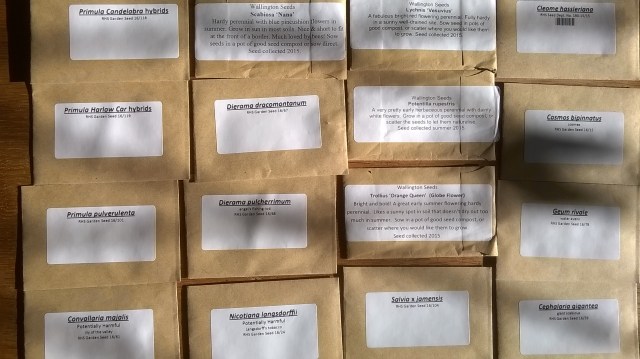
WP_20160130_13_10_48_ProI’ve now begun this year’s seed sowing; some early veg and some of the interesting varieties above, courtesy of my visit to Wallington Gardens last year and the RHS seed scheme…Looking at the germination requirements some of these are going to be a challenge!

Old School Gardener

Front Loading

A magnificent Kitchen Garden 'out front' in Drummondsville, Quebec, Canada

A magnificent Kitchen Garden ‘out front’ in Drummondsville, Quebec, Canada

Front Gardens under the Spotlight

A new study to help understand what impact front gardens have on their owners and passers-by has been commissioned by the Royal Horticultural Society (RHS). Scientists from the RHS are teaming up with academics from the Universities of Sheffield (UK) and Virginia (USA).

They’ll be employing a PhD student to help determine how gardening affects the mood and psychological health of people who have not gardened before, by helping them, amongst other things,  to ‘green over’ once paved front gardens. The societal value of gardens will also be evaluated by gathering information on the extent to which gardening encourages communication and engagement between garden owners, neighbours and passers-by. Here’s a video about the creation of the ‘kitchen garden out front’ in Quebec, Canada.

Part of the RHS campaign ‘Greening Grey Britain’, the new research will seek evidence to make the case for gardening to local and national government, supporting what many of us instinctively know- that green spaces have positive impacts on health and well-being.

On a similar theme, the RHS Hampton Court Flower Show this year will feature four front gardens designed and created by winners of a new competition being hosted by the RHS and BBC Local Radio to design a front garden.

Anyone can enter a ‘feel-good garden, celebrating the health benefits of gardening and taking inspiration from where they live.’

See here for more information and how to enter.

Source: RHS ‘The Garden’ Magazine, February 2016

Old School Gardener


12631529_1281544595194731_4525393432846353928_n

canwefeedtheworld's avatarOne Billion Hungry: Can We Feed the World?

By Katrin Glatzel

Alvise Forcellini 2006 urbanisation blog Credit: Alvise Forcellini, 2006

“How to feed our cities? Agriculture and rural areas in an era of urbanisation” – that was the theme of the Global Forum for Food and Agriculture, or for short, the GFFA, hosted in Berlin in mid-January. With Habitat III taking place in October in Quito, Ecuador, urbanisation features on top of the agenda of many meetings and conferences in 2016 including the Chicago Council on Global Affairs’ annual flagship report and the Committee on World Food Security (CFS). These forums are important as they draw attention to what urbanisation will mean for rural areas, the agriculture sector and those millions of smallholder farmers, upon which urban areas rely for their food supply. This is particularly important in a developing country context.

Urban and rural transformation

According to UN figures, in 1950 only about a third of the world’s population…

View original post 719 more words

Finding Nature

Nature Connectedness Research Blog by Prof. Miles Richardson

Norfolk Green Care Network

Connecting People with Nature

Discover WordPress

A daily selection of the best content published on WordPress, collected for you by humans who love to read.

Susan Rushton

Celebrating gardens, photography and a creative life

Unlocking Landscapes

Writing, photography and more by Daniel Greenwood

Alphabet Ravine

Lydia Rae Bush Poetry

TIME GENTS

Australian Pub Project, Established 2013

Vanha Talo Suomi

The Journey from Finnish Rintamamiestalo to Arboretum & Gardens

Marigolds and Gin

Because even in chaos, there’s always gin and a good story …

Bits & Tidbits

RANDOM BITS & MORE TIDBITS

Rambling in the Garden

.....and nurturing my soul

The Interpretation Game

Cultural Heritage and the Digital Economy

pbmGarden

Sense of place, purpose, rejuvenation and joy

SISSINGHURST GARDEN

Notes from the Gardeners...

Deep Green Permaculture

Connecting People to Nature, Empowering People to Live Sustainably

BloominBootiful

A girl and her garden :)