Trees and shrubs are important for all forms of native wildlife, including birds, mammals and insects. They will add another dimension to your organic growing area – providing leaves and fruits as a rich larder; habitat for nesting; shade and shelter, plus height for safety. A mature oak tree will support over 280 different insects. See Beneficial Insects..
Where possible, the organic grower plants trees or hedges, along with flowers, shrubs and water, to provide a valuable and diverse ecosystem.
Many of our native creatures are also predators of garden pests. Did you know that a ground beetle eats slugs? And a family of blue tits can eat 100,000 aphids a year? Natural pest control is an essential aspect of organic gardening.
Trees don’t have to be huge. The following list provides ideas for trees for small and large gardens. Some can be grown as a hedge. Hedges supply housing for over 30 species of British birds. A mixed hedge will also provide a variety of nectar producing plants, supporting bees and other pollinators.
Key
N = native
O = non-native
D = deciduous
E = evergreen
Extreme conditions tolerated: W = wet, Dr = dry
Specific soil type: Cl = clay, C= chalk
Common alder, Alnus glutinosa. Full height 22m (70 ft), suitable for hedge.
Can provide a home and food to at least 90 insect species. Small woody cone-like fruit is important food for birds such as goldfinch, siskin and redpoll
N, D, W, Cl
Ash, Fraxinus excelsior. Eventual height 40m (130 ft)
Flowers provide nectar for insects, the seeds or ‘keys’ are food for birds and small mammals. Over 41 associated insect species.
N, D, C
Quaking Aspen, Populus tremula. Eventual height 20m (65ft)
Aspen colonises new ground and is quick to grow. The leaves move in a magical way, immortalized in the poem ‘Lady of Shallot’- ‘willows whiten, aspens quiver, little breezes dusk and shiver’. Over 90 associated insect species.
N, D

Beech, Fagus sylvaticus. Eventual height 36m (120 ft), suitable for hedge.
Richly coloured autumn leaves and beech nuts, or ‘masts’, provide food for many birds such as tits, chaffinches, nuthatches, as well as squirrels and mice throughout the winter. Over 64 associated insect species.
N, D, C
Wild Cherry,Prunus avium. Eventual height 9-12m (30-40 ft)
Bright red fruit are popular for birds and mammals in early summer. Scented white flowers are attractive to bees and flies in the spring.
N, D
Bird Cherry, Prunus padus. Eventual height 6-9m, (20-30ft)
Beautiful white to pale pink blossom fill the air with almond fragrance in the spring. Attractive to bees and flies. Bitter black/red fruit, are eaten by birds. Common along streams and watery areas in North of England and Scotland.
N, D, W
Cotoneaster, Cotoneaster frigidus. Eventual height 9m (30ft), suitable for hedge.
Sweet scented flowers are borne early summer, popular with many insects, followed by a mass of scarlet berries in the autumn. These are much loved by birds including the waxwing and pheasant. C.horizontalis is very popular with bees in the spring.
O, D
Crabapple, Malus sylvestris. Eventual height 9m (30ft)
Pretty pink or white flowers in the spring, followed by small bitter fruit in the autumn. Many mammals such as foxes and badgers, as well as birds, enjoy the fruit. Over 90 associated insect species.
N, D
Buckthorn, Rhamnus Eventual height 5m (16ft), suitable for hedge.
The small yellow flowers of the Purging Buckthorn in spring provide food for the brimstone butterfly, whose caterpillars also feed on the leaves. Black berries in the autumn are borne on the female plant and are enjoyed by birds and small mammals.
N, D,C
Hawthorn, Crataegus monogyna. Eventual height: 8m (26ft), suitable for hedge.
A small tree or shrub. Heavily scented white flowers in early spring are much loved by bees and other insects.The bright red berries, called ‘haws’ are a favourite food in winter for many birds including fieldfares and redwings. Leaves are food for the brimstone moth and oak eggar moth. As a hedge, it is a fast growing and sturdy plant, and can be ‘laid’. 149 associated insect species. The midland hawthorn, Crataegus oxycanthoides, is more tolerant of shade and heavy clay soil.
N, D
Hazel,Corylus avellana. Eventual height 6m (20ft ), suitable for hedge.
Classed as a tree or shrub, regular coppicing will keep the tree quite short. Nuts and leaves provide a great deal of food for birds and mammals, including the now rare dormouse.
N, D, W, C
Holly, Ilex aquifolium. Eventual height 20m (65ft), suitable for hedge. The small, pale green scented flowers attract butterflies, bees and other insects, in late spring/early summer. Long-lasting red berries are important winter food for many birds including the thrush and small mammals. Spiny, glossy leaves are eaten by caterpillars of the holly blue butterfly. It is important to have both a female and a male tree for the development of berries.
N, E
Hornbeam,Carpinus betulus. Eventual height 24m (80ft) , suitable for hedge.
Dead leaves remain overwinter when grown as a hedge, rather than leaving a bare framework. Seeds are important food source for squirrels and birds.
N, D
Small-leaved Lime,Tilia cordata. Eventual height 22m (70ft), suitable for hedge.
This can be grown as a hedge, with sweet smelling flowers that are highly attractive to bees early summer. Host to 31 insect species. Commonly found in limestone regions in England and Wales.
N, D
English Oak, Quercus robur. Eventual height 35m (115ft ) , suitable for hedge.
Can provide home for more than 284 species of associated insects. Although lofty at full height, this tree can be pollarded, or coppiced, and can also be ‘laid’ to make a hedge. Long lived.
N, D
Rowan,Sorbus aucuparia. Eventual height 12m (40 ft)
Sweet smelling flowers in the spring attract many insects. Orange berries in the autumn are an important food source for many birds and small mammals such as hedgehogs. Over 28 associated insect species. Can survive in exposed situations.
N, D, W
Silver birch, Betula pendula. Eventual height 15m (50 ft)
A beautiful tree, with silvery-white bark. Suitable for small gardens. Older trees play host to bracket fungi and birds such as woodpeckers. Supports 229 associated insect species. Seeds popular with over-wintering birds and small mammals.
N, D
White willow, Salix alba. Eventual height 18m (60 ft), suitable for hedge.
Flourishes beside water; useful in reducing soil erosion. Over 200 associated insect species.
N, D, W


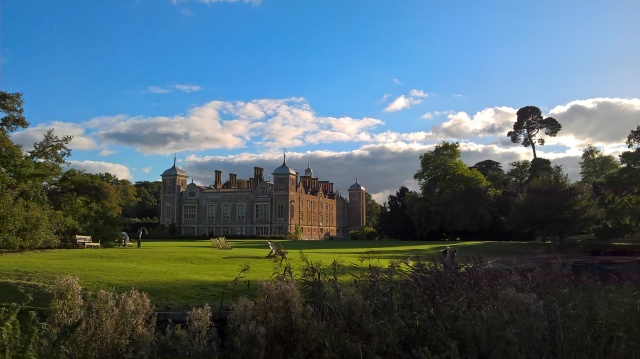 It was Wednesday again this week at Blickling. ‘Lucky you turned up’ said a fellow volunteer, you’re the 14th person here today!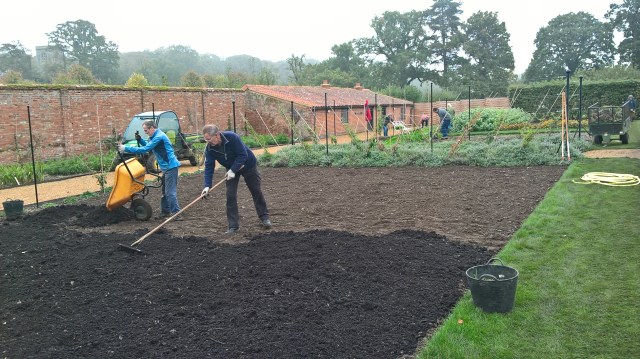


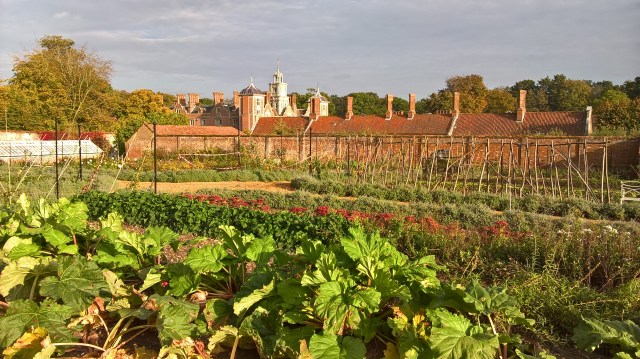
 By the end of the afternoon the sun was shining brightly and the garden looked wonderful bathed in this light, which created a glowing sea of backlit foliage, especially the lime green lettuces. In fact the whole place shone.
 Further Information:




 Old School Garden