Archive for August, 2015


WP_20150810_13_00_34_ProOn my latest trip to Portugal, I was thinking there must be another classic garden to visit in the mountain hideaway of Sintra. But having checked, it seems I’ve been to all of them, and if you’re interested you can see them in my series ‘Portuguese Gardens’.

But there remained a lingering doubt (or was it hope?), that there must be an historic garden somewhere close. Looking at the Lisbon map, and planning our days out, it stood out in that large green lung that is the Monsanto Park: the Palace of the Marquesas Fronteira.

This classic house, originally built in 1670 as a hunting lodge in what was then the rolling, wooded hills of northern Lisbon, is still lived in by the current Marquis and his family, so the house is only partly open to visitors (via a very informative 45 minute guided tour). Today, the views are of the sprawling Lisbon suburb of Benfica, including the red-arched Estadio da Luz, home to that famous football team of the district. About 100 years after its inception, after the infamous Lisbon earthquake had destroyed his main home, the then Marquis decided to extend his hunting lodge and make this palace home.

WP_20150810_12_52_39_ProAfter being asked if we’re mind waiting for a later house tour (to enable the rest of the party to benefit from the French version), I had a little wander into this compact, but interest-filled garden. And I went round again after hearing about and seeing some sumptuous interiors.

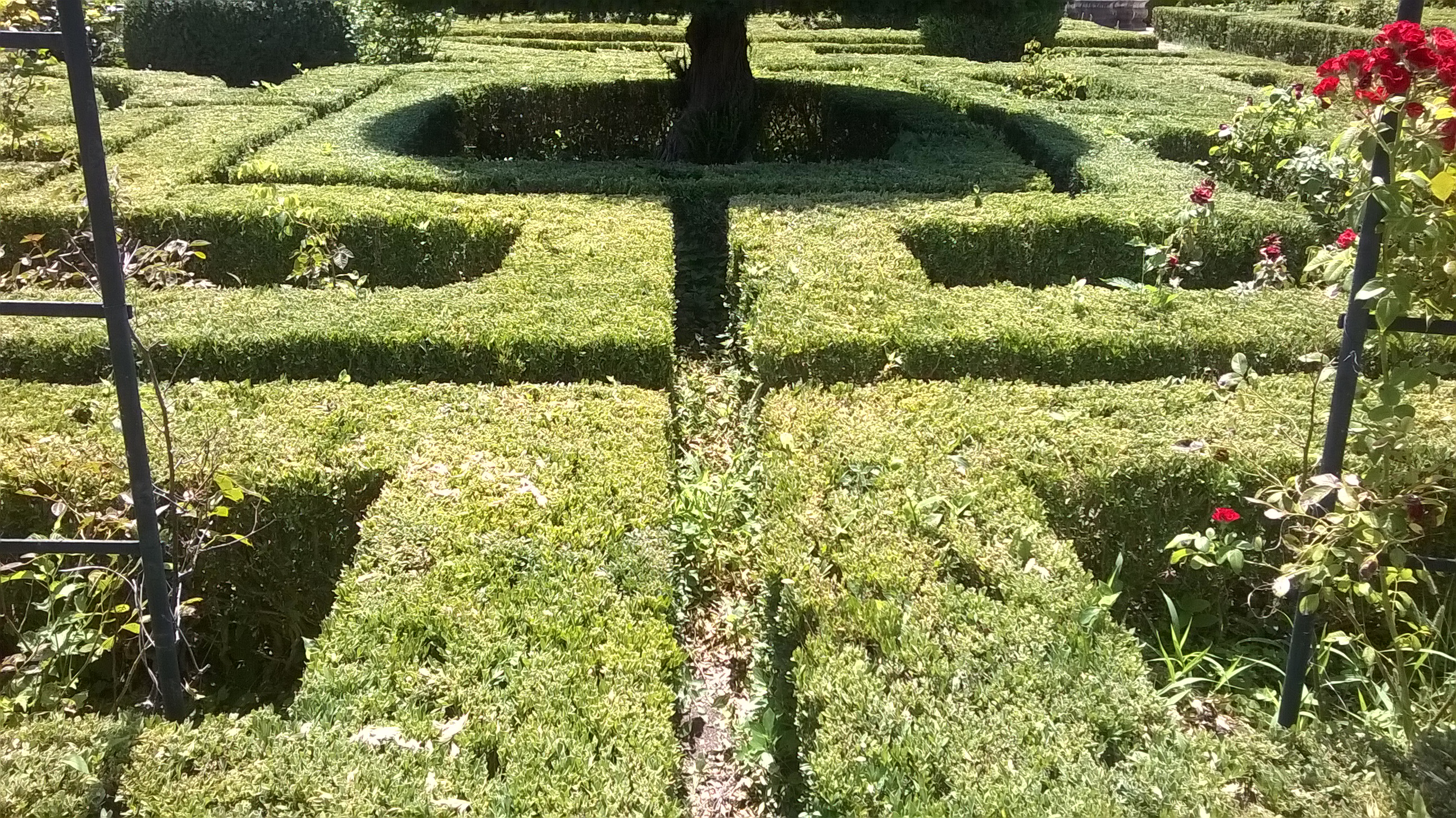
The centre-piece, especially as viewed from the upstairs rooms of the house as well as the high terrace overlooking the formal pool, is a rather intricate box parterre, where the shapes are closely edged, leaving what seems to be an impossibly narrow gap between the bushes: still the gardener seems to manage somehow.

This impressive feature was only partly filled with a selection of roses, and though traditional, I find the combination of close-clipped box and rather more unruly roses not as satisfying as when the enclosed beds contain slightly shorter plants that themselves have a rather more symmetrical form, e.g. lavender or perhaps catmint.

The elevated terrace with its display of sculptures of Portuguese kings surrounded by metallic-glazed tiles, is also very satisfying to walk along and gaze from, including downwards to a well-stocked carp and goldfish pool, with a lone, and rather aggressive black swan! I could picture this pool being the centre of 18th century fun and games, with rowing boats taking important guests from one little grotto to another, deftly avoiding the fountains of water (which today at least, were not in operation).

This slideshow requires JavaScript.

Nearby is a rather more naturalistic garden with tall trees and what must be at other times beautiful borders of hydrangea and agapanthus (I took the opportunity of gathering some seed heads of the latter). The walls of this area and indeed the rest of the garden, are beautifully tiled with traditional, if rather simply designed tiles, or azulejos, plus a vivid blue paint, the latter beautifully setting off fresh green foliage.

This slideshow requires JavaScript.

There is also a rather lovely terrace with immediate access to and from the first floor of the palace, with another impressive array of classically-inspired sculpture, leading to another large grotto, this one covered inside with the broken pieces of crockery and other shattered ceramics, apparently some coming from the plates used at the Palace’s inauguration, and smashed to commemorate the event!

Similar in style to other Portuguese palaces and gardens of the time, Fronteira is nonetheless well worth a trip, especially for the way our guide brought it to life.

Further information:

Fronteira Palace website

Gardens and Landscapes of Portugal

Old School Gardener

Anenome, picture by Steve Kozub

Anenome, picture by Steve Kozub

On a recent wet day in Cambridge, visiting our daughter, we went along to the Fitzwilliam Museum, really a mini ‘British Museum’ with its extensive collections of antiquities and art. There was a very interesting exhibition on titled ‘Watercolour- Elements of Nature’. This features rarely exhibited works highlighting the extraordinary versatility of watercolour, showing how it was used from the Middle Ages onwards to illuminate manuscripts, paint delicate likenesses, accurately record botanical detail and to capture fleeting moments of nature. Here are a few images I took before being told that photography wasn’t allowed…

Old School Gardener

Picture by Ellen Zillin

Balloon flower- Picture by Ellen Zillin

an101s1bWhen setting out new shrubs, it is wise to label them, particularly if you have selected a specific variety and want to remember its name.

For an unobtrusive but permanent marker, use a copper tag and tie, which weather to a greenish colour that blends in with the stems and foliage.

Just write on the tag with a a ballpoint pen and the name becomes indented. Attach it carefully to the chosen plant, making sure to leave plenty of slack for the shoot to thicken with age.

Source: ‘Good ideas for your Garden’- Reader’s Digest

Old School Gardener

Picture by Philomena Brady

Picture by Philomena Brady

The Regal Fern

The Regal Fern

Many plants cannot  tolerate damp, dense shade. But do not despair if your garden has a boggy, dark corner; one group of plants – ferns – relish such a site. Ferneries were popular during the Victorian era so you can create a period piece at the same time.

Choose hardy ferns for example Royal Fern (Osmunda regalis) and the sensitive fern (Onoclea sensibilis), for the boggiest areas, and Aldiantum venustum – which needs neutral to acid soil- on slightly drier land. Dig rotted manure or compost into the soil before planting. Then enjoy the tender green and bronze- red young leaves, unfurling into rich green mature foliage.

Source and further information:

‘Good Ideas for Your Garden’- Reader’s Digest

A Fern Quiz

Old School Gardener

Picture by Ellen Zillin

Picture by Ellen Zillin

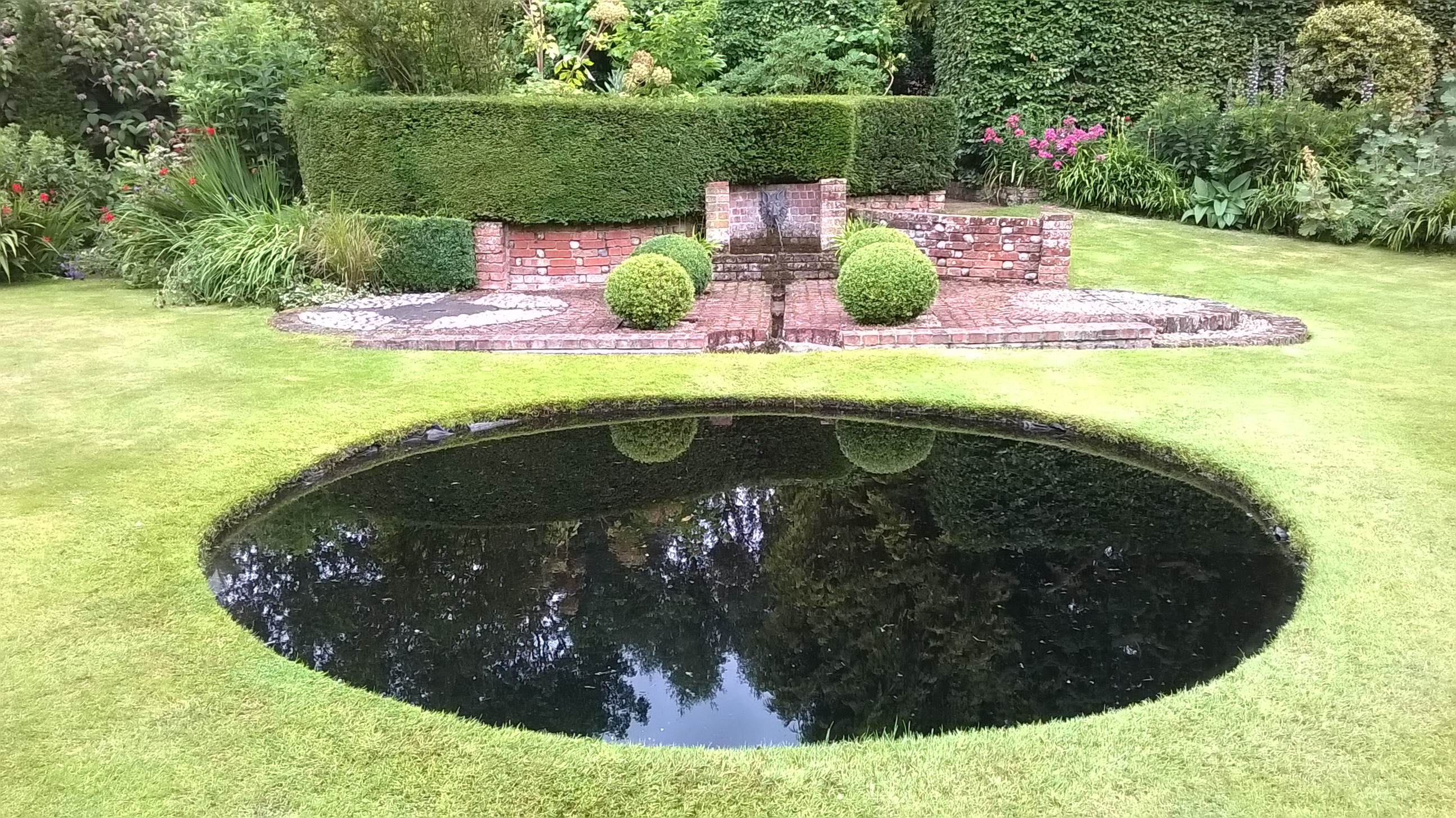
WP_20150714_14_08_43_ProThe second half of the recent Blickling volunteers and staff day out involved a trip to nearby Corpusty Mill, a garden developed over many years by its owner Roger Last and his late brother John since 1965. The RHS says of it:

‘Water is used extensively (ponds, streams, a small lake and a river) and there are strong architectural elements, garden buildings or follies, including a vast flint wall with the heads of Roman emperors, a Gothic arch and window, a grotto (with four chambers), a ruined tower, a classical pavilion and stainless steel spire. The planting is knowledgeable, varied and controlled. Most visitors come away quite amazed by the beauty and ingenuity of what they have seen.’

I must admit to being blown away by the thoughtful, clever and sensitive design and the sheer beauty of this five acre garden laid out in three distinct parts.  The main and more complex layout is on an intimate scale near to the house and there are two landscaped meadows.  Each area has its own character and atmosphere. A recent Country Life article comments:

‘Although the garden’s buildings and plantings are very varied, all are governed by three general ideas. First, the brothers felt it was important to manage visual effects ‘with some restraint’, thus hedges and borders were positioned so that only one building showed at a time. Next, to mitigate the possible dullness of an essentially flat site, they created innumerable changes of level, most of which were only modest, but, as Mr Last points out: ‘Even a few feet can make a huge difference.’ Finally, they wanted to create marked changes of mood, so some areas are open and light-filled, but others are densely planted and shaded.’

This slideshow requires JavaScript.

All I can say is that ‘it works’- a sensitively designed and fantastic blend of planting, statuary, humourous features and attention to detail.

Further information:

Corpusty Mill Garden website

Country Life article 2014

Old School Gardener

Picture by Ellen Zillin

Picture by Ellen Zillin

Finding Nature

Nature Connectedness Research Blog by Prof. Miles Richardson

Norfolk Green Care Network

Connecting People with Nature

Discover WordPress

A daily selection of the best content published on WordPress, collected for you by humans who love to read.

Susan Rushton

Celebrating gardens, photography and a creative life

Unlocking Landscapes

Writing, photography and more by Daniel Greenwood

Alphabet Ravine

Lydia Rae Bush Poetry

TIME GENTS

Australian Pub Project, Established 2013

Vanha Talo Suomi

The Journey from Finnish Rintamamiestalo to Arboretum & Gardens

Marigolds and Gin

Because even in chaos, there’s always gin and a good story …

Bits & Tidbits

RANDOM BITS & MORE TIDBITS

Rambling in the Garden

.....and nurturing my soul

The Interpretation Game

Cultural Heritage and the Digital Economy

pbmGarden

Sense of place, purpose, rejuvenation and joy

SISSINGHURST GARDEN

Notes from the Gardeners...

Deep Green Permaculture

Connecting People to Nature, Empowering People to Live Sustainably

BloominBootiful

A girl and her garden :)