
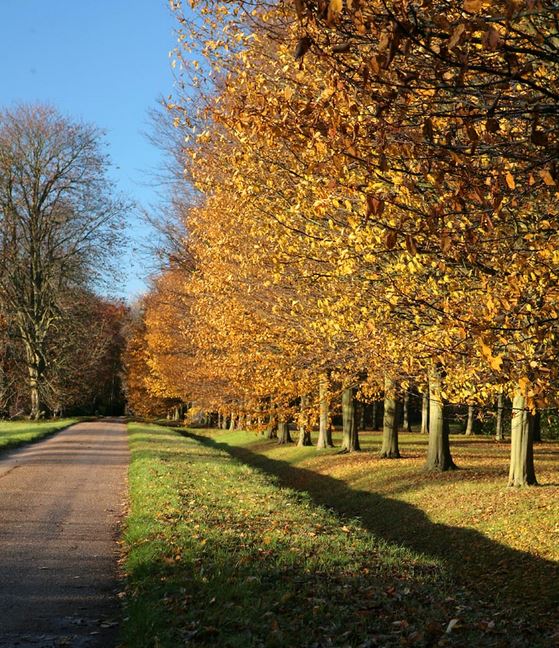
 This is the third in my new series on garden trees. I’ve also done an article about trees and garden design.
Common name: Hornbeam
Native areas: The 30–40 species occur across much of the north temperate regions, including the U.K., with the greatest number of species in east Asia, particularly China. Only two species occur in Europe, and only one in eastern North America.
Historical notes: Traditionally, the timber of hornbeams has been used to produce mallets, skittles and even the moving parts of pianos! The common English name of “hornbeam” derives from the hardness of the wood (likened to ‘horn’) and the Old English ‘beam’, a tree (similar to the German for tree, “Baum”).

- Pleached trees- picture RHS
Features: A large, deciduous tree (growing to 20 metres plus), with a grey-fluted trunk and spreading canopy. It has ovate, ribbed and serrated edge leaves that turn a beautiful clear yellow in autumn. The flowers are wind-pollinated pendulous catkins, produced in spring. The male and female flowers are on separate catkins, but on the same tree (i.e it is monoecious). The fruit is a small nut about 3–6 mm long, held in a leafy bract; the bract may be either trilobed or a simple oval, and is slightly asymmetrical.
Uses: Wonderful in a parkland setting, grown in groups, it also ideal for pleaching (i.e. training into a ‘hedge on stilts’) and for use along the edges of smaller gardens – just like here at Old School Garden. Received the Award of Garden Merit from the RHS in 2002. Some of the cultivars are suitable for smaller gardens as their growth habit is more columnar.

Carpinus betulus foliage…

Trunk…

Flower…

Seeds
Some of the cultivars available include:
‘Fastigiata’–– a tree of medium size (10-15 metres in height) and with a pyramidal habit, slender in its youth. Suitable for smaller areas despite developing ‘middle age spread’ (it can grow out to 1o metres wide). Very effective if left feathered at the base to encourage gold and orange autumn leaf colour. Stiffly ascending branches give it a columnar shape, resembling Lombardy Poplar.
‘Fastigiata Frans Fontaine’- selected from a street in the Netherlands in the 1980’s this retains its columnar habit better than the ordinary ‘Fastigiata’ variety (3 metres wide after 25 years) so is even better suited to restricted areas.
‘Purpurea’- medium height (10-15 metres), introduced in the 1870’s , this is well suited to arboretums and plant collections. Young leaves flush with a purple tinge and then gradually turn deep green and them a similar yellow to the species hornbeam in autumn. Slower growing and ultimately smaller than the species tree. Well suited to heavier soils.
”Japonica’- (Japanese hornbeam), introduced from Japan in 1895, a small (5-10 metres tall), rounded tree, very effective if pleached. Darker than the species tree, with heavily corrugated leaves, darker than the species tree. Attractive, prolific hop-like fruit. AGM in 2002
Growing conditions: hornbeams grow well in most soils, including clay and chalk and is useful for planting where there are poor planting conditions.

C. betulus ‘Fastigiata’

C. betulus ‘Fastigiata Frans Fontaine’ after 3 years

C. betulus ‘Purpurea’ as a hedge

C. betulus ‘Japonica’ hop-like fruit

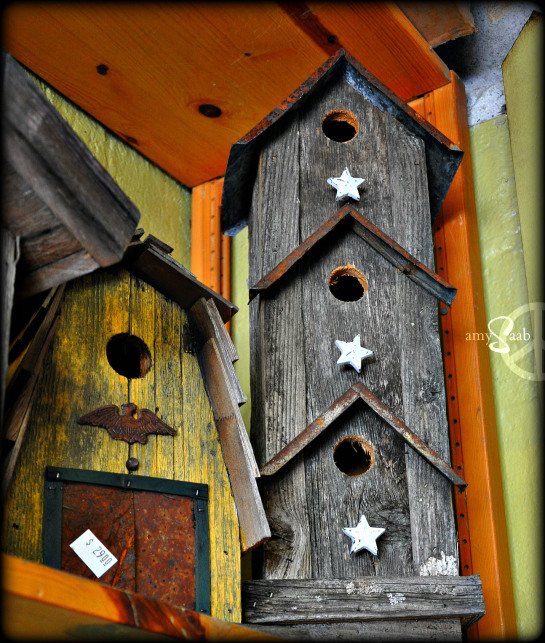


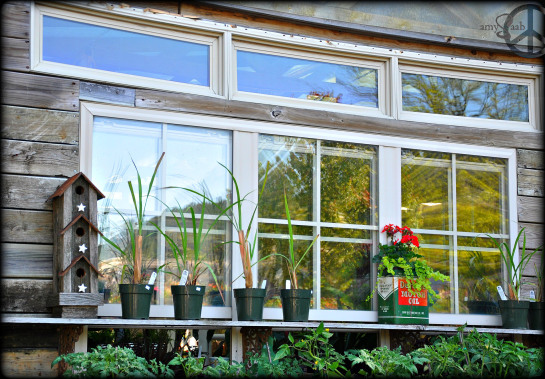


 Using recycled materials to make an insect hotel.


 The second and final stop on our trip home from Devon recently, was Montacute House, Somerset. Surrounded by beautiful, formally laid out gardens, the warm, honey-coloured stone of the house glowed in the spring sunshine. There was a splendid display of tulips and wallflowers and a magnificent ‘cloud’ yew hedge reminiscent of those at Blickling House, near our home in Norfolk. We were fortunate to meet a gardener in the ”orangery’, which, she explained, was not really in the best spot for this and had in the past been more of a shady water feature, with its





 Old School Garden