

- Bitton church, South Gloucestershire
Archive for May, 2014

The winding drive, down an avenue of beech trees to the front of the house, belies the formality of the garden, not yet visible, at the rear.

The picturesque drive arrives at a formal, almost austere, front façade. And contrast is, for me, the key characteristic of the gardens at Powerscourt Estate, named by “National Geographic” as number 3 in its Top Ten Gardens of the World.

The Powerscourt Estate is nestled in the Wicklow Mountains, an easy drive from Dublin, in an area of breathtaking natural beauty. And it is this contrast, which is particularly interesting at Powerscourt – the formal green symmetrical amphitheatre laid out below,with its terraces, statues and grottoes, wrestling for attention with the natural backdrop of the fields and the Sugarloaf mountain beyond.

And I think it does pull it off – the monolithic statues managing to frame the distant view and mirrored by the…
View original post 554 more words
Install Your Own Green Roof

Maddy Harland describes how to convert a pitch and tar flat roof into a green roof: a beautiful and enduring paradise for birds and bees -click the title for the full article.
Old School Gardener
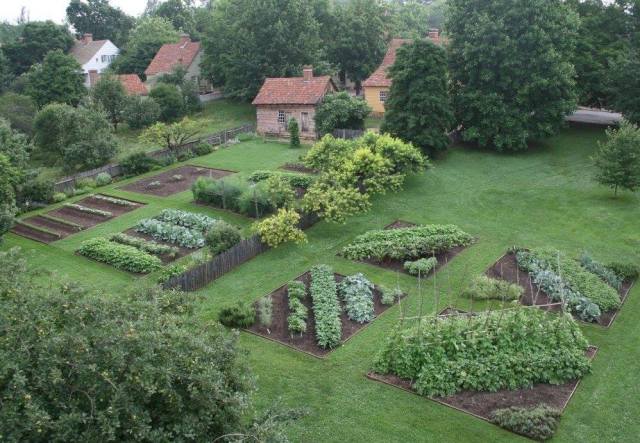
‘Diagonal Veg’ at Old Salem Museums and Gardens via P. Allen Smith
Old School Gardener

The Monkey Orchid
‘A number of images depicting a flower with the face of a monkey are currently circulating via social media posts and the blogosphere. Many commentators have suggested that the images have been “photoshopped”.
However, the images are genuine and depict a real flower. The botanical name of (one of) the pictured orchids (top right) is Dracula gigas. Another orchid species, Dracula simia, also has flowers that resemble monkey faces. The name pays homage to the “monkey” resemblance (simia) as well as to a resemblance to the flowing cape and long fangs of the Dracula character in popular fiction.
These orchid species grow in their natural state in Colombian, Ecuadorian and Peruvian forests at high elevations are thus not often encountered by people in the wild. However, collectors have cultivated the plants elsewhere.’ (extract from hoaxslayer.com)
Old School Gardener

Drosera plants, more commonly known as Sundews, often grow in soil that lacks nitrogen. Sundews get their nutrients from bugs lured in by the succulent droplets landing from the plant’s leaves.


 With the recent release of the IPCC Fifth Assessment Report, climate change has been a familiar topic in the news and media. More recently new publications have explicitly linked climate change to food security and they show that there is much to be done by governments, big business and the public sector, if our food and agricultural systems are to be resilient to predicted changes in the climate.
A new report by the Chicago Council on Global Affairs, Advancing Global Food Security in the Face of Weather Volatility and Climate Change, which builds on the IPCC report, explains how climate change will undermine efforts to tackle hunger, limiting food production and putting food supplies at risk. Higher temperatures, changes in rainfall patterns and more frequent and severe natural disasters could reduce food production growth by 2% each decade for the rest of this century. But, the report…
View original post 1,413 more words

Surplus ammunition canisters used imaginatively as a vertical garden
Old School Gardener

- Picture from ‘Voice in the Garden Blogspot’
In researching this article I’ve solved a little mystery. A couple of years ago I ‘liberated’ some curious looking fruits from a tree in a grand garden in Cornwall I was visiting. It was autumn and the leaves were a beautiful muted rusty golden colour. I couldn’t identify it at the time and the three fruits have been sitting on my desk ever since both intruiging and annoying me!
Well it turns out that they are the fruits of Davidia involucrata, better known as the ‘Paper Handkerchief’ or ‘Dove Tree’ because of its large white bracts enclosing the flower (and followed by the fruit). It looks like it may be a long and fiddly business to grow from seed, but I think I’ll have a go!
Common name: ‘Paper Handkerchief’ or ‘Dove’ Tree
Native areas: originally from damp woods in south West China, it is extremely endangered in the wild and also rare in cultivation.
Historical notes: discovered by Pere David in 1869 and introduced in 1904. It first flowered in 1911 on Veitch’s Coombe Wood nursery.
Features: a broadly conical, very beautiful tree that is (eventually) fast growing and of medium to large height, growing to 10-15 metres at maturity. However, it is difficult to grow from a young age and seems to thrive once it gets beyond 2-3 metres tall. Foliage and habit are similar to the Lime.The sharply toothed leaves are heart shaped to around 15 cms long, are pinkish in spring turning bright green above, densely hairy beneath in summer, then turn to gold in the autumn. The flowers are tiny but it is the large white flower bracts up to about 15 cms long that put on a great show in late spring. The fruits are rounded and green, up to 1.5 inches across, later ripening to brown (like the 3 I have here!). The attractive bark is orange brown and peels vertically in flakes.
Uses: very good in parkland or as a specimen and does best in a sheltered position. Sometimes the cultivar ‘Vilmoriana’ is specified, but it appears to be very similar to the parent species.
Growing conditions: Davidia grows best in a sheltered spot in deep fertile soil. It responds to light summer pruning. Growing tips can frost off if it is subjected to icy winds and invariably the best specimens are seen nestled away in a comfy sheltered spot. They also respond well to fertilizers with lots of potassium. They are best trained to a central leader when young with lower branches gradually removed. Propagation is from seed sown immediately upon ripening, germination can take up to 1.5 years but seedlings grow fast. It can also be grown from semi-ripe cuttings taken during late summer. Insect pest and disease problems rarely occur and are not serious.

Davidia involucrata ‘Aya Nishiki’

Autumn foliage

Autumn colour




 Old School Garden