Archive for February, 2014


Municipal Dreams's avatarMunicipal Dreams

A few weeks ago, Keeling House in Bethnal Green featured in BBC2’s Great Interior Design Challenge.  Its presenter Tom Dyckhoff paid due homage to the building’s architecture – a Denys Lasdun brutalist masterpiece – and to its history.  But let’s pay a little more attention to the latter here.  Now privately owned, Keeling House was once a vision of high quality housing for the people.

Keeling House (55)

Before the Second World War, Bethnal Green was the heart of the traditional working-class East End – with social conditions to match.  At the height of the Great Depression, it was stated that 23 per cent of the borough’s men were unemployed and some 43 per cent of its population living in overcrowded conditions. (1)

Claredale HouseBoth the London County Council and Bethnal Green Metropolitan Borough Council built extensively to rehouse local people.  The Claredale Estate was a local council scheme, begun in 1932.  Claredale…

View original post 1,993 more words

gressenhallfw's avatarGressenhall Farm and Workhouse

As part of my traineeship, I have been asked to organise our Mother’s Day event on the 30th March. The event will have a floral theme which will include a botanical art exhibition, children craft activities based around flowers and a florist who will be making small posies with the children but also promoting the flower arranging short course for adults taking place at Gressenhall in the spring.
As part of my research I have been looking into the Victorian “language of flowers” and what different flowers mean. In the Victorian times specific floral arrangements were used to send coded messages to the recipient, allowing the sender to express feelings which could not be spoken out loud in Victorian society. Though often portrayed to relay positive messages of interest, affection, and love, flowers could also send a negative message and at times, the same flower could have opposite meanings depending…

View original post 418 more words

PicPost: A New Level

Roof top prairie planting via Urban Gardens

Old School Gardener

My first ‘Over My Head’ post was of architectural detailing in Canterbury High Street. The second features pictures in and around Canterbury Cathedral also taken last week, as before looking up.

Some of the newly – cleaned outside of the cathedral was looking rich and creamy gold, probably how it must have looked a thousand years ago. And the interior was as awe inspiring as you might expect for this most important of Anglican religious centres.

I find it interesting that so much trouble and effort (as well as skill) was put into making buildings and objects look great in places you wouldn’t normally expect to look, well at least casually that is. Maybe in days gone by people had their heads in the clouds more…..

Old School Gardener

Brigid Jackson's avatararistonorganic

OLYMPUS DIGITAL CAMERA

Propagation is the term used to describe the process of plant reproduction. There are two categories of propagation, i.e. seminal and vegetative. Seminal propagation results from sowing seeds. Plants grown from seed are entirely unique and may differ from each other and from the parent plant. Vegetative propagation embraces all other techniques of reproduction such as cutting, grafting and layering and plants propagated in this manner are identical to their parents i.e. they are clones.

Cuttings

The terms softwood, semi-ripe and hardwood are to plant life the equivalent to the stages of infant, teenager and adult life in humans.

Softwood – is taken very early in the growing season, before there is any sign of hardening of the new shoots. They are green, both at the tip and base.

Semi-ripe – is taken at the end of the growing season when the tip of the stem is soft and…

View original post 613 more words

PicPost: Stumped

A lovely idea for using old tree stumps- I tried hollowing out a couple of Oaks that were felled next to our boundary wall last year, but had to give up through lack of drilling/cutting power- oak is VERY hard stuff! Still, I’ll have another go this season- hopefully the various holes I left will have encouraged the wood to rot down. Watch this space….
Old School Gardener

canwefeedtheworld's avatarOne Billion Hungry: Can We Feed the World?

Rosegrant_book_cover_crop240 Solutions to the world’s food insecurity and environmental problems are numerous. Some suggest it is the not the lack of a solution that hampers progress in addressing hunger, climate change and natural resource scarcity but rather the difficulty in choosing the most appropriate solution.

The International Food Policy Research Institute recently launched the results of a new research project (Food Security in a World of Growing Natural Resource Scarcity: The Role of Agricultral Technologies), which assesses the likely impacts of agricultural technologies on global crop productivity, hunger and economic development. Showcasing the project, is an infographic, produced by IFPRI, which outlines:

The eleven agricultural innovations investigated

  • No-till farming
  • Water harvesting
  • Organic agriculture
  • Precision agriculture
  • Drought tolerance
  • Heat tolerance
  • Integrated soil fertility management
  • Drip irrigation
  • Sprinkler irrigation
  • Nitrogen use efficiency
  • Crop protection

The data used

Global crop land was divided into cells, and data on physical characteristics such…

View original post 317 more words
Brigid Jackson's avatararistonorganic

????????

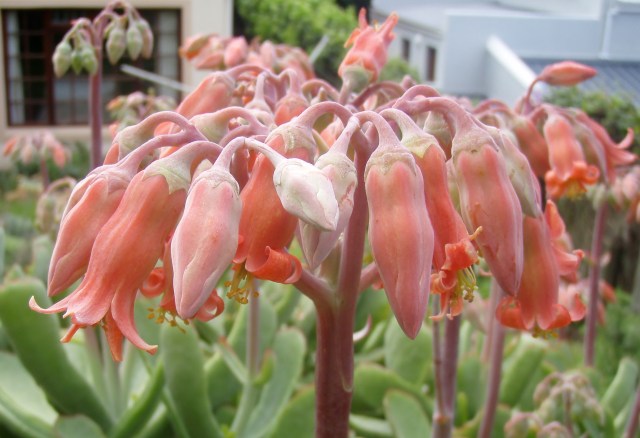
Pigs’ Ears, “plakkies” (Afrikaans) Cotyledon orbiculata, fast-growing succulent is well known to gardeners, forms a low shrub and adds colour to the winter garden. Forms with handsome grey leaves provide year-round interest in the garden.

??????????????

These are photographs of ones I planted in a garden 2 years ago. What a beautiful display they make. The brightly coloured flowers attract bees and birds, which feed on the nectar of the plant. The silver-grey leaves of some forms owe much of their attractive colouring to a powdery white coating which may assist in reflecting much of the sun’s heat to prevent excessive water loss from the thick succulent leaves.

????????Uses and cultural aspects
This is a well-known medicinal plant. The fleshy part of the leaf is applied by many South Africans to soften and remove hard corns and warts. The Southern Sotho use a dried leaf as a protective charm for an orphan…

View original post 151 more words

Finding Nature

Nature Connectedness Research Blog by Prof. Miles Richardson

Norfolk Green Care Network

Connecting People with Nature

Discover WordPress

A daily selection of the best content published on WordPress, collected for you by humans who love to read.

Susan Rushton

Celebrating gardens, photography and a creative life

Unlocking Landscapes

Writing, photography and more by Daniel Greenwood

Alphabet Ravine

Lydia Rae Bush Poetry

TIME GENTS

Australian Pub Project, Established 2013

Vanha Talo Suomi

The Journey from Finnish Rintamamiestalo to Arboretum & Gardens

Marigolds and Gin

Because even in chaos, there’s always gin and a good story …

Bits & Tidbits

RANDOM BITS & MORE TIDBITS

Rambling in the Garden

.....and nurturing my soul

The Interpretation Game

Cultural Heritage and the Digital Economy

pbmGarden

Sense of place, purpose, rejuvenation and joy

SISSINGHURST GARDEN

Notes from the Gardeners...

Deep Green Permaculture

Connecting People to Nature, Empowering People to Live Sustainably

BloominBootiful

A girl and her garden :)