Archive for 2013


IMG_6583A rather lower key garden visit this one, but still very enjoyable.

The Godolphin Estate is the former seat of the Dukes of Leeds and the Earls of Godolphin. It contains one of the most fashionable Tudor/Stuart mansions in Cornwall. The present house is remnant of a larger mansion. At one time it was a secondary seat of the Dukes of Leeds, but the Duke sold it in 1929. The Estate is a total of some 550 acres (220 ha). The early formal gardens (dating from around 1500) are said to be among the most important historic gardens in Europe, having barely changed over the years.

These include some interesting formal walled gardens and further afield remnants of grassed areas, ponds and ancient trees, with the addition of some meadow areas. The atmosphere is one of quiet and restraint, typical of its age and predating some of the more exuberant formal and landscape gardens of the following centuries.

It was very pleasant exploring the gardens on a sunny August afternoon, the peace and quiet, interrupted only by the sound of bees humming around a series of hives which are part of a study looking into the qualities of the Cornish bee, one of the oldest breeds around. In some areas the gardens and planting are in need of careful restoration and renovation, to bring out their full interest and attractiveness. This process is being pursued by the National Trust, which has also been improving public access to the Estate. since they acquired it in 2000.

Further information :

National Trust Website

Old School Gardener

If you’ve enjoyed reading this post and others on this blog, why not comment and join others by signing up for automatic updates via email (see side bar, above right ) or through an RSS feed (see top of page)?

PlayGroundology's avatarPlayGroundology

Last week Canada’s national public broadcaster, CBC, aired an item on playground injuries. The lead pretty much summed it all up, a numbers story that fell short on broader context.

“More than 28,000 children are injured every year on playgrounds across Canada, and the rate of hospitalizations has gone up by eight per cent between 2007 and 2012, CBC News has learned.”

CBC Playground Injuries copy

One thing is sure, no one wants to see a child injured. I live in Halifax, Canada a city with more than 300 playgrounds. My kids and I have played at about 50. They’re well maintained, mostly of the predictable off the shelf variety that address safety concerns and are light on excitement. In the last few years, I don’t recall any media reports about serious injuries.

Now I’m sure we can make playgrounds safer. How about thick foam landing mats as ground covering like those that…

View original post 754 more words

PicPost: God's Fingers

Peak District

deltagardener's avatarThat Bloomin' Garden

Have you ever wanted to start a community garden? With many communities building more and more high density housing , community gardens are becoming all the rage. People living in townhouses, apartments, condos and basement suites often don’t have enough room to grow plants. Although you can grow a lot of food on a  balcony, some places don’t have this kind of space. Starting a community garden means looking for a piece of land that can often be leased from a landowner. Surprisingly these pieces of land are often found quite easily. Lets take a look at this tour of community gardens to see how they got started. Below is a photo of Alexandra House community garden in South Surrey. It’s hard to believe this garden is just over a year old.

community gardens

The gardens are full of abundant harvests and so much fuller than the first season. This garden was built…

View original post 894 more words

joepyeweed1's avatarPardon My Garden

Part of the fun of encouraging biodiversity is seeing all the little critters this time of year.  I try to have something blooming from March through November, if possible, and that gives opportunities for many species to survive.
Garden 09 22 13 121

The sedum is even busier this weekend.  This praying mantis has been sitting on the sedum all weekend.  It did not actually snatch anything while I was watching.  The painted lady butterfly was on the sedum all weekend, too.

Garden 09 22 13 099

Side view of painted lady butterfly on sedum.

Garden 09 22 13 081

Also on the sedum were this little skipper butterfly and many kinds of bees and flies.  I can see why the praying mantis hangs out here.  There was also a little yellow sulphur butterfly, I am not exactly sure which kind of sulphur it was.  I can’t show pictures all the species that were on the sedum!

Garden 09 22 13 095

Praying mantis blends in on miscanthus “morning light” ornamental grass.  This one has a…

View original post 331 more words

Tim Gill's avatarRethinking Childhood

Boy in streetEven a generation ago, most parents would have greeted this question with blank faces. Playing out was just what kids did – why would you need a reason? Of course, things are different today – for all sorts of reasons. In almost all neighbourhoods, parents need to take a stand, and to resist the norm of parenting that says being a good parent means rearing your child in captivity.

For parents who come together to set up Playing Out road closure projects, taking this stand means extra commitments: talking to neighbours, liaising with the Council, setting up rotas, and maybe spending a couple of hours a week out in the street. So, to rework my opening question: why do parents get involved in organising road closures for play?

View original post 918 more words

greenbenchramblings's avatargreenbenchramblings

We went to Waddeston by default! We were planning to visit another garden in Oxfordshire, but as we got close we decided to check the details of the garden, especially how to find it. The trouble was the garden details also showed that we were visiting on a day when it was closed. Oops!!

Plan B quick! Luckily we found another garden literally a mile from where we had parked up to get directions to our original destination. From the description in our book, the garden at Waddeston did not sound my style of gardening but the architecture of the house itself sounded interesting. So we decided to go and have a look.

We arrived to discover Waddestonto be an architecturally fussy building in the style of a French chateau. I admired it but didn’t like it. Jude, the Undergardener liked it a lot.

2013 07 24_20462013 07 24_2047

2013 07 24_2058

There were lots of fussy little…

View original post 181 more words

Soil that you can make pots from is a challenge...

Soil that you can make pots from is a challenge…

Having ‘good’ soil is one of the most important elements in successful gardening, though some plants are well adapted to and actually prefer ‘poor’ soils. A good soil is especially important for growing food crops. The terminology and approaches to creating and keeping good soil can be confusing, as this week’s questioner illustrates:

‘My garden seems to have a very heavy clay soil. i want to know what to do to make it easier to work with and I’ve heard the terms like structure, texture and tilth – can you explain what these terms mean and advise me on what to do to improve my soil?’

So writes Lise B. Lowe from Hereford. Well Lise, a good way of summarising the different terms is:

Texture = the mix of different types of soil particle

Structure = the spaces between these particles

Tilth = the quality of the structure

The basic types of soil texture

The basic types of soil texture

Texture

Garden soils contain particles of varying size. Clay particles are minute and tend to clog together (which is why your clay soil is so heavy and difficult to work). At the other end of the scale, gravel consists of very large particles; this type of soil drains very easily and so is known as a ‘hungry’ soil. Between these two extremes will be found comparatively small soil particles, known as silt, and larger particles of sand. The majority of soils consist of mixtures of the different sizded particles. The proportions of large, medium and small particles in a given soil determine its texture.

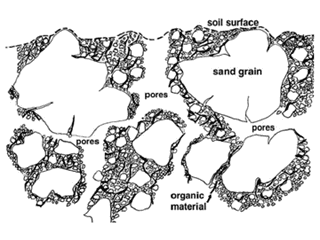
The components of soil structure

The components of soil structure

Structure

A soil has good structure if it contains a balanced range of particle sizes that provide air pockets of a size to accommodate the right amount of air and moisture for healthy plant growth; it drains well; and contains adequate humus (decayed organic material like leaves and stems which will not decay any further) and other organic material.

Tilth

When soil has been forked and raked and its clods have been broken down to a fine, workable structure it is said to have a good tilth. This quality is particularly important when small seeds are being sown, because it enables them to make good contact with the available soil moisture. Too fine a texture does not make a good tilth because such a soil’s surface will ‘cake’ (develop a hard surface or ‘pan’) in the first shower of rain. So working the soil (and adding different materials to it like organic matter, gravel , sand) produces different tilths, some suitable for seed sowing, others for establishing and growing on different plants etc.

With your heavy clay soil the best approach is to add lots  (and lots) of organic material such as compost, humus, manure so as open up the structure of the soil, making cultivation much easier. Autumn is an ideal time to do this, as once you’ve dug over the soil and incorporated organic matter, the winter weather should help to further break down the larger clumps of soil, making it easier to cultivate in the spring. Regularly adding organic matter before you sow/plant and as a a mulch during the growing season will continue to help improve the structure of the soil and add nutrients too.

Adding compost or other organic material to the soil by digging in or as a mulch is a must...

Adding compost or other organic material to the soil by digging in or as a mulch is a must…

If, on the other hand, your soil, like mine, is on the sandy side, adding organic matter can help with moisture retention and add much-needed nutrients to an otherwise poor soil. I tend to add lower nutrient material such as leaf mould in the Autumn and richer material like compost and manure in the Spring so that the nutrients these contain have less time to wash away and are readily available when plants need them most, as they burst into life. However, if your soil is really in need of improvement then add any organic matter in the Autumn and give it time to break down and blend with the soil. Of course the alternative approach, where possible, is to plant things that are suited to your soil, even if it’s on the ‘poor’ side!

However, you’re probably on to a winner by adding organic material, whatever your soil!

Different soil types

Different soil types

Further information:

Checking your soil condition

Soil structure and formation

The genesis of soil structure

Feed your soil not your plants

Old School Gardener

If you’ve enjoyed reading this post and others on this blog, why not comment and join others by signing up for automatic updates via email (see side bar, above right ) or through an RSS feed (see top of page)?

Project Wild Thing- showing at Picturehouse Cinemas!

project wild thing‘The roaming radius of British children — i.e.. the distance they wander from their home — has shrunk by 90 per cent in the last 30 years

It’s a disheartening statistic, but one that has inspired award-winning filmmaker David Bond, who, keen for future generations not to miss out on the magic of the great outdoors, dreamed up PROJECT WILD THING.

The film itself is only one part of Bond’s campaign, which enlists a number of scientists, nature experts, sociologists, as well as the National Trust, to set about selling nature to kids.

Conscious that it will take more than eulogising to prise them away from their TVs and games consoles, Bond also recruits a marketing team to lend their branding savvy and repackage the countryside.

A charming exercise in creative, socially-minded activism, PROJECT WILD THING is a grass-roots triumph..’

PicPost: Apple of My Eye

Finding Nature

Nature Connectedness Research Blog by Prof. Miles Richardson

Norfolk Green Care Network

Connecting People with Nature

Discover WordPress

A daily selection of the best content published on WordPress, collected for you by humans who love to read.

Susan Rushton

Celebrating gardens, photography and a creative life

Unlocking Landscapes

Writing, photography and more by Daniel Greenwood

Alphabet Ravine

Lydia Rae Bush Poetry

TIME GENTS

Australian Pub Project, Established 2013

Vanha Talo Suomi

The Journey from Finnish Rintamamiestalo to Arboretum & Gardens

Marigolds and Gin

Because even in chaos, there’s always gin and a good story …

Bits & Tidbits

RANDOM BITS & MORE TIDBITS

Rambling in the Garden

.....and nurturing my soul

The Interpretation Game

Cultural Heritage and the Digital Economy

pbmGarden

Sense of place, purpose, rejuvenation and joy

SISSINGHURST GARDEN

Notes from the Gardeners...

Deep Green Permaculture

Connecting People to Nature, Empowering People to Live Sustainably

BloominBootiful

A girl and her garden :)