Archive for November, 2013


PicPost: Step up

succulent steps

deltagardener's avatarThat Bloomin' Garden

Its been a few years since I planted spring bulbs. One year I was able to get a very good buy on almost 1500 bulbs so needless to say the garden looked fabulous the following spring. I must admit that it seemed like a lot of bulbs but they don’t go as far as you think. With half an acre to cover we soon had them all planted.

Its time to talk  Tulips

Tulips grow very well here in the lower mainland of British Columbia. Even with our spring rains they will often stand up to the weather. Above is a photo of Tulips in one area of my garden. I love a mix of colours and have lots of pinks, reds, oranges and yellows.

Its Time to talk Tulips

This grouping of Tulips amazed me last spring. In the winter this area sat underwater for a few days. They still grew. It seems that even though it was very…


View original post 518 more words

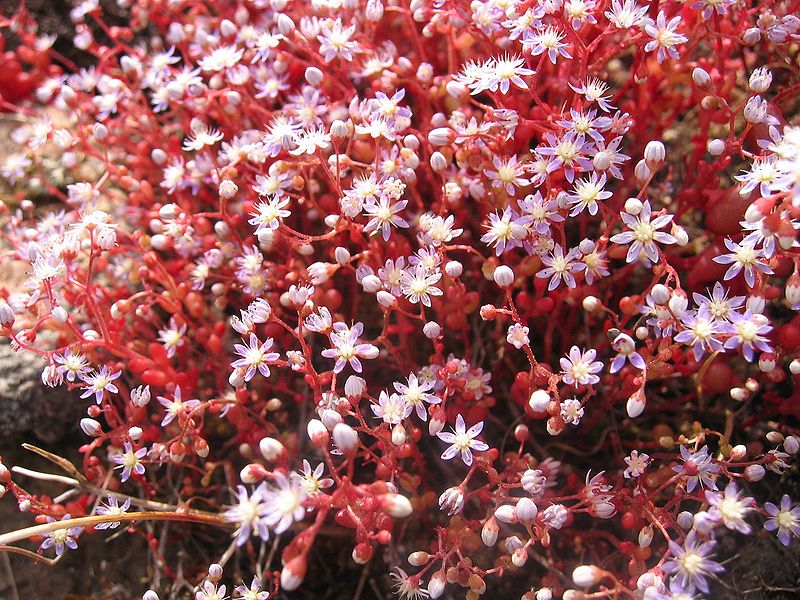
Sedum caeruleum
Sedum caeruleum

So, I’m getting close to the end of the alphabet and thinking about if and how I should follow up my current ‘A-Z’ series with another- what do you think? Any ideas? Maybe trees or shrubs? Or perhaps bulbs? Let me have your ideas!

S caused me a moment of uncertainty. I thought, it has to be Salvia, then I thought, Sedum is obvious as many are at (or close to) their best at this time of year, and I do love the larger forms which add so much to the garden with their chunky, glaucous foliage and shields of flowers, especially in autumn and on into winter as the flowers fade and their strong shapes give structure to the ‘close season’ border.

Sedum (common name ‘Stonecrop’) is a wide genus of some 400 species, encompassing annuals, biennials, deciduous, semi evergreen and evergreen perennials, subshrubs and shrubs- from both hemispheres! What you might call a botanical success story!

Their habitats in the wild vary from mountainous areas (where most come from), to arid regions of South America. As a result, they vary widely from dwarf, rock garden plants (the predominant type) to fairly  tall plants, very suitable for beds and borders. Some of the smaller species can be quite invasive. Sedums prefer sun, but some will tolerate light shade. They are drought tolerant, and prefer light, well-drained soils. The border types  will grow in almost all soil types, but do become rather lush and need to be staked if grown in over fertile conditions.

The foliage of ‘stonecrops’ is usually thick, fleshy and succulent, although the arrangement of the leaves varies. Individual flowers appear in summer and autumn, are mostly 5 – petalled and star shaped, and are borne in a range of different forms: corymbs, panicles or cymes.

Butterflies love the flowers- especially Sedum spectabile. The green buds on this species look good from midsummer, then colour pink into autumn. Stems are succulent and frosted, hence the common name “ice plant”. Unfortunately slugs and snails are fond of the leaves . All parts of the plant are poisonous, and contact with the sap may cause skin irritation.

Smaller, rock garden types are used extensively in ‘green roofs’. The ever popular Sedum spectabile ‘Herbstfreude’ (also know as ‘Autumn Joy’) goes well with many other autumn flowering herbaceous plants such as Michaelmas Daisies (Asters) and some of the shorter grasses such as Stipa tennuissima (‘Pony Tail’ grass). Carefully chosen cultivars of Japanese anemones, penstemons and phlox will also look good with them. They can also be used to good effect massed below a sun baked wall or hedge where other things might struggle, perhaps intermingled with spring bulbs and backed by early – mid summer ‘floppers’ like Perovskia (‘Russian Sage’). Leave the faded flower heads on over winter for some interesting garden shapes, especially after a ‘hoar’ frost.

Further information:

Sedum spectabile

Sedum spectabile ‘Brilliant’- BBC

Sedum ‘Purple Emperor’

Herbaceous Sedums- trials and awards by RHS (pdf)

Living sedum roofs

Sedum photos

Sedum Society

Old Schoool Gardener

Afloat and flowered - tribute to a live wire

A former colleague of mine, Howard Dickenson, died recently. I hadn’t seen ‘Howie’ for many years, but another former colleague attended his funeral and paid a wonderful tribute to him which awoke some warm memories. I particularly like this picture of Howie aboard his canal boat with the beautiful flowery roof garden. Here’s to a life well spent and one that brought pleasure and amusement to many. All the best Howie.

Winter Tares- good at protecting the soil, smothering weeds and maintaining nitrogen in the soil, once dug in. Picture from Garden Organic

At one of my recent ‘Grow Your Own’ classes, one of the participants raised an interesting question about Green Manures (GM’s).

He wondered if it was actually worth growing green manures as additional sources of nutrients. He reasoned that as they use up nutrients from the ground there isn’t any real gain in the nutrients avialable to follow on crops. Like me, he had also heard that legumes, (peas and beans) do fix nitrogen from the air and therefore their roots are a source of additional supplies of this if dug into the soil. And he also mentioned that deeper rooting plants like Comfrey tap into nutrients that wouldn’t otherwise be available to plants with shallower roots, so making these available via their leaves once composted, and also from a  ‘tea’ made from these and applied as a liquid feed. So is this all correct?

I decided to contact my colleagues at Garden Organic and ask for their advice on all  this and got a very interesting reply from Francis, their Horticultural Research Manager:

Green manures and nitrogen

Legumes, when the temperature is warm enough and they have the right bacteria, will fix the nitrogen they need from the atmosphere. It is very true, and seldom appreciated, that if a legume crop (eg beans) is harvested then most of this nitrogen is taken away and not left in the soil. However, if the legume is grown as a green manure and dug in whole (usually in an immature state) rather than being harvested then there will certainly be a net benefit; nitrogen fixation (directly or indirectly via animal manures) is the main source of nitrogen for agriculture and horticulture in the absence of artificial fertilisers.

Non leguminous plants can only take up nitrogen from the soil as inorganic ions (ammonium but mainly nitrate). The latter is very soluble in water and so easily washed out by the rain and so lost from the soil, contaminating drinking water and rivers etc. A lot of work was done (some by Garden Organic) to demonstrate that one of the best ways of preventing this was by growing winter green manures such as rye. When this is dug in the nitrogen they have taken up is mineralised to be made use of by following vegetable crops.

Green manures and other nutrients

Other nutrients (especially the metals such as K, Mg etc) are more tightly held on the surface of the soil particles and so are not easily leached so it is true that green manures are less important for keeping them in the soil. However, some do have specific effects (eg buckwheat can help mobilise phosphorus and chicory is deep rooting and so is a source of trace elements from the subsoil that may have been depleted nearer the surface). All green manures will add organic matter to the soil which helps with structure and also stimulates microbial activity, important for general nutrient cycling.”

So, the net result is that there are several good reasons for using GM’s over the winter, including maintaining nitrogen where this would leach away from unprotected soil, weed reduction, protecting soil structure, and the addition of organic matter to help moisture retention and soil structure. However, the legume contribution to soil fertility (assuming you grow these to produce food), is of questionable value if left in the soil and dug in. Better to add animal manure or your own compost to boost nitrogen levels.

Comfrey- reaches the nutrients other plants cannot reach...and you can out them into your soil via a (smelly) tea made from their leaves
Comfrey- reaches the nutrients other plants cannot reach…and you can out them into your soil via a (smelly) tea made from their leaves

Further information:

Garden Organic and Cotswold Seeds have produced a useful advice booklet on soil improvement. It’s available as a pdf to download for free at  ‘Sort out your Soil’

Linked articles:

Green Gold – 7 reasons for using green manures

Green Gold: Where and when to use Green Manures

Green Gold: Making the most of green manures

Green Gold: 12 plants for soil improvement

Old School Gardener

How to make leafmould

Leafmould bin and wheelbarrow

A downloadable factsheet from the good folk at Garden Organic- just click on the link above.

Old School Gardener

Heritage Gardening Trainee Vacancies

garden pic gressenhallI was one of the first Heritage Gardening trainees at Gressenhall Farm and Workhouse Museum, Norfolk. There are some new vacancies now available, including placements at historic gardens in Norfolk and Cambridgeshire. Just click on the link above for more informaiton.

Old School Gardener

Finding Nature

Nature Connectedness Research Blog by Prof. Miles Richardson

Norfolk Green Care Network

Connecting People with Nature

Discover WordPress

A daily selection of the best content published on WordPress, collected for you by humans who love to read.

Susan Rushton

Celebrating gardens, photography and a creative life

Unlocking Landscapes

Writing, photography and more by Daniel Greenwood

Alphabet Ravine

Lydia Rae Bush Poetry

TIME GENTS

Australian Pub Project, Established 2013

Vanha Talo Suomi

The Journey from Finnish Rintamamiestalo to Arboretum & Gardens

Marigolds and Gin

Because even in chaos, there’s always gin and a good story …

Bits & Tidbits

RANDOM BITS & MORE TIDBITS

Rambling in the Garden

.....and nurturing my soul

The Interpretation Game

Cultural Heritage and the Digital Economy

pbmGarden

Sense of place, purpose, rejuvenation and joy

SISSINGHURST GARDEN

Notes from the Gardeners...

Deep Green Permaculture

Connecting People to Nature, Empowering People to Live Sustainably

BloominBootiful

A girl and her garden :)