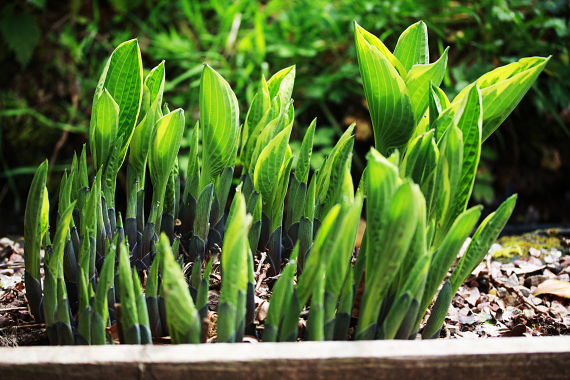
Hosta shoots -courtesy Marcus Bawdon http://www.countrywoodsmoke.com
25/04/2013 10:00 am
Hosta shoots -courtesy Marcus Bawdon http://www.countrywoodsmoke.com
Otherwise known as the ‘Plantain lily’, Hostas come originally from eastern Russia, China, Japan and Korea. They are very hardy. Most of the 40 – 70 or so species (there is disagreement over the exact number) and over 7000 cultivars are grown for their foliage, though for many the flowers are also noteable. True perennials, their foliage dies back and they descend underground over winter, to send up new growth spears in spring and achieve their full glory in summer with some varieties flowering into early autumn. Some species also give a second, albeit brief, display in autumn.
 Hosta ‘Ginko Craig’ flower
  Hosta fortunei ‘Picta’ flower
The leaves vary between round, ovate, lance or heart – shaped and are between 12cm and 50cm in length. They come in all shades of green, some solid in colour others with margins or centres variegated in shades from white to golden yellow. Flowers range from bell to trumpet shaped, and are held in one-sided racemes or ‘scapes’.
 ‘Bette Davis’ eyes’
  ‘Fried Green Tomatoes’
  ‘Sweet Sunshine’
  Hosta ‘Bressingham Blue’
Hostas will grow in full sun to full shade – they flower better if in the sun and the yellow-leaved varieties also do better in full sun. Overall, however, they tend to do best in dappled shade and where they are away from the hot noon-day sun (the blue – green leaved varieties have more intense colouring in the shade). They need moisture at their roots and this is even more the case in full sun – so they need watering in dry spells and generally do best in moist ground which is rich in organic matter and neutral to slightly alkaline . Foliage will start to wilt if they are too dry. They can be easily propagated by division at almost any time of year – a sharp spade or knife thrust down to split the roots is all that’s required.
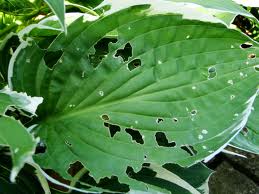
Slug and snail damage
Pest problems focus on slugs and snails which can nibble the emerging shoots – such damage can scar the leaves for the rest of the season, so preventative and quick action to remove slugs and nails is crucial, especially in early spring. Sometimes, especially in water – logged ground, the plants can be susceptible to ‘crown rot’ and if this is the case they should be moved to a more suitable site. Hostas have low levels of allergens. Some Hostas are edible, their young shoots being forced and harvested in the far east, eaten sauted or rolled in proscuitto!
 Hosta border edge
  Hosta grouping
  Hostas and Lillies
  Mixed Hosta planting
  Hosta ‘Royal Standard’ flowering
Hostas look good in groups around ponds and damp areas, and are particularly useful in areas of medium to light shade. Their foliage makes for a bold texture so they are good as focal points, contrasting well with grassy – like leaves and stems. They are also good in containers where the leaves and flowers can be seen close up. I grow most of mine this way, in black planters in our Courtyard Garden – the black provides wonderful contrast to the rich greens and yellows of the foliage. But it’s important to keep them well watered once growth starts. Other ideas for using Hostas include:
‘Plant different varieties in large masses or drifts for reliable color and texture in the garden.
Brighten shady garden areas with gold or variegated hostas.
Use hostas to bridge gaps in seasonal perennial bloom.
Variegated hostas with white or cream margins paired with other white flowering plants glow in “moonlight gardens” when homeowners arrive in the evening from work.
Hosta leaves emerge just as spring bulb foliage starts to fade, hiding it from view.
A single hosta in a container is dramatic and sculptural. Hostas look great in containers paired with other foliage plants or annuals. Remember to provide adequate water.
Plant fragrant hostas close to paths and walkways for best appreciation.
Use small hostas for edging along walkways and flower borders.
Hosta leaves and flowers are attractive in floral arrangements.’
Source: University of Minnesota Extension
Images from: Newtonairds Lodge Hostas and Garden (the national collection), Wikipedia and other sites as shown on picture titles.
Further information:
British Hosta and Hemerocallis Society
How to lift and divide Hostas (video)
Hosta varieties and where to buy etc.
Winsford Walled Garden, Devon- success with Hostas
Hosta shoots wrapped in prosciutto


If you’ve enjoyed reading this post and others on this blog, why not comment and join others by signing up for automatic updates via email (see side bar, above right ) or through an RSS feed (see top of page)?
Posted by Nigel Boldero
Categories: A-Z of Perennials, Feature plants
Tags: container plant, flowers, focal point, foliage, hosta, leaves, old school, perennial, sculptural, shade, slugs, snails
Mobile Site | Full Site
Get a free blog at WordPress.com Theme: WordPress Mobile Edition by Alex King.
Reblogged this on aristonorganic and commented:
Such wonderful plants Hostas
By aristonorganic on 25/04/2013 at 3:52 pm
this is really nice. Pity we really have a hard time growing here in the Western Cape South Africa. 🙂
By aristonorganic on 25/04/2013 at 3:51 pm
Hi- thanks for the reblog! what’s the problem with your area and hostas- too warm/dry?
By Nigel Boldero on 25/04/2013 at 7:44 pm
too warm and too dry in the Summer Nigel 🙂
By aristonorganic on 25/04/2013 at 9:31 pm
Lovely!
By Arthur in the Garden! on 25/04/2013 at 2:32 pm
thanks!
By Nigel Boldero on 25/04/2013 at 8:42 pm
I use praying mantis for natural pest control and I found that somehow control the slug/snail damage on hostas leaves.
By myfoodandflowers on 25/04/2013 at 2:17 pm
Wow! Are they easy to come by? I’m not sure this is a recognised pest control in the UK!
By Nigel Boldero on 25/04/2013 at 8:43 pm
Every country has mantis in countryside or open field/wild. Here I buy the egg cases. I hang the egg cases around 4-5feet high on a branch, partial shade area where they can find bugs to eat easily! 🙂
By myfoodandflowers on 25/04/2013 at 8:58 pm
Fascinating!:)
By Nigel Boldero on 25/04/2013 at 10:57 pm
It is a lazy gardener’s pest control too! 🙂
By myfoodandflowers on 25/04/2013 at 11:16 pm
Hmm, takes some thought though 🙂
By Nigel Boldero on 25/04/2013 at 11:23 pm
Perhaps you can find some European Mantis (Mantis religiosa) their egg cases?
http://suite101.com/article/praying-mantis-a31441
By myfoodandflowers on 26/04/2013 at 2:41 am
Hostas are lovely. I used to have a few in my garden but I think the snails eventually ate them to pieces.
By Gallivanta on 25/04/2013 at 1:31 pm
Thanks for the comment- yes, you have to be vigilant about the slimey ones!
By Nigel Boldero on 25/04/2013 at 8:44 pm
Reblogged this on My Botanical Garden.
By tamara on 25/04/2013 at 12:31 pm
Hi Tamara- thanks for the reblog!
By Nigel Boldero on 25/04/2013 at 8:44 pm
You are more than welcome;)
By tamara on 29/04/2013 at 9:37 pm